323. The grown up side of crypto: how JP Morgan, Visa and Mastercard are using blockchain to reshape global finance
Sep 30, 2026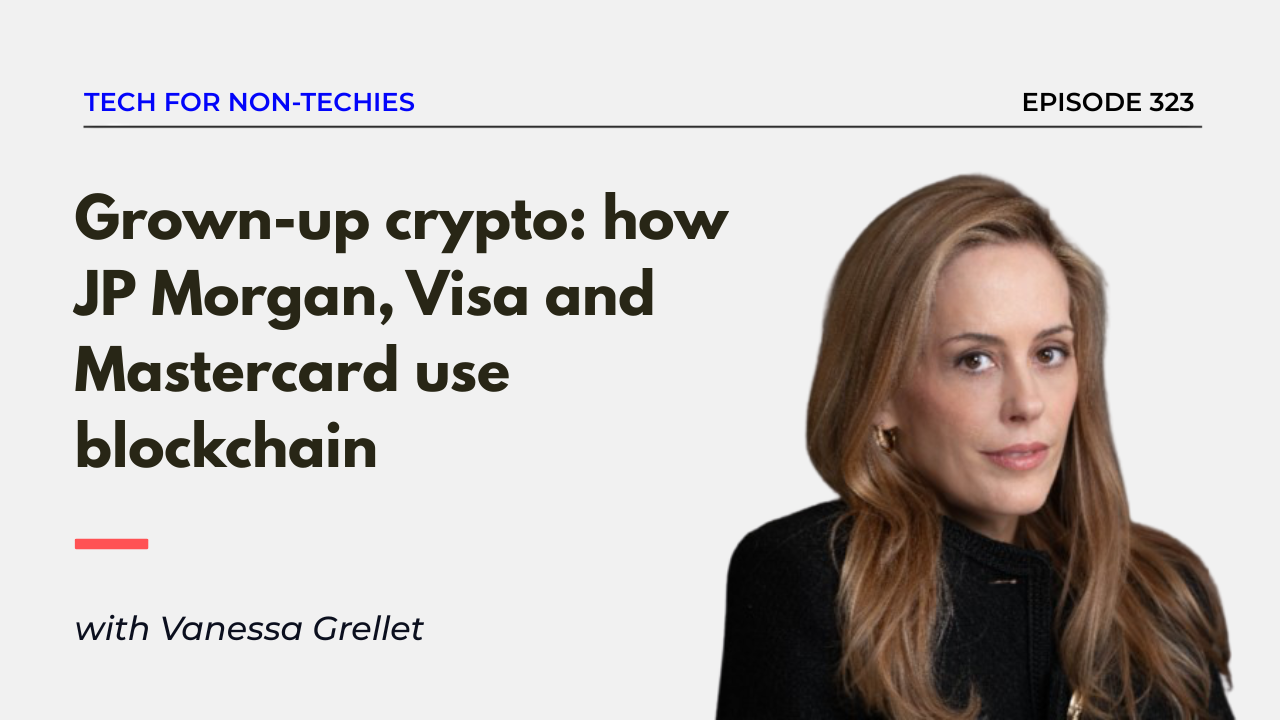
Crypto has grown up.
It's now no longer just about overnight millionaires and meme coins. It is now how the largest corporations do business.
JP Morgan has processed over $5 trillion through its blockchain division, even though Jamie Dimon famously hated crypto a decade ago. Visa, Mastercard, Fidelity and BNY Mellon are all in now too.
This episode is about the grown up side of crypto — where nobody goes to jail or becomes a millionaire overnight — and why it matters to you as a business leader even if you have no intention of buying a single coin.
Listen to learn:
- Why JP Morgan, which famously hated crypto, now has three major blockchain divisions handling over $5 trillion in transactions
- The difference between the silly end of crypto and the serious end — and why the serious end is reshaping global finance
- What tokenisation actually means in plain English — and why major asset managers are paying attention
- How corporates are using blockchain to make international payments faster, cheaper and more reliable
- What size of company should be thinking about this — and the specific use cases worth exploring now
This episode is for you if:
- You are a business leader who wants to understand what crypto actually means for your industry — beyond the headlines
- You work in finance, treasury or payments and want to understand what is coming
- You are a founder or investor who wants to know where the serious institutional money is going
Vanessa's book: Digital Assets and Crypto for Investors — available now from Wiley
Free masterclass — 12 October: Smart, skilled and invisible: how to get seen by the people who decide your career.
Timestamps:
- 00:00 – JP Morgan's $5 trillion crypto blockchain business
- 01:26 – Free class: how to get seen in your career
- 03:33 – Meet Vanessa Grellet, crypto and blockchain expert
- 05:08 – Why JP Morgan built its own crypto coin
- 09:10 – Do companies like Coca-Cola use blockchain too?
- 10:49 – Public vs. private blockchain networks explained
- 13:13 – What is the Melania meme coin, really?
- 16:02 – How companies custody digital assets and crypto
- 17:05 – How gold gets tokenized on the blockchain
- 22:29 – Is crypto right for your company's size?
- 25:53 – Real use cases: crypto for global payroll and payments
- 29:29 – Vanessa's new book on crypto investing
Follow and Review:
We’d love for you to follow us if you haven’t yet. Click that purple '+' in the top right corner of your Apple Podcasts app. We’d love it even more if you could drop an honest review on Apple Podcasts. Simply select “Ratings and Reviews” and “Write a Review” then a quick line with your favorite part of the episode. It only takes a second and it helps spread the word about the podcast.
Listen to our podcast on:
Transcript:
[00:00] Vanessa Grellet: JP Morgan got involved very early in crypto — back in 2016, while there were some criticisms of Bitcoin, they were exploring blockchain technology. So ten years later, we see that JP Morgan has three huge divisions dealing with blockchain and crypto.
[00:20] Sophia Matveeva: Welcome to Tech for Non-Techies. This is a podcast for business leaders and non-technical founders building the future in the age of AI. Whether you've been in business for a hundred-plus years and you're looking to modernize, or whether you're building something new, this is the show for you. You'll learn how to come up with new ideas and make them come to life, no matter the size of your organization. I've taught tech and innovation at Oxford University, advise companies like Microsoft, and written for the Harvard Business Review. You're going to hear the frameworks and the thinking that I've built, tested, and taught at the highest level. And now it's your turn. Let's get started.
Hello, smart people, how are you today? I just got home from a massage and I feel fabulous, and I hope you do too. Before we get started, I want to make sure you come to my next free class — it's called "Smart, Skilled and Invisible: How to Get Seen by the People Who Decide Your Career." I know this is going to resonate with so many of you, because aside from how to create new products and new ventures, you most often ask me about how to get discovered, how to be appreciated — how to get paid for what you're worth — and how to make opportunities like headhunters, clients, and investors come to you.
I find the smartest and most capable people are actually least likely to make a proper, concerted effort to get discovered, because they believe in the fallacy that hard work and merit will pay off. It should, but sadly it won't — you kind of know that it won't. So if this is resonating with you, and pushing a few buttons, you should definitely sign up. Because what I see — and I'm sure you see this too — is that there are people who aren't that smart, aren't that hardworking, but they get the jobs, the board seats, the opportunities that frankly you should be getting instead. Why? Sometimes they were born to the right parents, and you can't change that. But what you can change is making an effort to be seen as an expert in your field.
This is frustrating, I totally get it, but it's also fixable. So come to my free class, and forward it to your clever friends — they'll get a lot of value from it too. It's called "Smart, Skilled and Invisible," taking place on the 12th of October 2026, and the link is in the show notes.
[01:26] Now let's talk about today's lesson. Today we have an episode on the serious side of crypto — yes, there is such a thing. I think the industry is mostly known for get-rich-quick schemes, massive fraud — remember Sam Bankman-Fried — and meme coins like Dogecoin and, of course, the Melania coin. But if we just think that's all crypto is, we're missing the bigger picture, which is really important for us as business leaders today, because crypto is actually changing how the largest financial institutions and corporations in the world do business. Did you know that? Well, you're about to.
JP Morgan has processed over five trillion dollars through its blockchain division — interesting, given that Jamie Dimon famously hated crypto just a few years ago. Visa, Mastercard, Fidelity, BNY Mellon — they're all in too. This is the boring side of crypto, where nobody goes to jail and nobody becomes a millionaire overnight. Because this grown-up version of crypto is basically how major institutions operate, as a self-respecting business leader, you need to know about it. That's what we're doing today.
[03:33] You're going to hear from Vanessa Grellet, co-founder and managing partner of Arche Capital. Vanessa started her career on Wall Street, including a tenure at the New York Stock Exchange, before becoming one of the early team members at ConsenSys, where she helped build the core infrastructure that powers Ethereum. She now sits on the board of the Enterprise Ethereum Alliance and has just published a book with Wiley called Digital Assets and Crypto for Investors. So — do I bring you great guests on this show? Yes I do, you're welcome. Now let's learn from Vanessa.
Vanessa, Jamie Dimon, the CEO of JP Morgan, famously hated crypto, but now JP Morgan is really involved in it. Can you tell us about that, and why it happened?
[05:08] Vanessa Grellet: JP Morgan got involved very early in crypto, or what we call blockchain technology. Back in 2016, while there were some criticisms of Bitcoin, they were exploring blockchain and Ethereum. They were part of something called the Enterprise Ethereum Alliance, which I'm on the board of — we actually did the first inauguration of that organization at JP Morgan's offices. JP Morgan is very diligent and methodical about how they carry out technology innovation. So ten years later, JP Morgan has three huge divisions dealing with blockchain and crypto, aligned with their current business models: global payments, trading, and FX.
The first division is around JPM Coin, which they launched a few years ago — over five trillion dollars in assets have moved through it. It's a token, what we call a tokenized deposit coin — like a stable coin — that allows you to settle and trade in a much faster and atomic way compared to traditional systems. Blockchain lets the banking system do the same thing, but quicker, faster, and cheaper.
[06:45] Sophia Matveeva: I just want to understand that — is that like an interbank currency? So if I'm doing something with JP Morgan in London and need to transact with the JP Morgan office in New York, I'd use this internally?
[07:00] Vanessa Grellet: Exactly. And you can think of companies with huge treasuries all over the world using this coin in the back end to make things settle instantaneously, instead of having to settle across all the different ledgers across their organizations.
[07:19] Sophia Matveeva: Interesting — does Microsoft have its own currency? Meta, I'm sure, does?
[07:25] Vanessa Grellet: Meta tried once, it didn't work — I think they're trying again. Large organizations would definitely benefit from creating their own deposit or stable coin, or using something like JPM Coin. That's JP Morgan's first business — about five trillion dollars moved through it.
The second business is what we call tokenization — the digital representation of an existing asset. You take an existing asset, like a fund, a money market fund, for example, and create a digital representation of it on the blockchain. Like with payments, you're able to move that asset around faster and cheaper because of the technology. JP Morgan has a whole division doing that. They also have another network, also based on blockchain, focused on data — allowing companies to verify data between each other faster and more securely, instantaneously, because they share the same ledger and have access to the same information about a transaction or entity.
Those are the big three buckets JP Morgan is involved in — really focused on the back-end technology of the banking industry. That's the case for most institutions. Some are more focused on trading or asset management, but a lot of the large institutions active in blockchain are doing what JP Morgan is doing.
[09:10] Sophia Matveeva: Interesting — what other institutions? Is it just finance companies, or would, say, Coca-Cola do this too?
[09:20] Vanessa Grellet: Largely finance companies — Visa, Mastercard, all the bankers, asset managers are deeply involved, and trading venues like the New York Stock Exchange or NASDAQ. But large companies are also leveraging this for treasury management — some have explored creating their own token or stable coin, but it requires a lot of technical knowledge and teams, and sometimes it's just easier to use an existing product rather than replicate the technology yourself.
[09:58] Sophia Matveeva: This is interesting, because when most normal people think of crypto, they think of Bitcoin, annoying people on Twitter, and probably Elon Musk. What you're describing is literally a technology — a way to get money from London to New York quicker and cheaper, which is a question of technology rather than buying a specific currency. I think this is where people really get confused between these two things. So what does this shift in adoption mean for how companies operate?
[10:49] Vanessa Grellet: You have to understand Bitcoin is the initial innovation — for the first time, you're able to send money to someone directly, peer-to-peer, with certainty that what you send will arrive at that specific person, without an intermediary and without having to double-check. I have an address, I send Bitcoin to your address, and there's certainty you'll get it, because it's cryptographically validated by a lot of computers. Bitcoin, Ethereum, Solana — those are what we call public networks, and over the past 15 years, these public networks have matured and become very robust.
When JP Morgan was looking at this, obviously they weren't going to put client assets on the Bitcoin network — so they developed private networks, where only specific people had access to the technology, but based on the initial innovation from Bitcoin, Ethereum, and Solana. So large companies have different ways to deploy blockchain solutions — public blockchains, or more private chains with their own network. A lot of companies tried private networks, but it was very difficult to get the network effect and get people to use them.
Now we're in a second phase, where people are trying to use public networks as the back end, with compliance, KYC, and AML checks, so it works in an enterprise environment. So there's a mix of both — you can even create your own blockchain if you wanted to, but it's available to everyone, and you decide the best solution for your use case.
[13:13] Sophia Matveeva: Okay, this is a very sensible start. Now let me ask a very non-sensible question — tell me about the Melania coin. Where does that fit into all this?
[13:25] Vanessa Grellet: Really, on the fringes. Among the public tokens — there are millions of tokens out there — Bitcoin, Ethereum, Solana are the largest ones, but anyone can launch a token or a network. What we've seen in recent years is crypto has always been related to trading and high-risk trading, akin to gambling. So we've seen the development of what we call meme coins, which have no value, serve no purpose, but allow people to trade and take risks. The initial meme coin was Dogecoin, which started as a joke — a meme — and then got traction, don't ask me why, people just love it.
[14:19] Sophia Matveeva: Didn't Elon Musk tweet about it and it became super valuable?
[14:25] Vanessa Grellet: Exactly. That's a completely different part of crypto and blockchain, related to gambling, trading, and memes — a lot of people participate, and no one can prevent them, because these networks are open. Anyone can buy a Melania coin and lose money if they want to — it's really not related to what enterprises and traditional trading firms are doing. There's a large spectrum of what you can do with this technology, and it's up to you where you want to be on it.
[15:04] Sophia Matveeva: So the most famous examples are obviously the silliest — most fun to read about, so that's what the press covers, and Melania is the wife of the US president, so that gets attention. But you're saying there's a sensible end of crypto that's much less discussed in mainstream media — I'm not seeing many articles about it in the FT, maybe because journalists don't understand it themselves, or maybe it's just not that interesting. Let's talk more about that sensible end. We know large companies use it to lower transaction costs — what else is important for a business leader to know about developments in institutional crypto?
[16:02] Vanessa Grellet: If you wanted to deploy a solution in your company, you'd have to deep-dive into what it means in terms of custody and operations, because it is different. Holding crypto or stable coins is a different interface than traditional assets — there are operational implications, it's not just adding software, you're revamping some of your operations too. For example, Citigroup offers custody, Fidelity offers custody services, BNY Mellon is looking into custody — all these large financial companies hold a lot of assets, and the way you hold digital assets is different from how you hold traditional assets.
[17:05] Sophia Matveeva: Give us an example — let's talk about the most traditional asset, gold. Walk us through what that actually looks like for an organization that holds gold and also digital coins.
[17:25] Vanessa Grellet: You can hold gold in different ways — physical gold in a vault, gold ETFs, which is what most companies hold, or you can hold what we call tokenized gold. There are two providers right now with about 90% of that market — Paxos and Tether. Tokenized gold means the person who issues it needs to hold, and prove they hold, the actual gold or ETF backing it, and then issues a digital asset. To access that digital asset, you need a wallet — your access to the network, which holds the digital asset. That's different from a bank account or a brokerage account.
[18:32] Sophia Matveeva: Is there actual gold involved in this whole situation?
[18:35] Vanessa Grellet: The person who creates the digital asset, or the ETF, needs to hold the actual gold.
[18:44] Sophia Matveeva: Okay, say tomorrow — I'm giving a talk to successful business people, and I'm sure at least one owns a gold mine. Let's say I meet a gentleman with a gold mine who wants to marry me, and I say, "If that gold mine is mine, we can get married tomorrow." So we marry, and now I own this gold mine. Does that mean I can issue tokens and sell gold via tokens? Is that how it works?
[19:19] Vanessa Grellet: You could do two things. You could tokenize the equity in the gold mine — say, "I have five percent of the gold mine" —
[19:29] Sophia Matveeva: Vanessa, come on, if I'm getting married it's going to be way more than five percent.
[19:33] Vanessa Grellet: Fifty percent, at least. And you want to sell it — the market for people who want to buy 50% of a gold mine isn't obvious, so you tokenize it and let people trade and buy it. That's tokenization of the gold mine itself, or its shares — which is what you see currently with, for example, pre-IPO shares in companies like Anthropic, or even existing listed companies traded as digital assets.
[20:11] Sophia Matveeva: Sorry to interrupt — what's the point? Why not just do a traditional IPO? What are the benefits of tokens versus that?
[20:26] Vanessa Grellet: Because you'd need to meet certain standards to do an IPO. Token networks were often launched one or two years after a company's creation — and usually you don't do it again after that. So people got access to very early-stage projects, maybe seed or Series A stage —
[20:56] Sophia Matveeva: So it's real fundraising.
[20:58] Vanessa Grellet: And you'd get liquidity — that's why there was a lot of volatility on these tokens, because you don't know exactly what they're worth or where the company is going. It's very difficult to invest in very early-stage things otherwise.
Coming back to the gold mine — you could tokenize the shares of your gold mine, and then figure out, as a shareholder, whether you actually hold the physical gold in order to tokenize it. Or the company itself could say, "I have X amount of gold and want to sell it" — instead of moving the physical gold around, create a gold certificate via a digital token, giving assurance you actually hold the gold — that's the hardest part to prove. Then people can trade that representation of gold. Some tried this with stable coins — there was an example in Zimbabwe where they issued digital dollars backed by gold, but not all the gold was actually there. So you have to make sure the gold reserves exist and there's proof of them. I think this will pick up in coming years — right now two incumbents have the lion's share of the market, but you could see states or others exploring this in the future.
[22:29] Sophia Matveeva: Okay — when a business leader, a non-technical person who's an innovator within a corporate or a non-technical founder thinks, "This is interesting, but I'm not the head of treasury at a giant company" — what would you say to them?
[22:53] Vanessa Grellet: You can go to large organizations like JP Morgan to understand what they can offer for treasury. But if you're a smaller firm, there are solutions — Mastercard, Bridge, or other stable coin companies have payment solutions now being deployed in smaller organizations, which are less of a heavy lift and let you leverage this internally or with clients who can also join your network. My recommendation is not to build a network yourself — the tech is mature enough that you can use existing products suited to your organization. You can speak to stable coin issuers too — for example, Circle and USDC have a lot of solutions for corporates. I mentioned Bridge — I believe they tried to merge with PayPal recently. There's real excitement about this technology making things cheaper and simpler for corporates in treasury management and payments.
There were experiments with things like NFTs and consumer engagement — trying to gamify the client relationship through tokens — that didn't work well, it was too complex for the end consumer to open a wallet and understand what was going on. But the strong product-market fit around payments and treasury management is definitely on the rise. We see a lot of crypto card payment companies and neobanks emerging — they're great because the experience is the same as traditional finance for smaller companies. They can use a corporate credit card, but everything in the back end runs on blockchain and stable coins — they don't need to see any of that, but they get extra yield, and can dabble in trading tokens if they want to.
[25:17] Sophia Matveeva: So what size of company should really be thinking about this? I can see the use case for a really large company, but at what point is a company too small for it to matter? Is it about revenue, number of transactions, how international the business is? What should make someone listening think, "Yes, I should check this out"?
[25:53] Vanessa Grellet: I think you have to look at the complexity of your organization in terms of departments and geography, and international payments — that's the sweet spot. If you have a solution that lets you pay employees anywhere in the world and manage FX risk via crypto with instantaneous payments in USDC — for example, a company operating in Latin America and Africa, where inflation or currency stability isn't very reliable in some countries — local employees would often prefer to be paid in USDC, a stable coin pegged to the dollar. It's as stable as the dollar, sometimes more stable than the local currency, and it lets them retain value during the month, or save for the future, and always convert back to local currency to spend via cards for what they need.
So if you have payments to employees in emerging or global markets, you can have one interface handling everything through crypto and stable coins in the back end. Treasury operations that settle daily and deal with a lot of FX issues are also a great use case. And even within one country, it's just faster and cheaper — international transfers can take three to six days depending on where you are, but even within one country blockchain-based transfers are instantaneous with very low fees.
There's a great example — a company called Yellow Card in Africa, which lets people conduct business across different African countries where FX costs are very high and unreliable. Because the back end is stable coins, it instantly manages the transfers, and people can convert back to local currency if they want.
[28:15] Sophia Matveeva: These are really good examples, and I've definitely learned a lot — really interesting. For me, the biggest insight is that the boring side of crypto is bigger than I thought, and it's worth really paying attention to it. Because stories like Sam Bankman-Fried, or a teenager who buys Bitcoin, forgets about it, and becomes a multimillionaire — those are interesting to read, but not serious. It doesn't mean my son is going to get any Bitcoin out of it.
[28:57] Vanessa Grellet: But you also don't want to be associated with that — I understand some people think, "If crypto is that, I don't want to touch it."
[29:07] Sophia Matveeva: What I'm getting is — if Jamie Dimon is getting into it, or already in it, then it's worth checking out. On that note, Vanessa, where can people learn more from you, if this really resonated and they want to learn about the serious side of crypto?
[29:29] Vanessa Grellet: I have a book coming out on the 5th of October, called Digital Assets and Crypto for Investors: How to Create a Diversified Portfolio. Although it focuses on the investment side, for traditional investors and finance executives who haven't had exposure to crypto, it also takes you through the history of adoption in crypto, examples of use cases, and enterprise use of crypto — to see how much we've progressed in the past ten years, as you said, on the quieter but much more significant side of crypto.
[30:20] Sophia Matveeva: Well, thank you very much for joining us and telling us all about the serious, boring, and important side. Wasn't that interesting? I thought so too.
And now, here's a reminder — make sure to sign up for my free class, "Smart, Skilled and Invisible: How to Get Seen by the People Who Decide Your Career." This is going to give you the kick you need to make the most of 2026. The link to register is in the show notes.
On that note, my dear smart person, have a wonderful day, and I shall be back in your delightful smart ears next week. Ciao!
Sign up to our mailing list!
Be the first to hear about offers, classes and events