327. Co-founder or catastrophe? How to get the relationship right from the start
Oct 28, 2026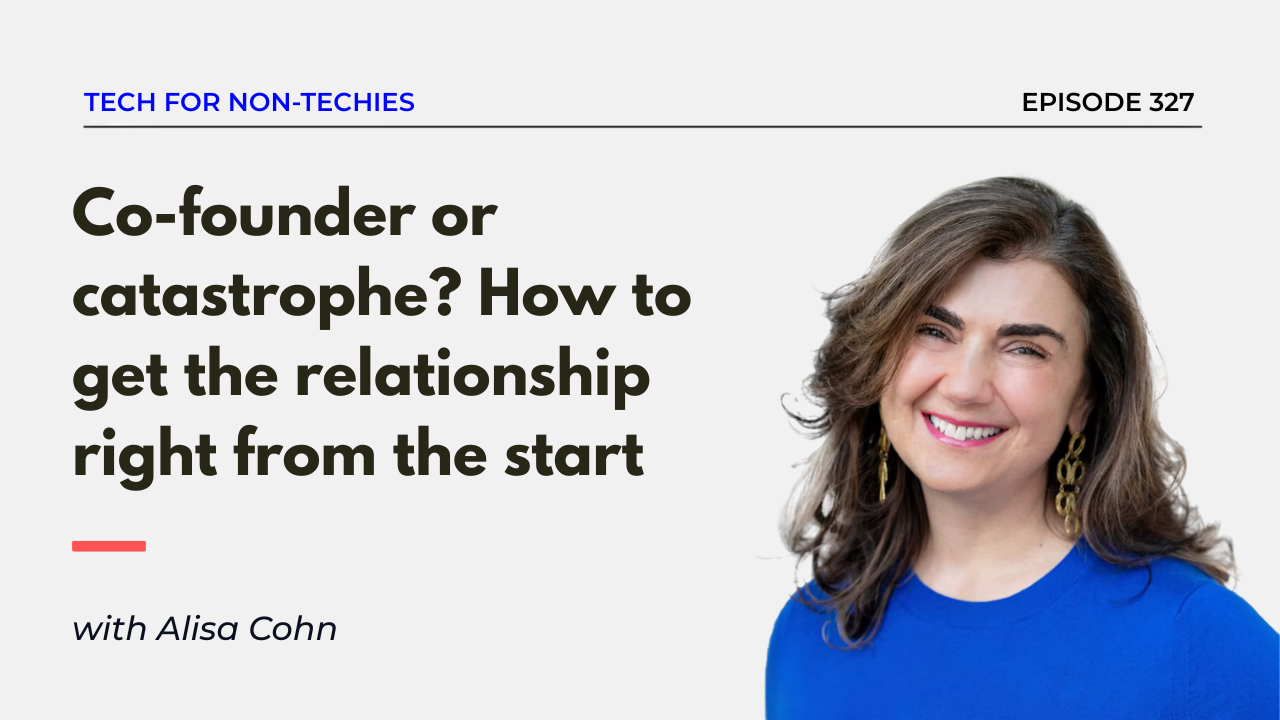
Co-founder conflict is one of the top reasons startups fail. And even when it does not kill the company, it can put it at serious risk, distract from building, and make founders miserable in the process.
This episode is for anyone working with tech startups — as a founder, team member, investor or advisor.
It is especially relevant if you are a non-technical founder trying to figure out who to build with and how.
You'll learn from Alisa Cohn - one of the world’s leading startup coaches. She has coached founders at companies including Etsy, Venmo and Tory Burch, is the author of From Startup to Grown Up.
Listen to this episode to learn:
- The red flags that tell you a potential co-founder is not actually committed to your venture
- Whether you actually need a co-founder at all — or whether a senior hire with equity might serve you better
- The co-founder prenup — the questions you must work through before you formalise anything
- The single most important thing you can do to stop small resentments becoming company-destroying conflicts
Free personal brand strategy session:
2/10 free spots remain at the time of recording!
If you want to work through how to position yourself as a credible, visible innovator — the kind that attracts the right co-founders, investors and clients — book yours now.
Book here: https://calendly.com/sophia-matveeva/personal-brand-discovery
Timestamps:
- 00:00 – Why co-founder conflict causes startup failure
- 02:02 – 2 free personal brand strategy sessions left
- 05:02 – Meet Alisa Cohn, top startup coach
- 05:40 – Technical vs. non-technical founder mindsets
- 10:15 – Do successful founders need to be young?
- 11:50 – How to find the right co-founder
- 14:46 – Co-founder vs. early employee: what's the difference?
- 20:08 – Why desperation leads to bad co-founder decisions
- 23:52 – How to build a healthy co-founder relationship
- 32:08 – Advice for non-technical founders in the age of AI
Follow and Review:
We’d love for you to follow us if you haven’t yet. Click that purple '+' in the top right corner of your Apple Podcasts app. We’d love it even more if you could drop an honest review on Apple Podcasts. Simply select “Ratings and Reviews” and “Write a Review” then a quick line with your favorite part of the episode. It only takes a second and it helps spread the word about the podcast.
Listen to our podcast on:
Connect with Sophia Matveeva on LinkedIn: https://www.linkedin.com/in/sophia-matveeva-556365a/?isSelfProfile=true
Transcript:
[00:00] Alisa Cohn: People think, "It's so cool, I'll be the co-founder," but there's a lot of baggage that comes with that. You can't quit. You have responsibility for the business. The board is looking to you just like it's looking to the other co-founder.
Sophia Matveeva: Welcome to Tech for Non-Techies. This is a podcast for business leaders and non-technical founders building the future in the age of AI. Whether you've been in business for a hundred-plus years and you're looking to modernize, or whether you're building something new, this is the show for you. You'll learn how to come up with new ideas and make them come to life, no matter the size of your organization. I've taught tech and innovation at Oxford University, advise companies like Microsoft, and written for the Harvard Business Review. You're going to hear the frameworks and the thinking that I've built, tested, and taught at the highest level. And now it's your turn. Let's get started.
Hello, smart people, how are you today? Today's episode is super important for everybody working with startups in any capacity — whether you're a co-founder, thinking of starting a startup, a team member of an existing startup, a lawyer working with startups, or an investor in startups. You need this episode, because we're talking about co-founders and co-founder conflict. Co-founder conflict is one of the top reasons startups fail — and even if a conflict doesn't lead to failure, it can put the company at serious risk, because it's very stressful and time-consuming for the people at the top. That's why you need to know what it is and how to prevent it.
In this episode, you'll learn how to manage co-founder relationships, especially as a non-technical founder. You'll learn how to spot red flags before you sign that contract — so maybe you won't sign it. You'll learn how to make a co-founder prenup — so you have an agreement for when, if, things go wrong, that was a Freudian slip — and we'll also discuss whether you really need a technical co-founder, or whether you'd be just as fine with a great early-stage employee.
You're going to hear today from Alisa Cohn — one of the world's top startup coaches. She's coached founders at companies including Etsy, Venmo, and Tory Burch. Not bad. She's also the author of a book I highly recommend: From Startup to Grown Up.
[02:02] Before we get to the interview — there are just two remaining free personal brand strategy sessions left. I offered ten, and eight are gone already, so two remain. Let me tell you exactly why these brand strategy sessions are actually very relevant to co-founders and co-founder conflict.
Yes, this episode is about finding and choosing co-founders and making the relationship work — but one of the biggest problems non-technical founders face when looking for a technical co-founder is feeling weaker going into that relationship, before the company has a product — because the technical person already has something to do. If that technical person can build, what do you bring? The answer is commercialization, relationships, sales, marketing, vision. I really want you to be confident in that. But if nobody knows you have these skills — if you're invisible to the right people — you're not just going to lose clients and opportunities, you're also going to make yourself a less attractive co-founder to the kind of technical person you actually want to work with.
If a technical co-founder believes you can open doors — get lucrative corporate contracts — they'll think, "I'm going to hitch myself to that wagon." But if they think, "This person's smart, their idea is good, but they have no connections, they're not recognized by the industry — how are they going to open doors to our first clients when we have no brand recognition?" — you're not going to look as attractive a proposition.
This is why working on your personal brand strategy is a business strategy — and especially as a non-technical founder, you cannot underestimate the power of your personal brand. If you don't have one, you're literally lacking power — but you can create that power, you can work on it, it's not only available to nepo babies and people who are already famous. If you're convinced, the link to book the last two sessions is in the show notes — they'll fill up fast.
[05:02] And now, my dear smart person, let's learn from Alisa.
Sophia Matveeva: Alisa, you've coached lots of founders, technical and non-technical. Do you see differences in how they succeed or fail — issues in how they approach tasks, maybe in mindset? Are there blocks non-technical founders have that technical founders don't, and vice versa?
[05:40] Alisa Cohn: Broadly speaking — to state the obvious — if you're a technical founder building something technical, you have confidence that you can build the thing, and that's a real advantage, especially early on when you have to build it yourself. Non-technical founders don't have that same confidence — they have to hire people, have a co-founder who's technical one way or another, and there's always a question mark of, "Is this what I'm supposed to be doing?" That's been mitigated substantially by AI now, with the ability to build things you couldn't have conceived of a year or two ago.
That said, technical founders often miss the skills essential to startup success — marketing, sales, people skills, product skills. Very often they're missing that and have to build it themselves, especially interpersonal skills — otherwise the venture won't work, because technical dexterity alone, even a technically excellent product, is necessary but far from sufficient for startup success.
Sophia Matveeva: Does that confidence gap — or lack of confidence in building the company versus the technology — come later, or are people aware of it? Non-technical founders are painfully aware they can't build the product, because that's the first task. If any of us see task one as something we can't complete, we don't even think about task nine. So are technical founders aware there's a lot they don't know, or are they so confident at step one that they don't even know step nine exists?
Alisa Cohn: I think that's certainly true of technical founders — they think the product will sell itself. I'd say it's equally true of non-technical founders who think they have this amazing, innovative product idea that will sell itself. All founders underestimate the role of sales, marketing, and storytelling skills in startup success.
Sophia Matveeva: In your book, you have a chapter on co-founders and managing that relationship. It sounds like there could be problems for the marketing-and-sales co-founder — that person might not be as valued at the beginning. Is that fair?
Alisa Cohn: Not necessarily — because when you bring a co-founder in, the story is different. Ideally, co-founders come together with a shared sense of mission — "we want this thing to exist" — shared values, and mutual respect for each other's skills: "Wow, you're amazing, I could never do that," and vice versa. The best co-founder relationships have that sense of value and respect, and understand it's going to take a lot more than just one skill set to build the company. That's why co-founders are so valuable — of course the relationship can be fraught with peril, but it's very valuable.
[10:15] Sophia Matveeva: This signals a certain maturity. We often hear the story of the 20-year-old who dropped out of somewhere fabulous and started a great startup — but I didn't have that level of maturity at 20 that I have now. Is that maturity just something you get with age?
Alisa Cohn: The meme of startup founders in their twenties, dropping out of college, having massive success — that's an extreme outlier, not the truth for most founders, and certainly not most successful companies. The median age of founders is more like 37. Most have not just degrees, but graduate degrees, and have worked at one or two places before their startup. That's much more typical. That said, maturity comes with age when age brings experience — and a startup is an extreme work environment, so it brings a lot of experience very quickly. You can grow up very fast inside a startup.
[11:50] Sophia Matveeva: Going back to co-founders — in your experience, do co-founders already know each other, or does one person have an idea and search for co-founders? We see a lot of non-technical founders who've tested an idea and a prototype, and are desperately searching for a CTO co-founder — sometimes with a "spray and pray" approach: "Are you alive? Can you code? Want to be my co-founder?" Which leads to disasters. What do you see?
Alisa Cohn: Desperation is never a good place to approach any critical aspect of building a startup from. It works in both directions — I've coached founders who've known each other since they were eight, with a very effective working and personal relationship, legitimately friends, and they're successful because they put the relationship first and have that familiarity. The downside is you can never really hold your co-founder accountable — when they're goofing off, you feel uncomfortable bringing it up because of the sacredness of the relationship.
On the flip side — I had Paul English on my podcast. He found his Kayak co-founder, Steve, because he was at a VC firm, someone said, "Could you go meet Steve, he's building a travel company" — Paul was famously technical, Steve wasn't. They had lunch, shook hands after an hour, and agreed to be co-founders. I said to Paul, "I have this co-founder prenup in my book that helps people really get to know each other — but you decided to co-found with someone you'd just met after an hour, am I a liar?" He said no — because after agreeing, they spent a lot of time working together and getting to know each other before formalizing everything. So getting to know each other is essential, however you arrive at it.
I've also coached married or romantically involved people working together — that brings its own complexity, but also a bright side, if they're both workaholics, they understand each other tremendously. All these ways of finding a co-founder can work — but it's essential you know what you're trying to build and how, and that your co-founder is aligned with that.
[14:46] Sophia Matveeva: What's your view on a co-founder versus a very early employee — the first employee? The title and equity differ, but the relationship and how much people care can be similar. We often see non-technical founders running around looking for technical co-founders, and we say, "If you find someone great, get to know them, run test projects, see they're dedicated — go for it." But it's a bit like finding the person you're going to marry — don't expect one Tinder swipe to work out. Non-technical founders sometimes think, "This guy seems up for it," and technical co-founders can take advantage of that. Is there really much difference between an early employee and a co-founder?
Alisa Cohn: There's a big difference — a co-founder has skin in the game in a way an early employee doesn't. What do you mean by "taking advantage"?
Sophia Matveeva: Just before we spoke, I was teaching a class for very early-stage founders — idea stage. One person said, "I've got this idea and this guy wants to be CTO — he works at a big tech company, he's also CTO at another startup, and he's going to do this for us too." I'm thinking, this doesn't — and the person I was speaking to wants to quit their job ASAP to work on this. Whoever this potential CTO is, intentionally or not, it looks like taking advantage of someone desperate.
Alisa Cohn: Taking advantage to get the co-founder title, or what?
Sophia Matveeva: Co-founder equity — a large proportion. The conversation was, "They're so busy, but maybe if I give them 25%, they'll do more." I often see technical co-founders being a technical co-founder on five other startups while also holding a full-time job. To me that's like, "I'm married, I'm dating five other women, but you really matter to me" — not a good look.
[20:08] Alisa Cohn: It's interesting — you've referred a few times to desperation and running around. I'd zoom out and say: when you want to found a company, you have to think through what that means for your life. Good advice for everyone: if someone asks, "Should I be an entrepreneur?" the answer is no — it's a really hard gig, and if you have to ask, it's probably better to take the job at the large company, because you probably don't have the drive and need to be a founder. The most successful founders are the ones who say, "I'm not employable, I couldn't do anything else, it's just the way it is."
So start from that orientation, then your goals — build something meaningful, or even something you'll sell in two years, great — but have a sense of how you'll do it, what resources you bring, how you'll learn and build what's necessary, with a North Star that prevents frantic decision-making.
That said — I talked to a founder a couple of months ago who'd been, let's say, not quite lured in, but mistakes happen. He talked to a VC who said, "This guy's great," they resonated, and the VC said, "Great, you can be my co-founder." Even as alarm bells were going off in his head — "this feels too soon, this doesn't feel right" — he went for it, because, "If I don't, the VC won't invest." That came from a place of desperation and fear. Rule of thumb: it's never a great way to make a decision.
Sophia Matveeva: I once moved to India out of desperation and fear — not one of my best decisions, though I made it work out.
Alisa Cohn: And the good news is startups are a great maturation petri dish — when you make those bad decisions, they teach you fast, because they're expensive and costly, and you need to course-correct, often in public. I have a TED talk where I say, "Relish being wrong, because you're either winning or you're learning." That's the truth of startups too.
[23:52] Sophia Matveeva: Let's go back to that scenario — a founder building something with enough traction that a VC is talking to them, and now thinking about bringing in a co-founder. One of our later-stage students is literally at this point right now. She's a non-technical founder who's spent three or four years building this — worked with outsourced developers, had to get rid of a previous co-founder, fought like a Viking, and now has a working product and is onboarding enterprise customers, all herself. She's become a completely different person. Now she's bringing in a technical co-founder. There are benefits, of course — but is that really a co-founder, if they didn't go through the formation hell, the hardest, loneliest part?
Alisa Cohn: I sometimes wonder the same thing when a technical co-founder comes in late in the game — why not just bring in a senior employee with equity? People have different feelings about it. Some people want to be a co-founder for their sins, I sometimes think — be careful what you wish for.
Sophia Matveeva: Why's that?
Alisa Cohn: Because once they're a co-founder, they're stuck — can't quit, have responsibility for the business, the board looks to them just like the other co-founder. People think it's cool to be the co-founder, but there's a lot of baggage that comes with it. That said, I agree — she didn't go through the first three years of hell, so now she's "a co-founder" in quotes. But most successful companies have different levels of ownership between co-founders — she might give this person 20% or 30% equity, not fifty-fifty. People want to be, or it's helpful to have them as, a co-founder — but it's very different from founding it together from the beginning.
Sophia Matveeva: I'd love to apply your template for a good co-founder relationship to this exact situation — I see this pattern often: start alone with an outsourced developer, bring in a technical co-founder later. There are benefits, but also obvious resentment.
Alisa Cohn: The most important thing is building the context for difficult, straight-talk conversations — period. You start by doing that, talking through topics from my co-founder prenup: how did you each handle conflict growing up? What are your goals? Would you rather be a king or a celebrity — rich versus famous? What would each of us do if we found the co-founder was shirking responsibility, and how would we handle it?
I also have an HBR article on keeping your co-founder relationship healthy — one suggestion is to practice having conflict. Bring up small things early, practice difficult conversations, practice being uncomfortable. Once that's a habit, you'll do a much better job having the right conversations at the right time.
Sophia Matveeva: How much of this happens before signing on the dotted line — during the "dating" phase?
Alisa Cohn: As much as possible. I worked with a client who said, "I'm starting this other business, I want you to be my co-founder" — we talked through everything, did the Hogan assessment, and they both realized this wasn't the right relationship, and it saved them a lot of aggravation by not co-founding together. That's a great outcome — clarity is a good outcome.
Sophia Matveeva: Tell us more — was there an event, an argument?
Alisa Cohn: No, just through the discussions they realized they didn't want the same thing — very different communication and conflict styles, and their values weren't aligned.
Sophia Matveeva: Going back to the fact that most founders start in their late thirties — often with kids, sometimes not. I've seen relationships where one co-founder says, "I'd love to do this, but I can't because of my parenting responsibilities," while the other, who isn't a parent, says, "I'm not a parent, I can't tell you not to be a good dad, but we've got this to do." If you're a non-technical founder considering a technical co-founder with two kids, while you have none — what's your advice?
Alisa Cohn: Every founder needs to talk through outside commitments — not just kids, though that's a big one. How much time do they take? What happens if we disagree? What if there's an emergency and your other commitments pull you away — can I ask you to cover for me in those moments, and vice versa?
One company I worked with — one co-founder left his job and worked full-time on the company; the other took 18 months to leave his job. They had a great relationship, no resentment, because it was clear — they were still close to fifty-fifty partners, and the one understood the other's situation, that he couldn't leave his steady income, even while still working on the business a lot. That worked out. But without those discussions, and the ability and skill to clear the air, it won't work — you'll be resentful and unable to talk about it.
Sophia Matveeva: We see this pattern a lot with technical and non-technical founders — the non-technical founder often goes full-time first, while the technical co-founder keeps their big tech paycheck, sometimes for eighteen months or more. What made this particular relationship work?
Alisa Cohn: They were good friends. They focused on the friendship — counterintuitively, the more you can put the relationship above the business, the better the business actually goes. They had the same vision, values, and alignment, and the one who hadn't left his job still worked really hard, and they respected what each brought to the table.
Sophia Matveeva: I want to pick up on "put the friendship above the business" — that's the opposite of what business schools teach. Why does that work?
Alisa Cohn: We're dealing with people. In this case, the co-founder who'd left his steady paycheck to work full-time genuinely felt, "I wouldn't want to do this without you" — that's how much alignment, trust, and mutual respect they had. You've made the marriage analogy more than once — when you have a co-founder, you have a marriage, and you have to put the marriage before yourself individually for it to succeed. The same is true in business — think appropriately about how to put the relationship above the business.
Now, if one person is constantly goofing off, shirking work, being inappropriate, or, God forbid, stealing money — there have to be normal boundaries around that. If someone isn't pulling their weight for a long time, you can't just let resentment build. Honoring the relationship means saying, "I love you, and I'm not experiencing you pulling your weight, and I want to discuss it because our relationship matters most to me — and I also want to build a successful business, and I want us to agree on what that means, because I think we disagree." That's the conversation to have early, before it becomes a big "I'm so mad at you" problem.
[32:08] Sophia Matveeva: So basically avoid resentment through honesty — good advice for relationships generally. As we wrap up — is there anything you'd specifically want non-technical founders to know, that might not apply as much to technical founders?
Alisa Cohn: As a non-technical founder, you should be aware you bring a lot to the table. A lot has changed in the age of AI — you have much more agency and potential to build than before. I'd just say: non-technical founders, your experience is important, so honor that.
Sophia Matveeva: That's a great note to end on. Yes, it's changing with AI, but I still see a lot of insecurity and undervaluing of what non-technical founders bring. I always say — yes, you need to build the thing, but somebody also needs to commercialize it, because you're in a for-profit situation. If you know how to do sales and marketing, that's really, really important.
On that note — thank you very much, Alisa, and I recommend everybody read your book, From Startup to Grown Up.
Alisa Cohn: Thanks, Sophia. It was so great to talk to you.
[34:00] Sophia Matveeva: Wasn't that interesting? What stood out for you? And here's your final reminder — at the time of recording, there are just two free brand strategy sessions left. If you want to stand out in a crowded world — which you do, if you're planning anything innovative with your career — and if you don't want to be another person posting AI slop on LinkedIn, which you really don't, book your brand strategy session before they run out. The link is in the show notes.
On that note, have a wonderful day, and I shall be back in your delightful smart ears next week. Ciao.
Sign up to our mailing list!
Be the first to hear about offers, classes and events