326. The innovator identity: why you need the reputation before you get the opportunity
Oct 21, 2026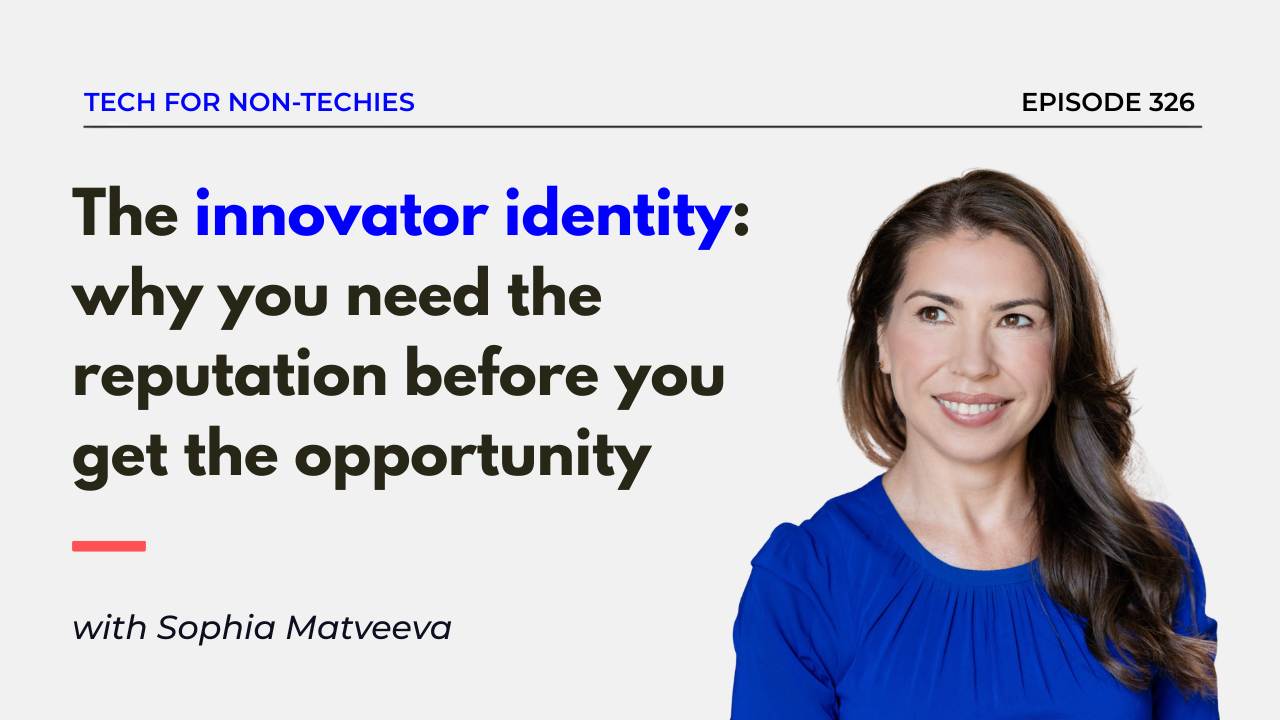
Today, in the age of AI, execution is easy.
Anyone can write code, produce a report, or generate a LinkedIn post.
What AI cannot do is imagine what does not yet exist, spot opportunities others have missed, or combine ideas in a new way.
That is the innovator identity.
And it is now the most valuable thing a knowledge worker can be known for.
In this episode:
- Why you cannot wait until you have done something innovative before claiming the innovator identity — and why that thinking will cost you
- Why being seen as an innovator is a pricing strategy, i.e. it means you get paid more
- Why the innovator identity is the only professional positioning that is genuinely defensible in the long term
This episode is for you if:
- You are a founder, executive or ambitious professional who wants to be known for your thinking, not just your output
- You want to attract better opportunities, higher fees and more interesting work
- You are ready to claim the innovator identity deliberately — not wait for someone else to give it to you
Free personal brand strategy session:
Book a free one-on-one session to figure out exactly how to position yourself as an innovator in your specific field.
[Book your session here]. ONLY 4 SPOTS LEFT THIS MONTH.
Timestamps:
- 00:00 – Why innovators earn more than executors
- 01:35 – Why this episode ties the personal brand series together
- 02:24 – 4 free personal brand strategy sessions left
- 05:11 – Myth: you need to earn the innovator title first
- 09:36 – Why innovators get paid more in the age of AI
- 11:51 – Why AI-generated content damages your reputation
- 13:30 – How to lead conversations like an innovator
- 15:59 – How to capture value without sounding whiny
- 16:34 – Recap: building your innovator reputation
Follow and Review:
We’d love for you to follow us if you haven’t yet. Click that purple '+' in the top right corner of your Apple Podcasts app. We’d love it even more if you could drop an honest review on Apple Podcasts. Simply select “Ratings and Reviews” and “Write a Review” then a quick line with your favorite part of the episode. It only takes a second and it helps spread the word about the podcast.
Listen to our podcast on:
Connect with me on LinkedIn: https://www.linkedin.com/in/sophia-matveeva-556365a/?isSelfProfile=true
Transcript:
[00:00] Right now, in the age of AI, execution is becoming easier. Many more people can and do write code now, and many more people now produce content. What AI cannot do is imagine what does not yet exist. Spotting opportunities and combining ideas — that is the innovator identity, and that is now the most valuable positioning available to a knowledge worker. This episode explains why and how to get it.
Welcome to Tech for Non-Techies. This is a podcast for business leaders and non-technical founders building the future in the age of AI. Whether you've been in business for a hundred-plus years and you're looking to modernize, or whether you're building something new, this is the show for you. You'll learn how to come up with new ideas and make them come to life, no matter the size of your organization. I've taught tech and innovation at Oxford University, advise companies like Microsoft, and written for the Harvard Business Review. You're going to hear the frameworks and the thinking that I've built, tested, and taught at the highest level. And now it's your turn. Let's get started.
Hello, smart people, how are you today? This is the third episode I've created in this series on creating your personal brand — specifically your personal brand as an innovator. I know the people listening to this show, and I know your aim isn't to become the next Kim Kardashian — you're not posting photos of cats... well, actually I do post photos of my cats, but I'm not attempting to monetize them. You want to be experts in your field so you can do something really cool and innovative — create a product, run a company, serve your clients better. This episode is about creating a personal brand for those purposes.
[01:35] This episode really ties the last two together. Two episodes ago was about how to get found in the age of AI, where lots of people are creating content, and AI is now the new gatekeeper, because people search for experts, startups, and service providers using AI. You need to be the person AI recommends. Then last episode was all about: once you've been discovered, how do you actually capture the value you've created — how do you get paid for it? This episode is about you actually embracing that innovator identity, and seeing why you specifically want to be seen as an innovator — not just a smart person, a smart lawyer who works with tech companies, or a founder with one particular idea. That's useful, but it's just the entry point. You need to be seen as an innovator, an innovative thought leader, if you want to create things — a new product, a new company, or a daring career.
[02:24] Before we proceed — I've offered ten free personal brand strategy sessions this month, and six are already gone, which means four remain. People are using these sessions to discover whether visibility is actually the right strategy for them — usually it is, but not always, so you always want to weigh the cost versus the return. I'm also discussing with people how they specifically can be more visible — what to stop doing, what to start doing, because we're all busy, we can't do everything, so you need to focus on what actually matters. And also what to do with visibility once you have it — how do you turn it into cash in the bank.
The link to book the last four remaining sessions is in the show notes. I highly recommend it, because it's Q4 — the money season, when promotion decisions get made, budgets get signed off, and companies move remarkably quickly. Just before recording this, I had a call with an organization I'd been trying to work with for ages — they kept saying, "We like you, we want to do this," but the bureaucracy moved really slowly. Now they're asking, "Can we start this project in November?" November is next month! They're moving much faster than I expected. This is the time when people move fast, so you want to capitalize on it — book one of these sessions so we can make sure you're seen as the innovator, you're discovered, and you monetize that discovery.
[05:11] So why do you need to be seen as an innovator? Let's start with some myth-busting. Here's the myth: if you want the opportunity to do something innovative — get funding for a new corporate initiative, or for your own venture, or land an innovative senior job — you need to be seen as an innovator first. Don't wait until you've done something to say, "I'm an innovator." Don't wait to be given the opportunity to innovate before claiming that reputation — that's backwards. You need the reputation to get the opportunity; the opportunity is what lets you prove it.
This is actually true in every field. Think about a law firm — some of my listeners are law firm partners — you didn't become partner and then start acting like one. You were already acting and functioning as a partner, carrying yourself that way with peers and clients, and the title just made it official. That's metaphorically dressing for the job you want, and the innovator identity works the same way — you need to be seen that way by the people who matter, who then give you the opportunity to prove you have the insightful, creative mindset to create something new.
I'm actually teaching a course on product innovation in the age of AI at a business school right now, and in my first class I told my students they need to post what they're learning and doing on social media — with photos and their own insights, not AI content. Go to class, do the homework, create a product, test it, and post what you're actually learning — tell people what you're experimenting with, what worked, what didn't, what disappointed you. Because this shows that, unlike most people, who aren't really trying new things, you are — and it leaves a trail of intellectual curiosity. The questions you're asking, the things you're exploring and testing — that's what makes you look like an innovator when someone sees you've been thinking about this for months or years. That really stands out, and it's how you go for the big opportunities.
[09:36] Now let's talk about the innovator premium — why being seen as an innovator is good for your bank account. Innovators get paid more than executors, and this is even more prevalent in the age of AI. A consultant known for fresh thinking commands higher fees than someone who just delivers reliably — especially now, when AI can get you pretty good, reliable delivery for not much money. So what commands the premium? Human insight, human ingenuity. A founder known for spotting opportunities raises at a higher valuation than someone just building something well. AI makes execution easier — but execution of what? That's why in my product thinking course, we always start with: what product are you creating, why does it matter, what problem is it solving, and for whom?
The point is, AI is making lots of things easier, which means human insight and ingenuity is what stands out — so you need to be known as an insightful thinker. You can see this at the top of business already. Satya Nadella at Microsoft — also a Chicago Booth MBA, like me — didn't become CEO because he was the most competent person in the building; at that level of competition, everyone is competent. He was seen as someone with a vision for where technology was going — that reputation came first, then the title. I'm sure he was also great at corporate politics, but that's another point. Look at Jensen Huang at Nvidia — he was talking about the future of AI way before most people cared, way before ChatGPT disrupted everything. He had that reputation, and now he has the results to match.
So if you want to build something new — a product, a venture, an imaginative career — work on that reputation now. Even if you don't know exactly what you want to build, but you know you want to be innovative and creative rather than just doing what others have done for years — start building that reputation now, because it's the foundation of your future success.
[11:51] So how do you actually do this? First — book the session with me, one of the four free ones, and we can talk about applying this to your specific situation. Remember, you cannot post AI-generated content on LinkedIn and call yourself an innovator — that's literally the opposite signal you want to send.
But if you don't manage to get a session — know that if you're one of the people creating AI slop on LinkedIn, you're doing more harm than good to your reputation. You've got to share original thinking — your views on where your industry is going, what you're seeing that others are missing, what you're building, learning, even reading — but it has to come from your own brain. Yes, get AI to tidy up the grammar, but the insight has to be yours.
You also need to get onto other people's stages and platforms — get into the press, industry publications, podcasts, conferences, speak on panels — because this signals to both LLMs and humans that the industry thinks you're worth listening to. You could be posting genuinely insightful, original content on LinkedIn, really good stuff — but if that's all you're doing and you've never appeared on any other platform, it looks a bit sketchy, like, "Is anyone in this industry actually interested in hearing from this person?" If you're only posting on your own social media, it can look like nobody in the industry wants to hear from you. I know that's not necessarily true — maybe you just don't know how to get onto other people's stages yet — but you need to learn that, and we can discuss it in our session together.
[13:30] Next — once you're found, once the board opportunity calls, the recruiter calls, the investor or client reaches out, you have to lead the conversation like an innovator. That means getting them to see something new, and getting them excited about it. I'm thinking of one of my clients who wanted a C-suite job in fintech — really ambitious, but also really cool. She met people at a pretty large fintech and told them there's this new C-suite role that lots of fintechs now have, that they didn't. She explained the opportunity — how having this role would impact the company, make their lives better, drive performance and revenue. She showed them the opportunity, they got excited, and long story short, she now has a C-suite role at that fintech. It took a lot of time and effort to get a corporate with a board and investors to create a new C-suite role — but none of that effort would have counted for anything unless she could paint a picture of a future they hadn't seen before she came along. That's what it means to lead a conversation like an innovator — creating and showing people an opportunity, and getting them excited about it, with you as the one who can lead them there. Steve Jobs was notoriously good at this, but don't let that intimidate you — you don't have to invent a new product category, you can do what my client did.
[15:59] Finally — once you're there, known, getting the opportunity (maybe even a C-suite role created for you) — you need to focus on the value you're creating, and tell people about it, but not in an annoying, whiny way — not, "I'm doing all this work and I'm underpaid," because nobody likes that, even if it's true. Remember the case study from last week — the client who got a 35% pay rise — he was sharing how he'd captured value, and that led to the raise, because he was seen as the person driving strategic impact for his organization. That was very deliberate — he worked with me on it, on how to get people to see he was leading an initiative that was actually driving results. Once people see you that way, the salary negotiations go in your favor.
[16:34] Okay, let's land this plane. If you want a career as an innovator, don't wait until you've done something impressive — start now. Simply posting AI-created content on LinkedIn will do more harm than good to your reputation. What you need to do to be seen as an innovator is get onto other people's platforms, where your target decision-makers will see you — that's generally the shortcut, if I were to give you one. This matters especially in the age of AI, because it's innovators, not executors, who earn the money, get the clients, and get the funding. You want that to be you.
To figure out how to apply this lesson, and the lessons from the last two episodes, to your career goals, especially in Q4, make sure to book one of the remaining personal brand strategy sessions with me — there are just four left, via the link in the show notes.
On that note, have a wonderful day, and I shall be back in your delightful smart ears next week. Ciao!
Sign up to our mailing list!
Be the first to hear about offers, classes and events