325. How to get paid more [TFNT classic]
Oct 14, 2026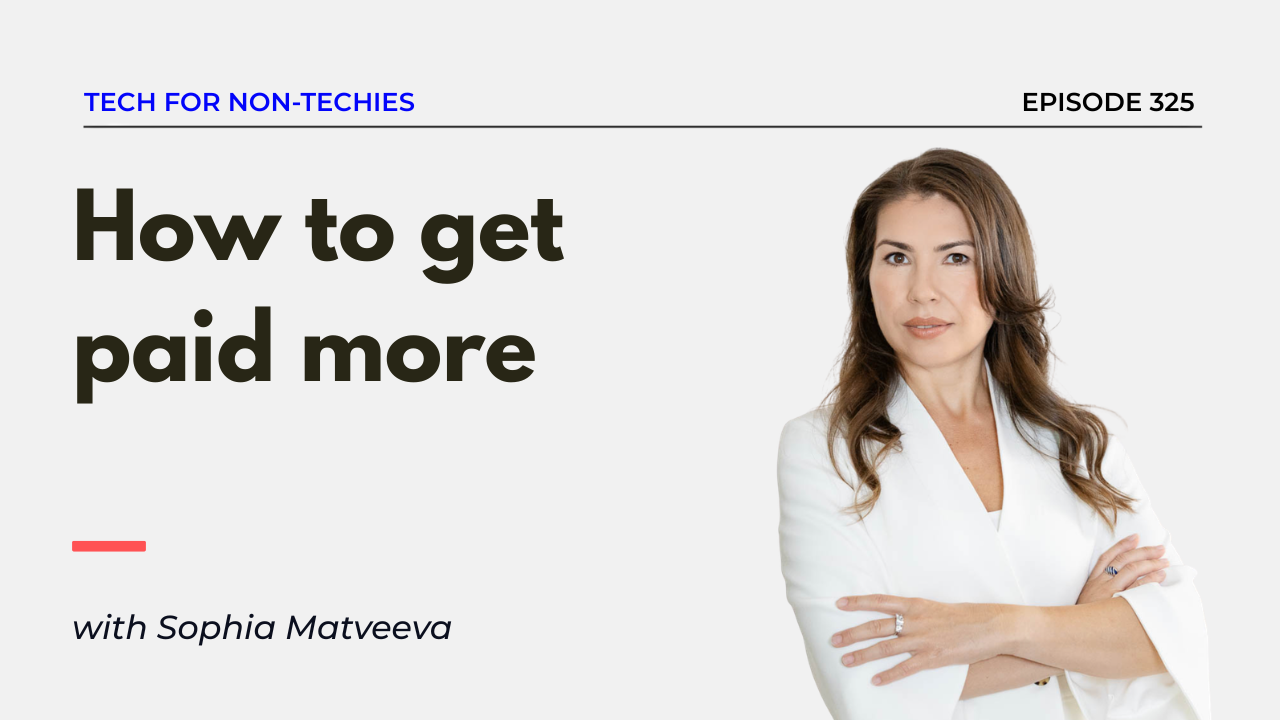
Too many smart, hardworking professionals focus on creating value, but never capture it.
They take on more responsibility, lead bigger projects, deliver real results — and somehow end up getting paid the same.
This is one of the most popular episodes in the Tech for Non-Techies back catalogue, and the timing could not be more relevant.
It is Q4.
Promotion decisions are being made right now. Budgets are being signed off.
Whether you are running a business, looking for your next role, or want to get paid more in the job you are already in — this episode is for you.
In this episode:
- The exact approach one client used to get a 35% pay rise — with no threats, no drama, and no mention of leaving
- Why talking about fairness and extra hours will never get you paid more — and what to do instead
- Why being perceived as a victim is the most expensive career mistake you can make
- How to align your value to what the budget holder actually cares about
This episode is for you if:
- You are doing more work than your compensation reflects
- You are leading a transformation or innovation project that has grown way beyond its original scope
- You want to negotiate better without damaging the relationship
Free personal brand strategy session:
This month only, I am offering 10 free brand strategy sessions.
We will diagnose exactly what you need right now — whether that is getting discovered by the right people or capturing the value you already create.
At the time of recording, 2 sessions have already been booked, so only 8 are left.
Timestamps:
- 00:00 – How to get a 35% pay rise without negotiating
- 02:18 – Free personal brand strategy sessions this month
- 04:43 – Case study: a project that ballooned out of scope
- 07:04 – Why digital transformation projects often fail
- 09:24 – Why complaining to your boss backfires
- 11:47 – How to quantify the value you've created
- 14:11 – The real reason David got his pay rise
Follow and Review:
We’d love for you to follow us if you haven’t yet. Click that purple '+' in the top right corner of your Apple Podcasts app. We’d love it even more if you could drop an honest review on Apple Podcasts. Simply select “Ratings and Reviews” and “Write a Review” then a quick line with your favorite part of the episode. It only takes a second and it helps spread the word about the podcast.
Listen to our podcast on:
Transcript:
[00:00] One of my clients got a thirty-five percent pay rise without threatening to leave, without a dramatic negotiation, and without even mentioning that he was underpaid. Yes, this actually happened, and this episode is about exactly how he did it, so you can do it too. Perfect to get ready for promotion season — and also a must-listen for the entrepreneurs here, because this is how you impact your client negotiations.
Welcome to Tech for Non-Techies. This is a podcast for business leaders and non-technical founders building the future in the age of AI. Whether you've been in business for a hundred-plus years and you're looking to modernize, or whether you're building something new, this is the show for you. You'll learn how to come up with new ideas and make them come to life, no matter the size of your organization. I've taught tech and innovation at Oxford University, advise companies like Microsoft, and written for the Harvard Business Review. You're going to hear the frameworks and the thinking that I've built, tested, and taught at the highest level. And now it's your turn. Let's get started.
Hello, smart people, how are you today? Last week we talked about visibility — how do you stand out and get found for opportunities, especially in the age of AI, when lots of people are copy-pasting AI-generated content on LinkedIn and calling it a personal brand. You can now even report AI slop on LinkedIn — that's where we are, people. So standing out and learning how to do it amongst so much AI-generated nonsense is a skill you really need to hone.
If you came to last week's free class, thank you — the feedback was incredible. I loved your questions, your comments, the class participation.
In this lesson, I want to talk about what happens next, because getting discovered is only half the equation. Yes, you need to get discovered, but what happens when you have been discovered? How do you actually turn that into a lucrative, interesting opportunity? So the other half is: what do you do with the opportunity once it arrives?
[02:18] How do you capitalize on it? I'm re-releasing one of my most popular episodes, and the timing is very deliberate, because this, my dear smart people, is Q4. Promotion decisions are being made right now, budgets are being signed off right now. I want you to be in the best position to capture the value you've already created, and for your hard work to pay off — whether that's your hard work in your job, or your hard work in pitching to a client, so you can make sure you actually get these things over the line.
So whether you're running a business, looking for your next role, or you want to get paid more, this episode is for you. This month only, until the 28th of October, I'm offering ten free personal brand strategy sessions. In each session, we're going to diagnose what you actually need to work on right now — because for some of you, you need to focus on getting discovered in the first place; for others, you need to make sure you're actually capturing the value you're already creating. We can figure out which of these matters most for you right now, so you can focus on that and make the most of Q4.
At the time of this recording, two of the ten spots have already gone. So if you're listening and thinking, "I need this," go to the link in the show notes right now and book it — I don't know how many will be left by the time you're listening.
[04:43] And now, my dear smart person, let's get paid more. One of my clients got a pay rise of about thirty-five percent without really negotiating. So if you want to get paid a third more than you are right now, this episode is for you.
I shared this story in my Power in the Digital Age masterclass, and I had a lot of questions about it, so I'm going to delve into it more here. This actually happened to one of my clients — I'm not going to disclose names, so let's call him David, after Michelangelo's very fetching statue in Florence. David was asked to work on a digital transformation project for a very prestigious organization — he was already working there, just to clarify. This was an additional large project he was asked to take on, and he was really thrilled about it, because getting into digital transformation was exactly what he wanted — a great career move, a great step up, a way of getting his foot in the door of the whole digital revolution.
He got to work on the strategy, got to know the stakeholders, learned the latest methodologies, really gave it his all. He was so dedicated. As time went on, the project ballooned way beyond the scope originally agreed — remember, this wasn't supposed to be his full-time job, but it kind of became it, on top of his original responsibilities. The organization was really happy with him and let him hire more people, and the project became much more cross-functional than originally planned. His bosses were delighted that somebody was taking the lead and making things happen.
But what do you think David was feeling? How would you feel? First, he was mega flattered, so excited that he was being listened to and his initiatives were coming to life. But then reality set in — he was working all the hours God sends, managing way more people than planned, with all the drama and admin that comes with that. He wasn't seeing his friends or family, he was eating crap, not working out — because that's what happens when we're overworked. And for all of this physical and emotional sacrifice, his compensation stayed the same. So he was basically doing lots of free work for a profit-making entity. Not fun. I've ended up in similar situations earlier in my career, so if this is you, I fully sympathize — but there is a way out, so listen.
[07:04] Especially in the world of digital transformation, it's quite normal for projects to balloon — that's why renegotiating compensation is a necessary skill for transformation leaders, and why I really want to drive this point home.
Company bosses often underestimate just how big the problem they're trying to solve is, and how many professionals it really needs. According to McKinsey, 70% of digital transformation projects fail to meet their goals, and in my experience, underestimating the problem and understaffing it from the start are huge causes of that. This happens because digital transformation projects aren't just about implementing a new IT system — that's how people used to think about it maybe 10, 20 years ago. Now there's more understanding that it's a much more holistic process — you have to change the entire organization, from mindset to process to messaging to tools. But just how holistic it is, is often underestimated. This is why whoever's leading the project often ends up taking on much more than they originally anticipated, and more than their compensation reflects.
If you find yourself in this situation, you might be tempted to tell your employer how unfair it is — show them the hours you've worked, the number of people you're managing, the original agreement, and say, "This isn't what I signed up for." This is actually what David was about to do before he spoke to me. When he came to me with this, I listened to him vent, because it was genuinely an unfair situation and he was frustrated.
[09:24] After listening, I told him not to approach his bosses like that. Because if you're underpaid and doing way more work than agreed, you'll be tempted to talk about how unfair the situation is, maybe even show the extra hours and the toll it's taking on you. But, my dear smart person, I discourage you from doing that. Number one: compensation is not a moral issue in a capitalist society. Talk about fairness and morality to your coach, your friends, your family — but not to your boss. Number two, and this is really important: being perceived as a victim is not useful for an ambitious professional, even if your situation is completely unfair. You don't want to be seen as a moaner, because that makes you look weak, like you're looking for a handout, like you need to be rescued. If you want a very successful career — which I assume you do, since you're listening to this podcast — you need to look strong and in control.
So how do you look strong and in control while asking for more? The answer is: you need to show how much value you've created for the organization. This turns the power dynamic in your favor, and it's about their needs, not your own — I'll show you what that means as we go on.
[11:47] First, let's talk about value creation. Can you quantify how your work has impacted the share price? Or revenue growth? Did you find a new way to save costs by getting rid of an old, bulky process? Also — look at what the CEO or the board say they care about. Can you demonstrate that your work brought value in those strategic areas? If it's a listed company, this information is pretty easy to find. If not, look online, look at your intranet — your CEO will be talking about their strategic priorities somewhere, you'll find it. If your position is relatively removed from the CEO, think about what your boss's boss cares about. This matters because you may have created genuine value, but if the person who controls the budget doesn't see it as a strategic priority, it won't matter as much — which would really suck, because you'd have done all that work and created all that value for nothing. So you've got to be smart about this. This is not about fairness, this is about strategy. Think about the value you created, and align it with what the person controlling the budget wants.
So David and I worked out the value he'd brought the organization, which in his case was truly massive — we quantified part of it, and also talked about the qualitative aspects, like what his work did for the company's brand building. Especially for digital transformation and innovation projects, brand impact is really important — don't underestimate it, because companies can show themselves to be innovators, ready for the future rather than stuck in the past, as a result of these projects, and that's the kind of image that attracts good employees and impresses investors and clients. Don't dismiss brand just because it's harder to quantify.
[14:11] After we worked on showing the value he'd created, David requested a conversation with his boss about the transformation project he was leading. He outlined all the differences he'd made, showed the value his leadership had brought, and how the project delivered way more value and impact than originally expected. Then he said his salary needed to change to reflect the value he'd brought — to be more in proportion with the value created, so he could capture some of it. Because he could quantify part of the value he'd created, talking about numbers and compensation was a natural next step.
And you know what? He got an immediate yes to his request — to be fair, it was more of a statement than a question, which is the best way to negotiate, by the way. Now David gets paid a third more by the same organization. A third more — that's massive. What would you do with a third more every single month?
He got this because the conversation wasn't about David, wasn't about his needs — which is what he originally wanted to focus on — it was about something his employer cares about much more, I'm sorry to tell you: their bottom line and their future. The thing is, if your employer sees you as the goose that lays the golden egg, they'll be very aware you could lay those golden eggs at a competitor. In most cases, you won't even have to point this out — and David didn't, he didn't say his skill set is transferable. He just asked for a meeting with a budget holder, showed why the organization made significant new revenue because of his work, and asked for a compensation review. He didn't need to threaten to leave, didn't need to get dramatic. He was calm, confident, and in control — and he got the result he wanted.
What I really see from smart, hardworking people is that they're dedicated professionals who focus on creating value, but they often neglect to capture it. I hope this episode gives you a perspective shift so you're not one of those people. If you're creating value, you need to capture some of it. If you're not creating value yet, start there. But if you are genuinely creating value for an organization, the negotiation tactic is to capture some of that value — that's how you capture what you create.
If this episode resonated with you and you want to apply it to your own situation, make sure to book your free brand strategy session with me via the link in the show notes — there are only a few spots left. On that note, have a wonderful day, and I shall be back in your delightful smart ears next week. Ciao.
Sign up to our mailing list!
Be the first to hear about offers, classes and events