320. Calendly: the $3bn non-technical founder success story
Sep 09, 2026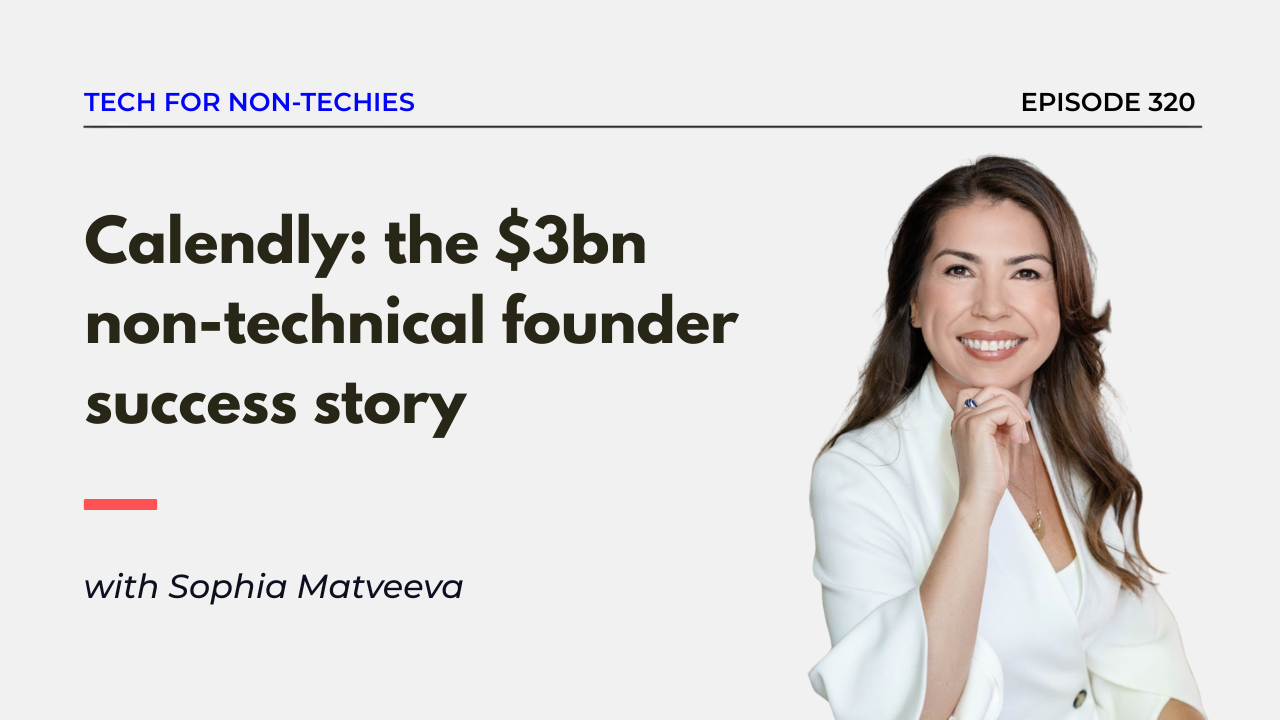
Tope Awotona had no co-founder, no coding ability, and three failed startups behind him. None of that stopped him — today, Calendly is worth $3 billion, used by over 20 million people in 230+ countries, and adopted by 86% of the Fortune 500.
In this episode, I break down exactly how a non-technical founder built one of the most capital-efficient startup success stories of the last decade — and what you can actually steal from his playbook.
What you'll learn:
- How he chose the idea that finally worked, after two failures
- How he built a $3 billion company completely alone, with no co-founder, ever
- How to tell if a development team actually believes in your product, not just your budget
- How running out of money by accident became Calendly's biggest growth engine
Want to build a tech venture as a non-technical founder?
Our Non-Technical Founders' Product Accelerator program is for you.
People have used it to build apps and platforms, raise funding and completely change their careers.
Timestamps:
- 00:00 – How Calendly's founder ran out of money by accident
- 02:23 – Listener shoutout and podcast review
- 03:04 – Meet Tope Awotona, Calendly's non-technical founder
- 04:43 – Calendly's $3 billion growth story
- 07:05 – Why sales, not coding, built Calendly
- 09:21 – The 3 failed startups before Calendly
- 11:39 – Why Calendly had no technical co-founder
- 14:06 – Paying $200K to outsourced developers
- 16:29 – How Calendly went viral by accident
- 21:18 – Fundraising only after proving traction
- 25:26 – 6 lessons for non-technical founders
Follow and Review:
We’d love for you to follow us if you haven’t yet. Click that purple '+' in the top right corner of your Apple Podcasts app. We’d love it even more if you could drop an honest review on Apple Podcasts. Simply select “Ratings and Reviews” and “Write a Review” then a quick line with your favorite part of the episode. It only takes a second and it helps spread the word about the podcast.
Listen to our podcast on:
Transcript:
[00:00] In 2013, a guy in Atlanta ran out of money. He had just spent $200,000 — that's his entire life savings. He maxed out his credit cards, took out a loan at a terrible interest rate, to build a piece of software as a non-technical founder. And when he was finally ready to launch, he actually didn't have a single dollar left to build the part that let him charge people for the product he'd just paid to build. So he launched it for free, by accident.
And that mistake is the reason you've probably used his product to book a meeting with somebody this week. His name is Tope Awotona, and the product is Calendly. Today, Calendly is worth three billion dollars. He had no co-founder, he didn't write a single line of code himself, and he'd already failed twice before this startup took off. This episode is all about how he did it, and what it means for you if you're trying to build a tech venture without a technical background.
Welcome to Tech for Non-Techies. This is a podcast for business leaders and non-technical founders building the future in the age of AI. Whether you've been in business for a hundred-plus years and you're looking to modernize, or whether you're building something new, this is the show for you. You'll learn how to come up with new ideas and make them come to life, no matter the size of your organization. I've taught tech and innovation at Oxford University, advise companies like Microsoft, and written for the Harvard Business Review. You're going to hear the frameworks and the thinking that I've built, tested, and taught at the highest level. And now it's your turn. Let's get started.
Hello, smart people. How are you today? Before we get to today's lesson, I want to thank our podcast listener and Tech for Non-Techies client, Joy Butler, for her super generous shoutout on LinkedIn. She shared my last episode, an interview with Rana Gujral, about what happens when we let AI do all of our thinking for us. Joy wrote — for the business-competitive implications of allowing AI to replace human judgment, tune in to a recent Tech for Non-Techies episode from Sophia Matveeva, one of her favorite podcasters and "business coach extraordinaire," and listen to her guest Rana Gujral's simple first steps for recovering from over-reliance on AI and staying sharp in an increasingly AI-driven world.
[02:23] So firstly, Joy, thank you for listening and for leaving that note on LinkedIn — it really made my heart sing. Secondly, if you haven't yet listened to last week's episode, it's a good one — Joy has two Harvard degrees and she's a clever person, so follow her advice and listen to it. And thirdly, if you're getting value from these episodes, please follow Joy's example — leave a rating and review wherever you get your podcasts, or share the show on social media and tag me, because I really want to know who's listening, so I can feel more connected to you and make these episodes super relevant.
[03:04] And now, my dear smart person, let's get to today's lesson. Today we're doing a case study episode on how a non-technical founder built a multi-billion-dollar tech business — and also how he built a product I personally absolutely love using. So researching this was a labor of love.
Tope Awotona is the founder of Calendly — the scheduling tool you've definitely used if you've ever had a meeting with me. If you haven't heard of Calendly or used it, get it now and watch your life get better. And no, they did not pay me to make this episode — I wish they did. Basically, Calendly lets you share your availability so people can book a meeting with you when it's convenient for them and for you. The company is now worth $3 billion following a $350 million funding round back in January 2021. It has over 20 million users across more than 230 countries, and is used by over 100,000 organizations, including 86% of the Fortune 500. In terms of revenue, it's estimated to be pulling in around $350 million a year.
So before we get into how this company was built, I really want you to let this sink in: a three-billion-dollar company, used by the vast majority of the Fortune 500, and yours truly, built by one guy with no co-founder and no coding ability. That's why I wanted you to learn how he did it.
[04:43] Calendly was founded in early 2013 by Tope. He was a single founder, and he worked with an outsourced development firm to build his product. I'll get into the details, but I want you to know this is literally what famous accelerators like Y Combinator tell you not to do — because those accelerators were built by and for technical founders and generally look down on non-tech people. But that's an aside.
Here's Calendly's story. Tope Awotona was born in Lagos, Nigeria, and emigrated to the US as a teenager, settling in the Atlanta area. He studied management information systems at the University of Georgia — a degree that sits right at the intersection of business and technology. Then he spent about a decade in enterprise software sales, working at companies like IBM and Dell. In college, he actually did door-to-door sales to make money, working on 100% commission — so he only got paid if he sold something. I wanted you to know about his college job because the most important skill a founder has is sales. Not writing code, not writing AI prompts, not product management, not even marketing — actual sales. Because sales is how you get people to believe in your product, and how you get a team, investors, and customers to back you and help you build your thing.
[07:05] As you're listening, you might think — hang on, how can this guy be a non-technical founder if he studied something quite techie and worked in tech sales? Honestly, I get you — Calendly is spoken of in the tech world as a non-tech-founder success story, and it's also how Tope identifies himself; he's been quite vocal in the press about how difficult it was to build a product as a non-technical founder, and how he had to scrape money together to pay this development firm. Tope had never worked as an engineer and didn't build the product himself, so from that point of view, he really did go through the standard non-technical founder journey.
A business technology degree doesn't make you able to actually build high-quality software — but I'd say he already knew how to speak tech by the time he started this venture. He knew how products get made, he knew the technical terms, he knew how to work with and hire developers. For many of you, my students and listeners, you don't even have that — I certainly didn't. My first degree is in political science, my second is an MBA. I worked in media and private equity — I didn't work in any tech field at all. So when I started a tech company, I didn't even know how to speak tech; I was very much behind Tope.
But what I want you to learn from his example is that he followed the non-technical founder path I'd encourage many of you to follow — you don't need his degree or professional experience to speak tech. You can literally take one of our courses: Tech for Non-Technical Founders, if you want to start a tech venture (link in the show notes), or How to Speak Tech for Leaders, if you're on the business side of a corporate and want to understand how to work with and lead tech people.
[09:21] So let's get back to Tope. He wanted to be a founder — he knew that long before Calendly. He actually tried starting three businesses before Calendly took off, and all of them didn't work out for various reasons. First, he wanted to build a dating site, and after fairly early research realized that wasn't for him. Then he built an e-commerce site selling projectors — didn't work out. Then he created another e-commerce venture selling grills and garden equipment — that didn't work out either.
Both flopped, and he talks about this in detail, with some humor, on Guy Raz's podcast, How I Built This — if you want more of his story, listen to that, I really enjoyed it. Tope says all these businesses failed for the same reason — he was chasing money. He was thinking, "If there's a business opportunity here, if I create this thing, people will want to use it" — chasing the financial opportunity rather than solving a problem he actually cared about.
Calendly was different because he was an enterprise sales guy who needed to schedule meetings, and he'd get stuck in this back-and-forth — especially organizing a meeting with five different people, all with different needs and diaries. A nightmare to organize. He knew and cared about the meeting-scheduling problem — it personally frustrated him. Because it was a problem he cared about, he actually tried all the existing solutions himself, because he wanted to solve it for himself — he was his own user. He saw none of the existing solutions were good.
After about six months of research and testing the market and existing tools, he decided to go for it — build his thing. I don't know if he did prototype testing, but I know he built a product requirements document, then started interviewing development firms who could design and code the product.
[11:39] A product requirements document is basically an outline of what you want the product to do and what functionality it should have — a core document you must have before working with developers. You can technically start without it, but you won't get proper ROI on your development spend unless it's thought through and properly prepared. It also makes you look like someone who knows what they're doing, rather than just another person with an app idea. We actually teach you how to write this document in our Tech for Non-Technical Founders course — it's linked in the show notes, and it's our signature course, taught at Techstars, London Business School, Oxford University, with about 800 people having gone through different iterations of it.
Tope said he did not create this document for his first three businesses — and it showed. Now, I'm not saying this document guarantees success — sadly there's no single silver bullet — but having it shows you understand the problem you're solving and have a specific view on how to solve it. That's an important foundation stone for success.
To get the product made, Tope needed to hire outside engineers — he couldn't find a technical co-founder, a very common story for non-technical founders. If that sounds familiar, you're not alone. Good engineers are inundated with non-technical people with app ideas, platform ideas, now AI ideas — and if the engineer is entrepreneurial themselves, they'll often just work on their own idea. So if you're thinking, "I can't start a company because I can't find a technical co-founder" — that's not a personal failing, it's just the market. As this story shows, and as I keep telling people, you can get going anyway, because Tope didn't actually need a technical co-founder — he needed to get the product made, and there are other ways to do that.
[14:06] Tope spoke to a bunch of development firms and found one he liked — Railsware, based in Kyiv, Ukraine, at the time. He liked them because they asked about the product, the vision, the problem — they wanted a holistic view of what he wanted to build, rather than just, "What's your budget?" This is a good lesson: working with outsourced developers doesn't mean working with people who don't give a damn. Yes, some development firms don't care about your vision and will just build whatever you say — but others genuinely want to be part of something successful, want to create something lots of people use. I worked with an outsourced development firm like that too, and so did Tope. It's perfectly possible, and you'll actually hear from a trustworthy outsourced development firm on this very podcast later this month — stay tuned.
Tope said that when he first started working with this firm, they challenged his idea so much he thought about giving up — they made him realize what he wanted to create was far more complicated than he thought. He got really deflated. But this is another sign of a good development firm — they'll challenge you, and it won't always be comfortable. If you're working with a bunch of yes-men, you should be worried, because that means they don't really care enough to challenge you.
Now let's get to the financials. To get the product made, Tope had to pay $200,000, and he paid for all of it himself — he withdrew his 401k, maxed out his credit card, and took on loans at an expensive interest rate. I'm not telling you to do that, just telling you what he did. But note the price tag: $200K was a perfectly decent amount for a working first product at the time — it's a bit less now, depending on what you're building, since you can get further with AI. But a proper working product you're going to charge money for isn't going to be five thousand dollars — I want you to know that.
Another thing: Tope never asked the development firms he was interviewing to sign an NDA. He'd go to a firm and say, "This is what I want to build, this is my vision, can you build it, how much will it cost?" — no NDA. That's the smart move, because it's execution, not the idea, that counts. If you ever hear someone worried about their idea getting stolen — send them this episode, but also tell them ideas are cheap; what's hard is execution, building the thing and getting people to use it. That's hard work, and nobody can steal that from you.
[16:29] Okay, the product gets built, he spent his $200K — what happens next? First, I want you to know that throughout all this, Tope still had his full-time job — still working in enterprise sales — while this was being built. This matters, because Tope, like all humans, needs food and shelter to survive, and he also needed to keep paying his developers, who also needed food and shelter. So he needed to keep getting paid — and getting paid rather well — at his full-time job, which actually allowed him to fundraise later when he already had traction, meaning the power dynamic was in his favor.
Now let's talk about how he got his users — this is quite interesting. He didn't actually mean to launch the product for free. Calendly went live in September 2013, and it was a completely free product — he didn't want it to be. By the time the main product was built, he'd burnt through his entire budget and had nothing left to build the billing and payment system. He wanted a freemium product — some features free, most behind a paywall — but he literally ran out of money to build the paywall. How ironic. So the product went out into the world with no way to charge anybody.
And here's the twist: this accident became a huge growth engine for Calendly, because it was free, so there was zero cost to try it. Every time somebody sent a Calendly link — say I sent you one to book a meeting — you'd see how useful it was, essentially a free, unpaid advertisement for this amazing product. The recipient experienced how frictionless it was, then signed up themselves.
But here's the actual chain of events that kicked off the growth: Railsware, the development firm, was also working with another client — a Bay Area data analytics company called BrightBytes, which sold tools to schools in the US. Railsware introduced BrightBytes to Calendly. BrightBytes loved it and started using it. They used Calendly to schedule meetings with teachers. Those teachers then thought, "Hang on, this is super useful" — and you know what's super annoying to organize? A parent-teacher conference. So they started using Calendly for that. From there, it just kept spreading — teacher to parent to the next person, and so on.
Now, I don't want you to think this was just pure magic, with Tope sitting back waiting for the internet to discover him. Yes, he got lucky here, but he also personally emailed everybody he knew in sales, recruiting, and customer success to try those first users himself — basically saying, "I've been in your shoes, I know how difficult this problem is, here's this tool, it's going to help you." So even the accidental viral story had real manual hustle by the founder underneath it — slog and gritty action.
And yes, this is a story of viral growth — and in a previous episode, I literally told you that viral growth basically doesn't happen. So let's address that. True viral growth like Calendly is so rare — I want you to think of it as something that essentially doesn't happen. Don't assume you'll build a product so great it grows by itself, because that's exceptionally rare. Yes, definitely build viral loops into your product — we cover this in the Tech for Non-Technical Founders course, along with growth hacking — and implement it. But make sure you have money for sales and marketing, and don't expect the "our product grew by itself" story that Calendly had, because relying on luck is not a strategy.
[21:18] So now the product is live, growing, and still completely free. At this point, Tope raises money — just over half a million dollars, $550,000, as a seed round in April 2014. By then, he already had around 15,000 free users. This is an amazing example of proving traction before raising — and again, this is rare. Notice the order: he didn't raise money to build the product. He raised once he already had thousands of people using and loving something he'd built with his own money.
Now you might be thinking, "I don't have $200,000 in savings, I can't even get that together with loans." I totally get you. But now, with AI tools, you can build a pretty decent test product and get fairly far. You still need professional developers, but to build a very simple product with maybe one developer, you actually need less money — not only because you can use AI to build and test your first prototype yourself, which we teach in our program, but because when you work with a developer, they'll likely be using something like Claude Code too. By the way, if you're a non-technical founder using Claude Code yourself, you're going to make mistakes — but a professional using it will use it to speed up, so you get a working product sooner and cheaper.
So, back to Calendly. When it finally started charging users in 2014, Tope said he botched the transition — he didn't give users enough notice, and didn't grandfather in the early adopters who'd been with him since the start. This caused real backlash from a vocal group of users — and you know how scary people can be on the internet. This was a mistake, and looking back you might think it was obvious — but it wasn't obvious at the time. He was busy, overwhelmed, probably still working full-time, or maybe he'd gone all-in on Calendly by then — either way, he was making a lot of decisions and missed one thing. I'm telling you this because I want you to see that even people who go on to build multi-billion-dollar companies mess up execution sometimes. It's what you do afterwards that matters — clearly he recovered, and everything turned out fine. I don't want you to think the Calendly story was smooth sailing with perfect decisions throughout — it wasn't, because that isn't possible. None of us are perfect. Even I'm not.
After that $550K round, Calendly did not raise another dollar of funding for years — again, really rare, really impressive. By the time the company hit $60 million in annual recurring revenue, that original $550K investment represented a 109x return multiple against revenue. If you don't fully understand what these numbers mean — it's the kind of return VCs probably don't even dare to dream of. That level of capital efficiency puts Calendly in the same conversation as companies like Atlassian or Zapier — businesses that grew almost entirely on their own money, not investor money. I want you to know this because the startup press, TechCrunch especially, really glorifies fundraising. But fundraising is a means to an end, not an end in itself.
Calendly actually became profitable in 2016 — just three years after launch, which is amazing. So they didn't need investor money to survive. When Tope finally did take outside investment at scale, it was January 2021 — six years later — a $350 million round at a $3 billion valuation. Most of that money was actually secondary capital, meaning it let early stakeholders and employees cash out some shares — it wasn't money the company needed to survive. This meant Tope negotiated from a position of total strength — Calendly was already profitable, already growing fast, and he didn't need anybody's money. That's literally the dream scenario if you want to build a tech venture — I want this for you. It's a completely different negotiating position than raising when you're desperate. And that's exactly what you get when you build traction first and ask for money second.
[25:26] Okay, let's sum up. Here are six key things I want you to take from this case study as a non-technical founder:
Number one — if you really understand the problem you're solving, you're far more likely to succeed than if you just find an idea you think has potential but don't actually care about.
Number two — being a non-technical founder doesn't mean you need a technical co-founder, because you don't.
Number three — working with outsourced developers can be wonderful if you find the right people, and they exist.
Number four — fundraising is not an end in itself. If you don't have to do it, or can delay it, that puts you in a position of strength.
Number five — build viral loops into your product, so when people see it, they want to try it and share it. But don't rely on this as your only marketing strategy — that's too risky.
And finally, number six — if you know how to speak tech, rather than do tech, just like Tope did, you can build a successful tech venture and lead a tech team.
I hope you enjoyed learning about Tope and how he built a $3 billion success as a non-technical founder just as much as I did. I love Calendly, and learning the story behind it has made me love the product even more. Check out the Tech for Non-Technical Founders program in the show notes if you have an idea for a tech venture and no tech skills to build it — our students have used it to build apps and platforms, raise money, and completely change their career trajectory. It's a proven program with great results.
And if you enjoyed this episode, which I assume you did because you're still listening, please leave this show a rating and review, or share it on social media and tag me — I'd love to hear from you. On that note, have a wonderful day, and I shall be back in your delightful smart ears next week. Ciao.
Sign up to our mailing list!
Be the first to hear about offers, classes and events