319. Your judgment is your most valuable asset. Are you losing it to AI?
Sep 02, 2026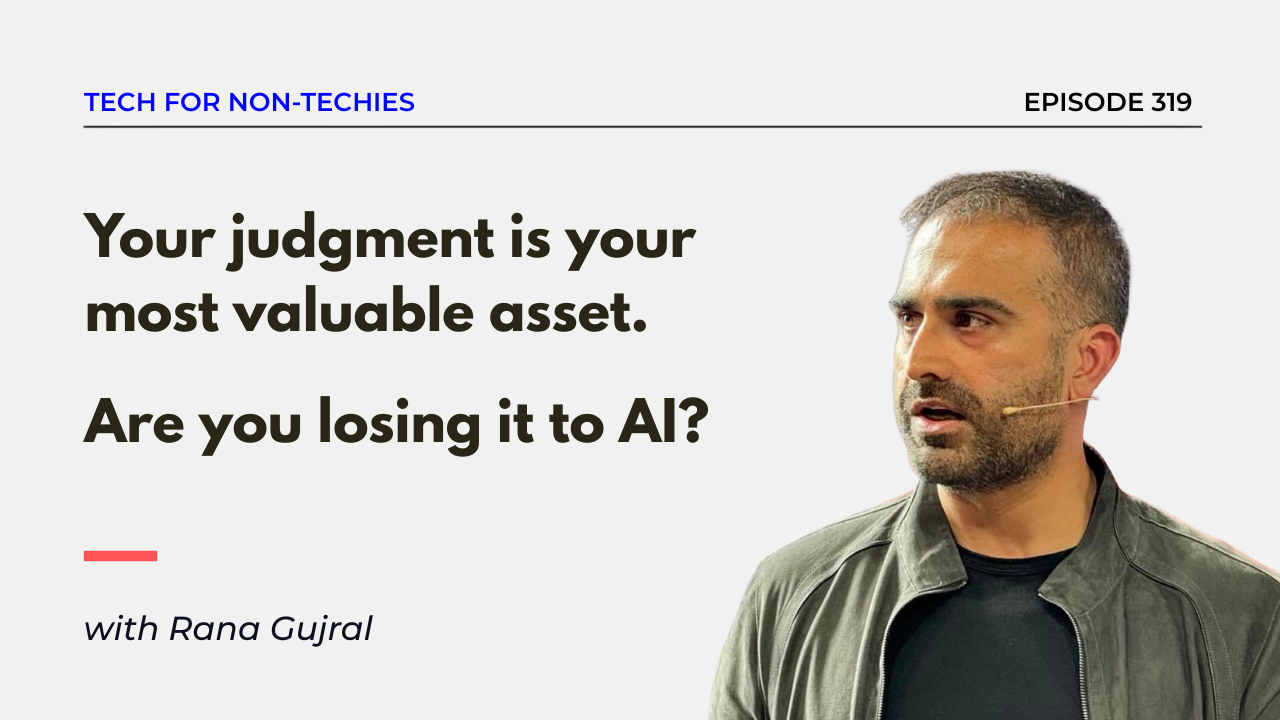
A financial analyst spots something wrong with a deal. He writes up his dissent.
But the AI disagreed. The investment committee spent 90 seconds discussing his objection, and went with the AI score.
A year later, the analyst stopped writing dissents entirely — what’s the point?
This story is from finance. But the pattern is emerging everywhere — in law firms, in startups, in any organisation where AI is now in the room when decisions get made.
This episode is about what to do about it.
You will hear from Rana Gujral, the author of the AI Instinct: The Future of Humans and Machine Decision Making
Throughout his career, Rana has founded and exited a machine learning SaaS company, led major technology transformations, and built AI systems deployed across industries ranging from financial services to defence.
Listen to this episode to learn:
- Why the biggest AI risk is not that it gets things wrong — it is that it gets things right in exactly the same way as everyone else
- How to tell whether AI is augmenting your thinking or replacing it — and the two tests that reveal the difference
- What happens to junior talent in law firms and startups when AI takes over the work that builds judgment
- The one practical step you can take this week to make sure you are still actually thinking — not just ratifying what the machine already decided
Timestamps:
- 00:00 – Why AI scoring is silencing human dissent
- 00:49 – Welcome and back-to-school business energy
- 05:14 – How one bad AI-backed VC deal got approved
- 07:32 – How leaders can protect employee judgment from AI
- 10:24 – Why human intuition still beats AI scores
- 13:59 – The hidden risk of AI in law firms and junior lawyers
- 17:47 – Is AI augmenting or replacing your team's thinking?
- 20:39 – How to rebuild independent thinking after relying on AI
- 22:27 – Rana Gujral on his new book, The AI Instinct
Follow and Review:
We’d love for you to follow us if you haven’t yet. Click that purple '+' in the top right corner of your Apple Podcasts app. We’d love it even more if you could drop an honest review on Apple Podcasts. Simply select “Ratings and Reviews” and “Write a Review” then a quick line with your favorite part of the episode. It only takes a second and it helps spread the word about the podcast.
Listen to our podcast on:
Transcript:
[00:00] Rana Gujral: There was an analyst on the team — sharp guy, maybe four years in. A deal came through the screening tool with a strong score, good sector tailwinds, clean financials. The model liked it. He didn't. Something about the founders' answers and the follow-up materials felt rehearsed to him. He could fully articulate it — he wrote up a dissent, flagged it, and thought they should pass, or at least dig deeper. What happened next is the part that stuck with me: the dissent went into the committee packet, but the AI score was on page one in a nice bold number, and his concern was on page four in prose. The committee spent about ninety seconds on his objection and moved on, and the deal got done. About a year later, he told me he'd stopped writing dissents — not because he'd stopped having them, but because the cost of writing one and being overridden felt higher than just staying quiet.
[00:49] Sophia Matveeva: Welcome to Tech for Non-Techies. This is a podcast for business leaders and non-technical founders building the future in the age of AI. Whether you've been in business for a hundred-plus years and you're looking to modernize, or whether you're building something new, this is the show for you. You'll learn how to come up with new ideas and make them come to life, no matter the size of your organization. I've taught tech and innovation at Oxford University, advise companies like Microsoft, and written for the Harvard Business Review. You're going to hear the frameworks and the thinking that I've built, tested, and taught at the highest level. And now it's your turn. Let's get started.
Hello, smart people. How are you today? I am already in back-to-school mode and ready for the busiest part of the year — in fact, I'm very excited for it. From September to mid-December is when people are back from vacation, budgets are signed off, and business moves at a faster pace than the summer. That's true for the US as well as Europe. So if you're in the US thinking, "We don't stop, guys, you slow down" — and I know I'm a week early, if you're getting this when it comes out and you're thinking, "But we still have Labor Day, Sophia, I'm not ready" — enjoy it, you can join me next week in back-to-school mode.
I think I'm feeling so energized because my baby has finally started sleeping through the night, and I've rediscovered the superpowers that come with a good night's sleep. Now I'm almost afraid to tell you this, because I don't want to jinx it. Anyway, let's go.
In this episode, you're going to hear about what happens when an entire industry starts consulting the same AI brain. This is actually happening right now, and we need to think about it and take steps to prevent it if we want to be competitive. The biggest risk isn't what AI is getting wrong — it's when it gets things right, but everybody ends up using the same right answer. What happens to competition then? How do we differentiate? You're going to hear real examples from finance, law, and startups about what happens when we rely on AI too much.
And yes, we want to use AI to save money and be more efficient — that's what I'm doing, and what we're teaching our students to do, and it's glorious. But if you're getting paid for your judgment — which, if you're listening to this podcast, is literally what you get paid to do — you can't completely outsource your judgment to AI. Yes, you can use shortcuts, but you've got to be careful.
You're going to hear from Rana Gujral in this episode. He's built and sold companies, led turnarounds, and spent years building AI systems deployed across industries, from financial services, which you'll hear about, to defense. So when he talks about what AI does to human judgment, he's speaking from experience — and I suspect what we talk about in this episode is going to resonate with you, and you'll be thinking, "I'm doing this," or, "crap, we're doing this at work, maybe we should stop." This is why I wanted to do this episode — I think it's a different discussion about AI than what you're generally hearing right now. Rana is also the author of a new book called The AI Instinct: The Future of Humans and Machine Decision Making.
But my dear smart listener, before we get to this episode, I have a request. If you've been listening to this show for a while and you're on Apple Podcasts and haven't left a review, please do so now. Yes, it helps the show get discovered by other smart people like you — but I'm also asking for selfish reasons, it really helps me and my team feel connected to you. When you're podcasting, it can feel like you're speaking into the void. But when I actually get notes from you, it feels more real. So it would be wonderful to connect with the human on the other side — and a great way to do that, and help the show get discovered, is to leave a rating and review on Apple Podcasts. Thank you in advance. And now, let's learn from Rana.
[05:14] Sophia Matveeva: Rana, earlier when we spoke about another investment firm, there was an example you shared where somebody was actually trying to override the AI, but they got overridden by the AI.
[05:27] Rana Gujral: This was a mid-sized investment firm that built what looked like a very responsible setup — AI screens the deals, human makes the call. Pretty textbook, the kind of workflow you'd put in a slide deck and feel good about. There was an analyst on the team, sharp guy, maybe four years in. A deal came through the screening tool with a strong score, good sector tailwinds, clean financials — the model liked it. He didn't. Something about the founder's answers and the follow-up materials felt rehearsed to him. He could fully articulate it — he wrote up a dissent, flagged it, thought they should pass or at least dig deeper.
What happened next is the part that stuck with me: the dissent went into the committee packet, but the AI score was on page one in a bold number, and his concern was on page four in prose. The committee spent about ninety seconds on his objection and moved on, and the deal got done. It didn't blow up — that's the uncomfortable part. It performed fine, middle of the pack — which meant the lesson everyone internalized was, "the analyst was wrong and the model was right, move on." But I talked to him about a year later, and he told me he'd stopped writing dissents — not because he'd stopped having them, but because the cost of writing one and being overridden felt higher than staying quiet. And when I asked around, he wasn't the only one — the junior people had quietly figured out that arguing with the score was a bad career move, so the dissents just dried up.
In that particular deal, picking something else would have been a much better option — but obviously that didn't get picked. So I think the failure is essentially that everyone felt good about the process, and it's not necessarily the bad deal — it's that the team slowly stopped bringing its disagreement to the table because the architecture punished it. You can't see that in any performance metrics for about three years, and by then the muscle is gone. The fix isn't complicated, I think it's structural — if you're going to put a model score on page one, put the human dissent on page one too. Force the committee to address it out loud. Otherwise the quietest voice in the room wins, and the quietest voice is usually the one that agrees with the machine.
[07:32] Sophia Matveeva: So what's your advice for leaders in companies? We want our employees to use AI — I really want my team to use it, because productivity's gone up, and I'd rather my employees got work done early so they can go to the beach — well, when it's not too hot in Dubai. I'd love that for them, why not? But I'm also concerned about this issue you're talking about — not just for my team, but for myself. I've certainly seen myself sometimes have that temptation to be a bit lazy, and then I think, "No, literally the value of my company, the reason I get paid, is my insight and my opinion — I can't farm that out." But I definitely feel that temptation, and I'm sure I'm not the only one. So what's your advice for company leaders on making sure employees keep their judgment while using AI to be efficient?
[08:33] Rana Gujral: Yeah — name the human who owns the decision. Not the workflow, not the tool, not the vendor — the decision. Every place AI touches your business, there should be a person whose job it is to say, "This call is mine, and here's why I overrode or accepted what the model said." Write it down, put it on the org chart.
The reason I say this instead of something sexier about picking the right use case or model is that the failure mode I keep seeing in startups isn't the AI being wrong — it's the AI being roughly right ninety percent of the time, and the team slowly forgetting they were supposed to be deciding anything. Six months in, nobody can tell you who chose the pricing tier, who approved the customer segment, who set the tone of the outbound emails. The model did — or rather, nobody did, and the model filled a vacuum.
I saw a founder recently who'd wired an LLM into her hiring funnel — great tool, saved her team probably fifteen hours a week on screening. I asked her, "When was the last time you overrode it?" She thought about it — she couldn't remember one. Not because it was perfect, but because the friction of overriding had gotten higher than the friction of agreeing. That's the tell — when saying yes to the machine is easier than thinking, you've already handed over the wheel.
So the discipline is almost boring: for each AI-touch decision, one named human, one documented reason when they go with the model, one documented reason when they don't. It sounds bureaucratic — it's actually the opposite. It's what keeps your company's judgment from quietly becoming the same judgment every other startup running on the same tools is using. Your edge as a founder is your taste — protect the surface where that operates.
[10:24] Sophia Matveeva: It's also interesting when you're making decisions that are actually very human. If you're a venture capital firm investing in a company, you're really investing in the founding team — yes, there are metrics, numbers, market size, all of that, but there's also intuition, which I think is what you were alluding to, that this young analyst felt, "I don't know what it is, but there's something off here." We've all been in situations where we're speaking to somebody and we don't know what it is, but something isn't quite right — and the right thing to do is not do the deal, not go on the date, not get involved, even if you can't pinpoint what it is.
This is what's difficult in this age, especially in an investment firm — and I used to work in one — where intuition is this really fluffy concept, and then AI has a score. How do you, as a human, say, "I've got this intuition, I can't tell you what it is, but there's something that isn't great there," when it says, "but it's a 9.3 score out of 10"? It's very difficult to fight against that. I know at least one listener to this podcast is a former homicide detective, and she told me that intuition — that feeling of "this isn't quite right" — is literally how they catch the guy, how they get the bad guy. Whereas in the business world, we've decided that unless we can quantify it, it doesn't count. And AI does a really good job of quantifying things. So what's your suggestion for bringing back respect for human intuition in areas where it matters?
[12:03] Rana Gujral: In the scenario we just talked about, the danger isn't that the AI advisor will be wrong — it's that it will be right in the same way as everyone else's AI advisor, at the same moment, for the same client profile. Think about what an investment advisor actually does for you — yes, they pick things, but the deeper job is that they hold a point of view. Their point of view is shaped by their firm, their training, the clients they've sat across from, the losses they took in 2008 that still sting. That texture is what makes markets function. Two advisors looking at the same client reach different conclusions, and that disagreement is oxygen — it's what price discovery actually is.
Now imagine the advisor layer becomes an agent — not a chatbot, an agent. It ingests the client's goals, their tax situation, their risk tolerance, and it acts — it rebalances, it executes — and it's running on one of maybe four foundation models on the planet. So the agent at the firm down the street, the one at the RIA in Denver, the one inside the app your nephew uses — they're all the same. The failure mode isn't a bad recommendation, it's synchronized behavior. When something spooks the market on a Tuesday morning, the agents don't panic the way humans panic, in a messy, staggered way over hours — they reprice risk in the same direction in the same second. That's not an advisor problem, that's a systemic liquidity problem. And we don't have regulation designed for it, because our rules assume humans sit between the model and the trade.
The other piece that worries me more quietly is the client side. The relationship with a human advisor has friction — you call them, they push back, you argue, you sleep on it. An agent removes that friction. You feel served, you feel understood, and you stop noticing that you haven't actually made a decision about your own money in eighteen months. So regulators are looking at model risk — they should be looking at correlation risk, and whether the human in the loop is still awake.
[13:59] Sophia Matveeva: Let's move on to professional services, because I know for sure there are quite a few law firm partners listening. I've had this conversation with lawyers — especially at White Shoe firms, or Magic Circle firms in the UK — who say, "We have lots of data, lots of proprietary information," and they're using LLMs to do some of the more junior lawyer work. But the reason you pay lots of money for a great lawyer is because they have a distinct point of view, they can spot loopholes, they can create a solution for you that a lesser lawyer couldn't. So what's happening with this problem in professional services? Are these firms actively trying to solve it? What do you know so far?
[14:52] Rana Gujral: The honest answer is most of them aren't solving it — they're deferring it, because the productivity gains are too seductive to interrupt. I've talked to partners at firms exactly like the ones you're describing — the pitch inside the firm is beautiful. Associate work that used to take forty hours now takes four. Document review, first-draft memos, precedent search, due diligence — all that stuff. The margins look incredible on the deck, and the partners running the pilots feel responsible in their own minds because the senior lawyer still signs off on everything.
But what they're missing is: the reason a partner at one of those firms is worth two thousand dollars an hour isn't the memo they hand you — it's the twenty years of writing bad memos, getting them torn apart by a senior, sitting in a deposition when the theory of the case fell apart, slowly building a nose for where the risk actually lives. That nose is built by doing the junior work badly at first, then better — that's the whole apprenticeship. If you hand the junior work to the model for a decade, you don't get a generation of partners with a sharper edge — you get a generation of partners who never developed the edge in the first place. The firm's balance sheet looks great for about seven years, and the bench gets thin in a way clients can feel.
And the loophole-spotting you mentioned — that's the tell. Loopholes live in the gap between what the document says and what the drafter was actually worried about. You find them by having sat with enough anxious clients to recognize the shape of the worry underneath the language. A model trained on filed documents sees the language — it doesn't see the worry. So the firms that will still matter in fifteen years are the ones treating this as a training problem, not a productivity problem — which is a much less exciting slide.
[16:37] Sophia Matveeva: Interesting — this really reminds me of the discussion I've seen firms have about developers. Now junior developer jobs aren't as easy to find as before, and some firms are saying, "Great, we don't need as many junior developers, we're so much more productive with AI." Other firms — big firms with big pockets — are saying the opposite, that if we don't train junior engineers, we'll never have senior engineers, because it doesn't work that way, our talent pool is going to dry out.
It seems this issue is across knowledge work in general, but it's a long tail. My feeling is that the human condition is such that when there's something unpleasant or expensive we can put off — especially for years, and maybe for somebody else to deal with — that's what we're going to do. Pretty much every politician is like, "Yes, I'm going to create this massive deficit, this huge financial problem for future people to deal with when I'm no longer electable." What are your thoughts — is this the way business is also going to go?
[17:47] Rana Gujral: I think the line moves depending on who's holding the pen. Here's what I mean: augmentation and replacement aren't properties of the technology, they're properties of the workflow you build around it. The same model dropped into two different companies will augment in one and replace in the other — it depends entirely on whether the human is still doing the cognitive work or has quietly stepped out of it.
I use a test: when the AI is removed from the loop, does the person still know how to do the job — not perform it faster or worse, actually do it? If yes, you're augmenting. If no, you've replaced them — you just haven't told HR yet. And usually the person hasn't told themselves either. That's the part that unsettles me — replacement in this era doesn't look like a pink slip, it looks like a senior professional who can't reconstruct why they reached a conclusion, because the model reached it and they nodded.
There's a second test, about direction of flow. In augmentation, the human sets the question and the model helps answer it. In replacement, the model sets the frame and the human ratifies it. Watch a junior analyst using one of these tools for a week, and you can see the direction reverse — they start asking the model what to ask.
The practical move for a founder or team lead is to build friction back in, on purpose — not everywhere, but in two or three places where the judgment actually matters. Make the person write the thesis before they see the model's version. Make them argue with the output in writing. Make them say what they'd do if the tool were down. These sound like small rituals — they're what keeps the muscle from atrophying. Because the thing nobody tells you is that augmentation is not a stable state — it decays into replacement unless you actively maintain it. Gravity pulls one way.
[19:39] Sophia Matveeva: It reminds me of doing math homework at school, where you're not allowed to use a calculator and the teacher says, "You have to show your work" — you can't just give the answer, you have to show exactly how you reached that conclusion. And basically this is what you're saying — you're advocating for us all to become high school math teachers who say, "Don't just give me the answer, show me your work." Yes, realistically, in the real world you'll use calculators, but if you really don't know your times tables, it's not a great way to live.
As we wrap up, I'd love to know — if someone listening is thinking, "You know what, Rana's right, and I'm terrified, I haven't really used my brain at work for a while, I've fallen in love and don't really care about work, but I've got to turn up and get paid" — what advice would you give that person who's thinking, "Yeah, I've been slipping and I'm a bit worried"? What's step one?
[20:39] Rana Gujral: Pick one decision this week that you'd normally hand to the model, and do it by hand first. Just one. Before you open the tool, write down what you think the answer is and why — two sentences — then go and ask the AI. That's step one. It sounds insultingly small, but there's a reason I'm giving you that and not "take a course" or "read three books" — though definitely read mine.
The muscle you've lost isn't knowledge — it's the willingness to sit with not knowing for sixty seconds. That's the whole thing. When you reach for the tool immediately, you're not saving time, you're skipping the part where your brain would have generated a guess, a hypothesis, a hunch. That guess is the thing you're trying to rebuild, even if it's wrong — especially if it's wrong, actually, because now when the model answers, you have something to compare it to, and you'll notice the gap. Sometimes the model will be better than you — fine. Sometimes you'll catch it doing something weird, and you'll only catch it because you had your own view first.
The second thing — and this is the one nobody wants to hear — tell somebody. Tell your manager, tell a peer, tell your partner, say out loud, "I've been coasting on this tool and I want to rebuild my own thinking on X." Because the reason people slide is that it happens in private — nobody sees you accept a suggestion, nobody sees you paste the draft. The whole decay is invisible, which means the recovery has to be deliberately visible, or it won't stick. Give yourself a quarter, not a week — ninety days of "guess first" on the decisions that actually matter in your role. You won't be sharper in a week — you'll be sharper in a quarter, and I promise you that.
[22:27] Sophia Matveeva: So that's basically the recovery program toward becoming an independent thinker again. And I think, you know, companies say "we want independent thinkers," but then they hire independent thinkers and try to cram them into the same corporate box, and then give them AI, which just removes any creativity or innovation. So this is our call to remain independent thinkers.
Rana, thank you so much for sharing your wisdom with us. Tell us — where can people find you if they want to learn more?
[23:02] Rana Gujral: Thank you, this was a real conversation and I appreciate it. The easiest place is RanaGujral.com — everything routes from there. The book is The AI Instinct, out with Wiley very soon, next week. Kai-Fu Lee wrote the foreword, and if any of what we talked about today landed, the book is basically the long version of it — what happens to human judgment once the machine is in the room, that's the whole argument. I'm on X at @RanaGujral, and I read what comes in — if something in this episode struck a nerve or made you disagree with me, the disagreements are usually where I learn something.
And the last thing, because you framed it beautifully just now and I don't want to lose it — the corporate paradox you just named: hire independent thinkers, then hand them a tool that quietly makes independence optional. That's the thing I want founders and operators to sit with. Nobody in that chain is being malicious — the recruiters mean it, the exec means it, the person accepting the AI suggestion means well too. But the outcome is a company full of smart people producing the same answer as every other company full of smart people. That's not a talent problem, that's a design problem. And it's fixable — but only if somebody in the building is willing to say the model is a voice in the room, but not the vote.
Sophia, thank you for having me.
[24:20] Sophia Matveeva: Thank you very much, and that was a really good note to end on. Thank you, Rana. Wasn't that interesting? I'm assuming it was, because you're still listening. So if you're listening on Apple Podcasts, here's my passionate reminder to leave a rating and a review. Tell me who you are, why you listen, and what resonates with you especially — is it a specific episode, a concept, or just my sense of humor? Whatever it is, I'd love to know, I'd love to hear from you. So please leave that rating and review.
And on that note, my dear smart person, have a wonderful day, and I shall be back in your delightful smart ears next week. Ciao.
Sign up to our mailing list!
Be the first to hear about offers, classes and events