316. What makes a great tech product? Product thinking for non-techies
Aug 12, 2026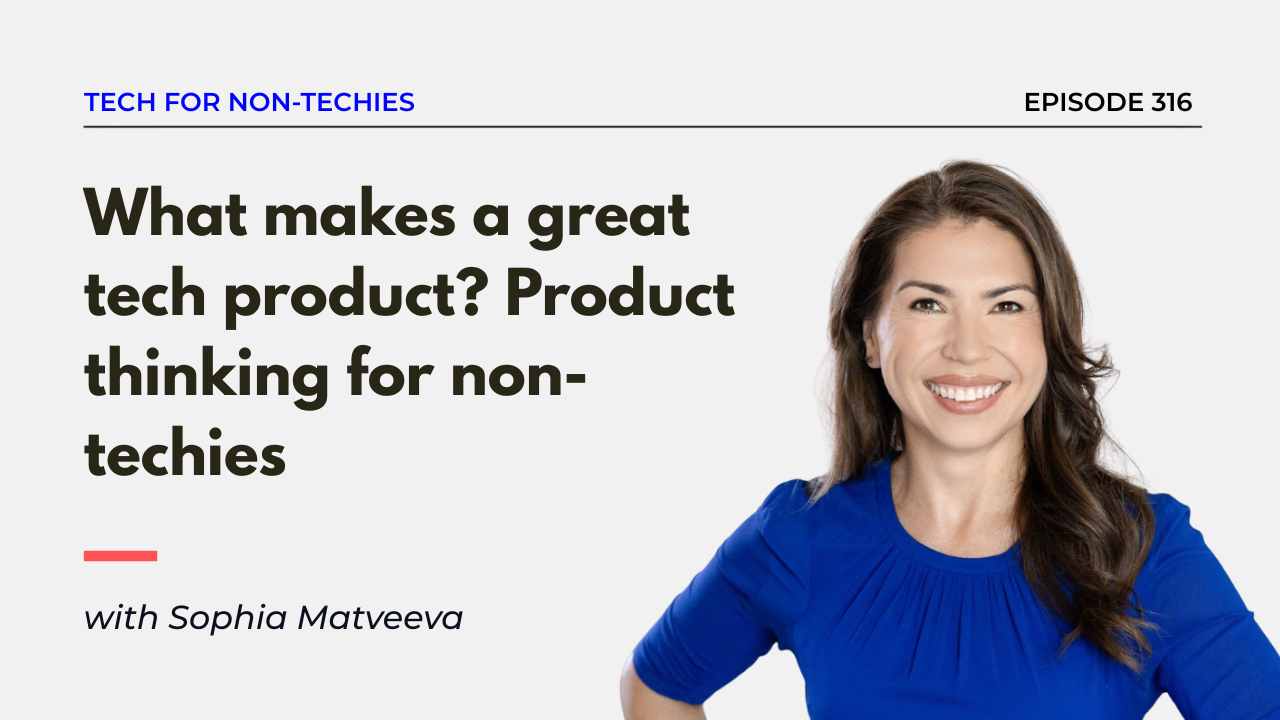
Did you wake up today thinking that you really want to use a cup?
No!
Because you are not insane.
You woke up thirsty, and then used a cup.
That distinction sounds obvious. But many founders and investors ignore it completely — and build or back the wrong thing as a result.
This episode is about what a product actually is, and why getting this right is the foundation of everything else.
In this episode:
- Why a product is not an app, a site or an algorithm — and what it actually is
- Why the person and the problem always come before the solution
- How companies that stay focused on the problem — not the product — outlast everyone else
- Why Steve Jobs said Apple the company was his greatest invention — not the iPhone or the iPod
- How to spot competition you didn't know you had by thinking about problems differently
This episode is for you if:
- You are building a product and want to make sure you're solving the right problem
- You are an investor evaluating tech companies and want a sharper framework
- You are a corporate leader trying to understand how great tech products get made
Two weeks left: Book your FREE 1:1 consulting session with Sophia
These sessions close on 31 August 2026 — and then they're gone.
Book yours before the deadline.
https://calendly.com/sophia-matveeva/sample-consulting-session-2026
Timestamps:
-
00:00 – The "cup" analogy: Why founders build the wrong thing
-
00:45 – Welcome to Tech for Non-techies
-
01:18 – Revisiting a foundational concept in product & investing
-
01:50 – Free 1-on-1 strategy consulting sessions (limited summer offer)
-
04:30 – What is a product? (hint: It’s not an app or algorithm)
-
05:15 – Problem first, solution second: The thirsty mindset
-
06:10 – Why non-technical founders excel in product thinking
-
06:48 – How companies solve the same problem with evolving products
-
07:50 – Case study: The evolution of Facebook’s product ecosystem
-
10:15 – Companies as products: Why Walmart bought Jet.com
-
11:45 – How to apply "Product Thinking" to your daily life
-
13:56 – How to book your free consultation before the august deadline
Follow and Review:
We’d love for you to follow us if you haven’t yet. Click that purple '+' in the top right corner of your Apple Podcasts app. We’d love it even more if you could drop an honest review on Apple Podcasts. Simply select “Ratings and Reviews” and “Write a Review” then a quick line with your favorite part of the episode. It only takes a second and it helps spread the word about the podcast.
Listen to our podcast on:
Transcript:
Sophia Matveeva (00:00) Did you wake up today thinking that you really want to use a cup? No, because you are not insane. You wake up thirsty, and then you use a cup. That distinction sounds obvious, but many founders and investors ignore this completely and build or back the wrong thing as a result. This episode is about what a product actually is and why getting this right is the foundation of everything else. Welcome to Tech for Non-techies.
This is a podcast for business leaders and non-technical founders building the future in the age of AI. Whether you've been in business for 100-plus years and you're looking to modernize, or whether you're building something new, this is the show for you. You'll learn how to come up with new ideas and make them come to life no matter the size of your organization.
I've taught tech and innovation at Oxford University, advised companies like Microsoft, and written for the Harvard Business Review. You're going to hear the frameworks and the thinking that I've built, tested, and taught at the highest level. And now it's your turn. Let's get started. Hello, smart people. How are you today? Is the sun shining where you are? Are you having a fabulous vacation? Are you drinking too much rosé? I hope the answer is yes to at least some of these questions.
Today we're going to revisit a foundational concept that I want everybody to know. In fact, I am so obsessed with this concept that I'm actually considering advertising this episode just so more people hear it, but I don't think that's going to be the most commercially sound decision. So let me see. Anyway, the concept you'll learn today is the foundation for building new products and investing in them. So whether you are an innovator or an investor, buckle up.
This episode originally came out in 2020 and it is actually one of my most popular episodes, and I want to make sure that you learn the concepts in it, even if you haven't scrolled all the way back in the catalog. But before we get into this important lesson, here's a quick reminder. This summer I've been offering free one-on-one consulting sessions with me, and through this, I've been able to meet many of you and it has been fabulous. It's been really interesting to get to know what you're working on, which part of the world you're in, and your ambitions, and to help you as much as I can.
These sessions have been genuinely free—they haven't just been a sales call dressed up as something else. In these sample consulting sessions, we spend the bulk of our time together on the problem that you actually want to solve. So book this session, because whether you want to figure out what to build, how to position yourself as an innovator in your field so opportunities come to you, how to get on the radar of the right investors, how to go to market, or how to bring a new product to market inside a large company—or whatever else is on your mind that's relevant to this show—book your session.
Because we are now in mid-August, which means that you literally have two weeks to book your session. I said that I was going to only do these for the summer, and I'm counting the end of August as the end of the summer. So you've got two weeks because after that, it's basically back to school and my diary is going to be filling up, so I just don't know when I'm going to be able to do these things again.
I want to make clear that at the end of the call, I will make you an offer to work with me if I genuinely think I can help you with what you're working on. But there is absolutely no pressure to buy anything. The point of this session is for you to get free consulting from the person whose podcast you listen to. Because you're here, my point of view interests you, and this is your chance to apply it to your unique circumstances. Therefore, if you have heard things on this show and you're wondering how to apply them to your goals, book your session now—the link is in the show notes.
And now let me get into today's lesson. Because once you understand this concept, you will never think about products, companies, or investments in the same way again. I realize that here on this podcast, we haven't actually defined what a product is, and that's a fundamental concept. It's a concept that we define in the Non-Technical Founders course. So let's define it here before we get into a model.
When you think of a product, what do you think of? Do you think of an app? Do you think of a site? Maybe you think of an algorithm? Given that you're listening to a podcast called Tech for Non-techies, that would all be reasonable—reasonable, but wrong. Such is life, my friends.
A product is a clearly identified solution to a people problem. At the end of every single product, there is a person experiencing a problem. There is a person who essentially wants to do something. For example, right now, I'm sitting at my desk and I'm a bit thirsty. I would like to take a sip of water. My thought process is focused on me and what I want. Yes, very selfish, but there we go. I'm thinking about what I want; I'm not focused on glasses, cups, or bottles. I am focused on the slowly drying feeling in my mouth, which I would like to get rid of.
So you see how, by definition, the solution is always secondary to the problem. Nobody wakes up thinking, "Today I really want to use a cup. What can I do today that requires me to use a cup?" If that person does exist, they are in the crazy minority. Building a successful business on the needs of a tiny minority is very hard unless they're all startlingly rich. If you know these really rich, crazy people, tell me where they are, because they must have crazy parties and I would like to go.
When you're thinking about building tech products, keep coming back to the person and the problem that they're experiencing. It's so easy to lose yourself in ideas for new features or learning new tech skills. But if you lose sight of the person, all those tech skills and all those features are going to be totally useless. This is why I actually think this is a really good area for non-technical founders or non-technical professionals to shine in the tech world.
You won't necessarily know what coding language to use, but if you know the users—you know who they are, what they want, and what problems they have—you are going to be in charge of a much more important skillset. You're going to have a much more holistic and important understanding of something that really matters.
Another thing I want to point out is that a company can keep solving the same problem for the same person with different products. Just because you have a company and they have a product doesn't mean that product is the be-all and end-all. That company can carry on specializing in solving that problem. Essentially, that company's specialty is the solution to that problem rather than the specific product. Those companies tend to have more longevity.
The people in a company who understand what problem they're solving, who they're solving it for, and how to keep coming back to that problem can keep creating new products or new versions of the same product to continue solving it. A company like that focuses on the user and their problem, not on the brilliance of their product. The brilliance of their products is secondary to solving that problem.
Let's look at Facebook. Facebook began as a website. Some of you may remember that in the olden days you had to connect a digital camera to upload photos. What does this say about humanity? I remember taking photos at parties, hooking my digital camera up to the computer, uploading them onto my computer, and then uploading them onto Facebook—and these were unfiltered anyway! That must have taken ages; we can't even imagine doing that now.
That's how Facebook began. Look at Facebook today—and I'm not even talking about all the acquisitions Facebook made, like WhatsApp, Oculus, or Instagram. I'm literally talking about Facebook itself. Right now, Facebook is a site, a mobile app, and Messenger. The aim of Facebook was originally to connect people. The products that Facebook has are solving the same problem. I was on Facebook when it originally started, and I'm on Facebook now, using it in a similar way. The aim is the same, and some of the people with that problem are the same.
By the way, I am not singing Facebook's praises. The company has many, many problems. I am probably going to do an episode on that because I've recently come up against some really startling things that I want to share with you so you understand what kind of beast Facebook is. In the Non-Technical Founders course, one of the things we do is break down the main components of the Facebook newsfeed algorithm to understand why you get served the content you do.
Facebook is a very powerful company that has not used much of its power responsibly. But the reason I often talk about Facebook as an example is because it has so many products that so many of us are familiar with. If you want to understand a particular product, Facebook serves as an accessible example. In this case, I'm using Facebook to show you how a solution to the same problem evolves so you can understand what products are.
What are products? A product is a solution to a people problem. By the way, a company can also be a product. Steve Jobs said that Apple—the company—was actually his greatest invention, not the individual inventions that came out of Apple. Considering they made the iPhone, the iPod, the App Store, and the Mac, that's saying a lot.
It's important—especially for investors—to remember that companies are also products, because companies buy companies. Why do they do that? They do that because a company has a problem to solve. For example, Walmart realized that it had an e-commerce problem—it didn't really do e-commerce, whereas Amazon did. Walmart couldn't buy Amazon, and Walmart couldn't build a competitor to Amazon quickly. So what did it do? It bought one. That's why Walmart paid $3.3 billion to acquire Jet.com in 2016. (That little noise was just me wishing I had $3.3 billion!)
Let's go back to the fundamentals. When you are thinking of products, keep coming back to the person and their problem. That person could be an end-user for whom you are solving a direct problem (e.g., "I am thirsty, my mouth is dry, and I solve that problem with a glass"). The solution could also be a tech solution: most of my friends are in other parts of Europe, the UK, and the US, so I connect to them via Facebook.
A company is also a solution to a people problem. People working in marketing or sales understand that their company—and therefore their jobs, profit margins, and ability to earn—is not going to thrive unless they find a solution. So they look for a company to invest in or buy.
Remember not to focus solely on the product. If you're an investor, don't just think about synergies. If you're making a tech product, don't just think about features. That's just noise around the main point. This week, when you interact with apps and things in your home, think about the problem they're solving for you. Run that thought experiment and see where that inquiry leads. You might end up seeing competition in ways you hadn't before. Uber's competitors aren't just other taxi apps; they potentially include options like food delivery or Netflix.
When you interact with things in your home, on your phone, or on your computer, think about what problem that thing is solving for you and see what happens. This is the concept that everything else builds on: the person and the problem always come first. The product is just the solution, and the product changes as the solution changes.
If today's episode made you think differently about what you are building or investing in, and you want to figure out what that means for your specific goals and situation, that's exactly what we can use the sample consulting session for. Book it! Come with your idea, your product, your career goal, or your investment question, and we will work on it. We'll spend the bulk of an hour figuring out what the real problem is, who the decision-makers are, who experiences the problem most acutely, and what you can do about it.
This is product thinking in practice, and it is the 21st-century career success skillset. You've got two weeks left to book your session. If you are listening to this after August 31st, 2026, these sessions are likely no longer happening. Try the link to be opportunistic—maybe we haven't switched it off—but it's frankly very unlikely. You've got two weeks left to book your session, so go ahead now; the link is in the show notes.
On that note, have a wonderful day, and I shall be back in your delightful, smart ears next week. Ciao!
Sign up to our mailing list!
Be the first to hear about offers, classes and events