315. What non-technical founders need to know before building with AI
Aug 05, 2026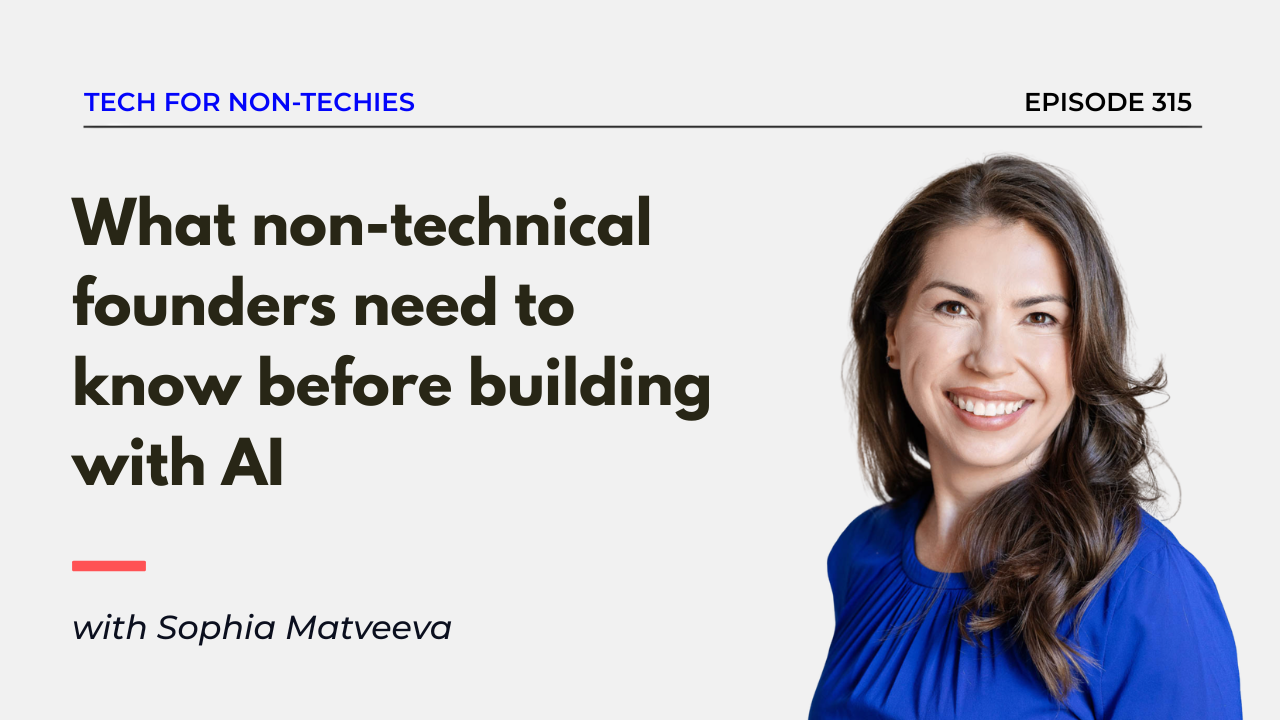
The number of non-technical founders running billion-dollar companies increased four times between 2013 and 2023. Not because the technology got easier — though it did.
But because investors finally figured out that the person who can sell, build relationships and spot a market opportunity is often more valuable than the person who can write the code.
This episode was originally recorded for Tech Talks Daily with Neil Hughes.
Sophia joined Neil to talk about why this shift happened, what it means for founders and business leaders today, and exactly where to start if you have an idea and no technical background.
Listen to learn:
- Why the number of non-technical founders running unicorns quadrupled in a decade — and what investors are actually looking for now
- Where AI genuinely helps non-technical founders build faster — and where it will quietly destroy your product if you let it
- The iceberg problem: why what you can't see in your product is the thing most likely to sink it
- How to work with developers when you have no idea what they're doing — including the mistakes Sophia made with her first team
- How to build technology fluency as a business leader without becoming a developer or faking it
This episode is for you if:
- You have a business idea and keep telling yourself you can't build it because you're not technical
- You are working with a technical team and feel out of your depth
- You want to understand where AI genuinely helps — and where to be sceptical
Book a free consulting session with Sophia: https://calendly.com/sophia-matveeva/sample-consulting-session-2026
Timestamps:
- 00:00 – Why non-technical founders are winning big
- 02:09 – Introducing Sophia Matveeva
- 04:10 – Sophia's year in Bahrain and beyond
- 10:13 – Why now is the best time to be a non-technical founder
- 15:19 – Using AI to test your idea before building
- 20:41 – What investors really want from founders
- 24:49 – Common mistakes with technical teams
- 31:30 – Building tech fluency without learning to code
- 36:48 – Your first actionable step this week
Free AI Mini-Workshop for Non-Technical Founders:
Learn how to go from idea to a tested product using AI — in under 30 minutes.
Get free access here: https://www.techfornontechies.co/aiclass
Follow and Review:
We’d love for you to follow us if you haven’t yet. Click that purple '+' in the top right corner of your Apple Podcasts app. We’d love it even more if you could drop a review or 5-star rating over on Apple Podcasts. Simply select “Ratings and Reviews” and “Write a Review” then a quick line with your favorite part of the episode. It only takes a second and it helps spread the word about the podcast.
Listen to our podcast on:
Transcript:
Tech for Non-Techies
Host: Sophia Matveeva
Guest interview from: Tech Talks Daily, hosted by Neil Hughes
[00:00] Sophia Matveeva: The number of non-technical founders running billion-dollar companies increased four times between 2013 and 2023, and has grown even more since then. And that's not because the technology got easier, although it did. It's because investors finally figured out that the person who can sell, build relationships, and spot a market opportunity is often more valuable than the person who can write the code. This episode is about why that shift happened, what it means for you, and exactly where to start if you have an idea and no technical background.
Welcome to Tech for Non-Techies. This is a podcast for business leaders and non-technical founders building the future in the age of AI. Whether you've been in business for a hundred-plus years and you're looking to modernize, or whether you're building something new, this is the show for you. You'll learn how to come up with new ideas and make them come to life, no matter the size of your organization. I've taught tech and innovation at Oxford University, advise companies like Microsoft, and written for the Harvard Business Review. You're going to hear the frameworks and the thinking that I've built, tested, and taught at the highest level. And now it's your turn. Let's get started.
Hello, smart people. How are you today? In this episode, we're doing something different — you're going to hear me being interviewed about how to build a tech venture as a non-technical founder. This episode is from the excellent Tech Talks Daily show by Neil Hughes. Whether you're a newbie or a longtime listener, I really recommend you listen to this episode fully — if you're new, you're going to hear new, useful concepts that you can apply today to building your tech venture. And if you've been working on your tech venture for a while, or listening to this show for a while, this episode is going to be super useful so you can sense-check your progress and see whether there are any steps you've skipped. So, enjoy!
[02:09] Neil Hughes: Do you really need to know how to code to build a successful technology business? This is a question that stops countless entrepreneurs before they've even begun. But today's guest not only believes — and is also going to show you why — the opposite has never been more true. Her name's Sophia Matveeva, and she's going to join me again to explain why this is one of the best times in history to be a non-technical founder. We'll explore together how AI can dramatically accelerate your journey, and understand why understanding technology matters far more than just writing code.
This is one of my favorite episodes of the year, because there are so many actionable takeaways. So if you're sat there with an idea in your head, but you don't consider yourself technical enough to bring that idea to life, we're going to walk you through a very real solution today. And I hope there'll be a few lightbulb moments — and maybe, just maybe, one of you out there listening, anywhere in the world, is going to bring an idea to life. And if that happens, please report back, I want to hear from you. But right now, we're at the beginning of your journey, so let me introduce you to Sophia right now.
So, a massive warm welcome back to the show. For anyone who missed our previous conversation, can you tell them a little about who you are and what you do?
[03:35] Sophia Matveeva: Hello, everybody, I'm Sophia Matveeva, and I run a company called Tech for Non-Techies. So if you are a non-technical professional — you're not a developer, you're not a computer scientist, you're not a programmer, and you don't want to be one — then Tech for Non-Techies is for you. We essentially help people who don't have backgrounds in programming and coding succeed in the digital age and the age of AI. So if you want to build a tech venture, or if you want to launch an AI initiative at a corporate, then the Tech for Non-Techies show is the thing for you to listen to, and also come to us for our consulting and education programs.
[04:10] Neil Hughes: It's such important work you're doing here, and I'm looking forward to finding out more about what you're doing now. But before we do — it's almost five years to the day since we last spoke. So what have you been up to? What's been keeping you busy since then?
[04:25] Sophia Matveeva: Well, as I was just saying off air, one of my favorite things is that last year I spent a large portion of the year in Bahrain, which is near Dubai — in the Persian Gulf. Bahrain is a beautiful little island, which actually is where Cartier gets most of its pearls to this day. So, a beautiful little island with gorgeous pearls.
The government of Bahrain reached out to me because they'd heard about the programs I'd been running for non-technical founders, and they said, "Can you come and do this here?" So I ended up creating an accelerator for them that about a hundred people went through — people who have ideas for tech ventures but aren't technical founders. So you have an idea for an app, but you don't know how to build it, you don't know where to use AI, where you have to work with developers, you don't even know what developers do. You kind of heard that Python and C maybe are a thing, but you have no idea what it is — but you see a gap in the market. That's essentially the problem we've been solving for ages. And it was just such a wonderful experience — to be plucked out... I was there in November, when in London the weather is pretty horrific, and I was swimming in the Turquoise Sea and it was 27 degrees.
And I was there because of my work for non-technical founders, which is now really being recognized in Europe — obviously in the UK, in Europe, in the Gulf, and in the US. So we're still really focused on non-technical founders. But what we've really noticed is that, with the Tech for Non-Techies podcast, there were a lot of people who started listening who are not founders. I was getting contacts from them — I know one of the listeners to the show is a lawyer in a massive law firm. They get paid, you know, a grand an hour, the partners do anyway. And I was quite curious, I said, "Well, what are you doing?" And he said, "Well, we work with tech clients, but we're lawyers — we need to understand how tech clients think and how they operate, so we listen to your show."
Apparently a lot of his people listen to the show too. So I said, "Well, sounds like what you need is training from us on how tech companies operate." So me and my colleague — my colleague Rajat Zodali, he actually launched Instagram filters to six hundred million people, so if you've used filters to make yourself look hot on Instagram, that was my colleague — him and I created this training for a law firm, White & Case, one of the major law firms that has Meta as one of their clients, on how tech companies and venture capitalists think.
And this made me realize more and more that the knowledge of how tech products are made, what happens on a tech team, what developers do, what all these terms mean, and how a product like an app or a platform comes to life and becomes a successful business — this is useful not only to people who are going to create these companies, but also to people who work with these companies, like lawyers, accountants, bankers. Because if you don't understand what your client is talking about, your clients are going to go to somebody who does.
I've also noticed a lot of people in corporates are listening to us, because every corporate is going through AI transformation right now, and I think we're in an era where AI hype is now a bit of a disappointment. The CFO is saying, "Okay, we signed this contract with OpenAI, or whoever — give me the cost savings. We seem to just be doing token-maxing — for what reason? Where's the ROI?" And I think non-technical professionals, especially people looking at the budget, are really asking this question. My aim is to help them ask questions confidently. Because some Silicon Valley guy comes and gives a talk about how his thing is going to change the world, and we all get very excited even though we don't really understand what he's saying — it's all very big, very hopeful, very exciting. And I think if you want to be a successful business person, you also need to be discerning — yes, take the excitement, but then also ask: what is it, how is it going to work, how much is it going to cost, when are we going to see the results, how can we make it work for us?
For example, I saw that Airbnb started working with OpenAI, but then noticed their AI costs were astronomical, so they switched to Alibaba's model — basically a Chinese model. And I thought this was really interesting, because yes, it was a technical decision, but I'm absolutely sure the CFO was involved. I'm absolutely sure the CFO said, "I don't care if we're an American company, I don't care about the tension between America and China, I care about our shareholders — and we can't go to our shareholders with these costs when there's literally a free Chinese model we could use." I think the more people understand how to fight back against AI hype and be discerning, the better decisions they'll make.
[10:13] Neil Hughes: Yeah, completely agree with you. And if we go back again — it feels like you were somewhat ahead of your time helping non-technical founders, five years ago when we spoke. We were then at the back end of a global pandemic, blissfully unaware about OpenAI, ChatGPT, and all things AI that was about to consume every aspect of our life. Fast-forward to present day, AI has now dramatically lowered the barriers to building software. But you've said this is the best time to be a non-technical founder for reasons that go way beyond just AI coding tools. So tell me more about that — why do you think that, and why are you so excited about now? It feels incredible, so many opportunities, but you were well ahead of the curve here, weren't you?
[11:04] Sophia Matveeva: Well, it's great, because now I get to say I'm a visionary and I have the proof — which frankly I really didn't expect. Even before the ChatGPT, generative-AI stuff happened, I saw a change in how investors were treating non-technical founders, and I actually have the data to prove it. There's a venture capital firm called Cowboy Ventures in Silicon Valley, and the founder of that VC firm coined the term "unicorn" — a company valued at over a billion dollars. They looked at how many unicorns there were in 2013, who was running them, and what they were. There were unicorns like Uber and Pinterest — the big consumer apps — and they were mostly run by technical founders. Basically the tech-bro era, the Travis Kalanick era.
Then they did the same research at the end of 2023, and saw there were ten times more unicorns. They also saw the number of non-technical founders or co-founders of unicorns had jumped from about 10% to 40%. A huge increase. That means investors are giving non-technical founders billions of dollars to build tech companies. I started looking at what these tech companies actually are, and a lot of the non-technical-founder-founded companies are actually enterprise sales — not consumer apps, but companies that sell to other businesses.
And I was thinking, well, what does it take to sell to another business? You can't be a tech bro with no social skills, because selling to businesses is all about relationships. It's about having a good relationship with, say, the CIO. It's about really understanding that business's problem, understanding their vision, knowing how to build relationships — not just with one person, but with a whole bunch of people, if it's an enterprise sale — and also keep delivering the product. This is what business founders are really, really good at. If you're working in sales, in law, in HR, whatever you're doing, you fundamentally have to have good relationships with your colleagues. If you're a developer — especially a back-end developer — you can basically sit by yourself, write code, and not really interact with other people. Maybe a couple of other developers, but you can be quite cut off. If you're a business person, you can't be.
This exact skill set is what's allowing non-technical founders to see opportunity and pursue it. And this was before generative AI tools. Now, with generative AI, they can actually build a lot of that idea themselves. I'm not one of these people who thinks you can build the entire thing yourself — I don't believe that's true — but you can get much, much further than you were able to before.
[15:19] Neil Hughes: So we're recording this in July 2026, and the barriers have officially been lowered. So for someone listening anywhere in the world who has a great business idea but no technical background, and they've been getting in their own way, saying "I can't bring this to life" — which isn't true — where should they be using AI to accelerate their journey and bring their idea to life? And where should they resist the temptation to over-rely on it, because that's equally bad? What should they be doing, for that person listening today?
[15:19] Sophia Matveeva: I'll quickly summarize, but we have lots of really extensive lessons on this on the Tech for Non-Techies podcast, so definitely have a listen. Generally, if you have an idea, the first thing you need to do is test it. Even if you think, "Yes, I know it's going to be amazing," you still need to test it to understand exactly where you need to start — because ideas are usually very big, and you need to start with a small step.
So first, you create a test product using AI. The whole point of a test product is that you create something very simple, just to test the basic concept, using something like Lovable. Lovable is a tool we like using, but there's Replit, there are lots of other similar tools. You can literally write into the chatbot what it is you want to build. I'd recommend learning a bit more about how to do it first — don't just jump in, listen to our show first to really understand how. But essentially, you can create a product on Lovable within a morning, within a couple of hours, you can create something decent.
Then you test it amongst your target market. When your target market says, "This is great, I love it, I would use it and pay for it," or you find businesses who would pay for it — once you have some idea of usage and who'll pay for it, you need to work with developers. This is what a lot of non-technical founders are missing, because things like Lovable — if you're not technical, you can create something that looks and feels real, and it's really exciting. If you've never done anything before, it looks like it stores data, it looks like it does everything. The problem is, if you're not technical, what you're seeing is the top of the iceberg. The bottom of the iceberg — that's the dangerous bit, that's what sunk the Titanic. That's literally going to happen to your product.
There was a study of five thousand apps built with no-code tools like Lovable, and each one had major security issues, because that bottom of the iceberg usually wasn't looked at by developers. That means your customer puts in their data — maybe their credit card, their address, information about their children — and often that ends up online, on the internet. Non-technical founders don't know how to fix this, because if you don't know what the problem is, you don't know how to fix it — you're completely blind. That's why I sternly recommend: if you've done the testing and it's gone well, and you want to create something you're going to charge for, a real company, you need developers looking at it.
But the good thing about the age of AI is that developers can get something ready for production much earlier than before, because the developer themselves can use AI — they can use Claude Code to write or check code. But the reason I don't recommend non-technical founders use Claude Code themselves is that you don't know what good code looks like. It's like editing — I use AI to edit some of the content and emails I write, but I know what I want to say, I know what good podcast copy looks like. It can give me something 80% finished, and I do the rest. If you can't do that with code, you shouldn't be using Claude Code.
So in the age of AI, you still need developers, but at a later stage than before — and they can create a product much more quickly and for much less money. Instead of a full-time developer working only on your thing, you could have a part-time developer who still creates something for you, while also working for other companies. Good for the developer, because they're making more money, and good for you, because you're paying less.
[20:10] Neil Hughes: Wow, so much gold in your advice there — I can almost sense developers around the world standing up applauding, saying "at last somebody gets it." Kudos there, I completely agree. And even better news, as you said, investors are becoming more and more willing to back non-technical founders — win-win for everybody right now. But what's driving that shift, and what qualities are investors looking for today, so that person with the idea can start appearing on their radars too?
[20:41] Sophia Matveeva: Investors, in theory, should want a return on their investment. I say "in theory" because we've recently had the SpaceX IPO, and I think a lot of the claims they're making are at best questionable — yet people are still piling in and buying shares, because Elon. Unless you're Elon Musk, and normal rules don't apply to you, investors are going to say, "If I invest a hundred dollars in your thing, when am I going to get a thousand dollars back?" Investors in early-stage companies are essentially looking for a ten-times return. So you need to not only create a great product — which now isn't that difficult — you need a credible path, not just to monetization, but to profitability.
It doesn't mean you need to be profitable straight away — companies list on the stock exchange without being profitable, you can put off profitability for a decade and that's fine — but it needs to be visible, there needs to be some sort of plan for what that looks like. The era of "let's just build this and people will come, we'll figure it out" frankly applies to the big AI companies — OpenAI is kind of doing that, Anthropic is kind of doing that. But unless you're one of these very few companies, you need a clearer path to money.
This is where non-technical founders really shine. If you're not technical, what else are you doing? You're not building the product — what's your contribution? The contribution of a non-technical person is fundamentally money. The tech people, the developers, build the products; the non-technical person brings in the money — from investors, from customers. This is where relationships, marketing, and having your own personal brand really matter.
In some of our programs, we have a personal-branding program for people who want to be seen as tech leaders. I'm thinking of one non-technical founder — a fund manager with a successful fund management business in South Africa. He wanted to launch an app for his fund management business — he already had people trading with him, and wanted to create a trading app. He took a non-technical founders course, created the app, people were using it, things looked good. Then he thought, "Okay, now I want to scale it across Africa" — because Nutmeg, Wealthfront, they're not tailored for the African market. To scale, he needed more money.
So one of the best things you can do to raise funding is actually get on investors' radars — but not just saying "hey, I exist," because that's boring. You need a message. Especially if you're not technical, you need to answer: "If you're not technical, you're essentially a riskier investment — so what are you doing to make sure I get my money back? What are you doing to make sure this is going to be a success? Since you can't build the product, what are you doing about the commerce?" My advice to non-technical founders: focus on the money, and show investors you're focused on the money. Because, again, unless you're Elon Musk, that's what investors are looking for.
[24:49] Neil Hughes: Again, fantastic advice. For that person listening who's gone from idea, to building a prototype, to testing, to working with developers — one thing I caught on your podcast is managing developers as a non-technical founder, another huge topic, so I urge people to go check that out. But what are some of the biggest mistakes you see leaders making when they first start working with technical teams — maybe feeling a bit out of their depth and trying to compensate? Any mistakes you see them making when working with technical teams?
[25:23] Sophia Matveeva: I can tell you about my mistakes, because I feel very comfortable talking about them, even though they were really embarrassing. When I ran my first tech company straight out of business school, I'd previously worked in private equity, so I knew how to raise money — I went to a very prestigious US business school, so I had the contacts and gravitas to do that. I raised money, hired developers, then realized I had no idea what these people were talking about or what I was supposed to do with them. But I thought, well, I'm the boss, so I need to go and give them direction. I had no idea what they do — how am I going to do that?
So I took an online course from Stanford, Computer Science 101, where I literally spent three hours coding a little blue square into a little black square. Needless to say, this did not turn me into a great developer. And because I was feeling very insecure, I didn't really know what I was doing at all — I'd attempt to get involved with the developers, attempt to micromanage, but I didn't know what they were doing. So I'd just be like, "Well, why isn't this thing working? Why aren't you doing this? What is this, what is that?" — basically coming in and annoying everybody by asking questions they'd take ages to answer, and I still didn't understand the answers. It was a complete disaster. I'm actually surprised nobody left, because I probably would have.
This is actually very typical behavior, because you're paying a lot for these people, you can't see what they're doing — especially in the early stages, when they're building that bottom of the iceberg, you can't see it. If they're working on security protocols for your app, that's something you can't see, but if they don't get it right, you could literally be sued for losing your customers' data. It's this invisible, expensive, difficult thing you can't see.
My advice: first, don't go in and interrupt developers every single day. In the business world, our day is more varied — I could be talking to you, then have an hour of deep work on strategy, then a client call. With developers, they essentially do deep work most of the time. So I always recommend starting with a Monday morning meeting, where you discuss what they're going to build. You don't direct — you tell them these are the features our customers have wanted, these are the features they say are most important, and this is why we think these are the features we need built. Ask them: what do you think, how long would this take, are there features that are low-hanging fruit — maybe something people really want that's easy to monetize and simple to build, versus something that's wanted but will take six months to build. Have that trade-off conversation.
Also ask them what's going on with the product — is there stuff they need to clean up, do they need time for that? There's something called technical debt — imagine when you're cooking, you always make a mess, even making toast there'll be crumbs. Imagine if you never cleaned your kitchen — imagine you're a teenage boy who's never cleaned his kitchen, it's going to get pretty nasty, your mom comes round and says, "What the hell?" That's what technical debt is — the mess left over when people are writing code. Just like you need to clean your kitchen after cooking, developers need time to clean up technical debt. You don't need to understand exactly what it is, just ask them: do you need buffer time to clean up after releasing a bunch of features quickly?
Have that conversation with them. Either they say the kitchen's clean, give us your hardest tasks — or if they say something will take a month, working on it full-time because they need to make changes to the back end, ask: are you happy only working on this for a month, meaning you can't take any other requests? When you have that conversation, you come to a decision together about what you're going to do. Agree on what's going to be delivered over the next two weeks, and then — this is really difficult — leave them alone. Ask on Friday, "Are you on track, do you need anything from me?" They'll probably say no. Don't be the kid in the back of the car going "are we there yet, are we there yet" — that's so annoying. If you keep constantly asking "are you on track, is everything okay," you're actually going to disturb them, and then it'll be your fault that they're not on track.
[31:30] Neil Hughes: Absolutely love it. One final thing I'd love to bring up — technology fluency has become an increasingly valuable leadership skill. What practical steps could a business leader take to become more confident discussing technology, without trying to fake it or become a software engineer themselves — just appear more confident in these conversations? Any tips?
[31:58] Sophia Matveeva: We cover this on the show a lot too, because what I say is: if you try to become technical and it's really not your talent, you're going to hate it. I think I'm much more of a right-brained person than a left-brained person — when I forced myself to take coding courses, I really didn't enjoy it, it wasn't a good use of my time.
A good way to achieve tech leadership is, when you're working on something, get involved with an actual initiative if you can. It doesn't mean you need to lead it — can you sit in on some meetings, offer some insight, bring customer insight about how customers are using an app or platform your company has created, get feedback and bring it to the product team? Because that means you're bringing something useful — and if they see you as useful, they'll let you sit at the table. It's a bit like learning a language in a classroom versus going to the country to practice it — get involved in an initiative, even in a light, passive way.
Another thing: make friends with a tech person. Is there a tech person you could take to lunch? Be friendly with a developer, ask them what they're working on and why. You could even be honest about it — say, "I really want to understand more about what you guys are doing, and if you want, I can tell you about what we're doing." Developers rarely get asked by business people about what they're doing — most people just try to run away when a developer starts talking about their work, thinking "please stop." So if you actively reach out with curiosity and interest, they'll be flattered.
Not every developer, but some developers want to become CTOs — those who just want to be individual contributors, who love writing code, are probably going to be less helpful to you as friends in this sense. But developers who want to get into top management actually want to understand the business side, because a CTO works with the CEO, the CFO, HR, the CMO — all these people on the business side. So it's in their interest to understand what they do, and in your interest to help them see what you do, so they can get more budget. The CTO who knows how to explain what they're doing and why it matters is the one who gets more budget allocated for the best tools and best people.
So if there's an ambitious developer, when you invite them to lunch you could say, "I want to know about what you're doing, and if you want, I can tell you about what we're doing on the business side, because it might help you understand the context of what you're building." You end up with a mutually beneficial relationship where you're both teaching each other — maybe you get to the point where they're SVP of Technology, you're SVP of Marketing, this beautiful symbiosis, and you reach the C-suite together. You don't need to make them your best friend and see them every day, but a monthly check-in — you might make a friend, but it's also a really useful and easy thing to do. And obviously, if you want to go deeper, take one of our programs, because this is literally what we teach — or bring us into your company and we'll create a custom program for you.
[36:16] Neil Hughes: You almost answered my question there. But for that person listening who's convinced themselves they can't bring their tech business idea to life because they don't think they're technical enough — I think today we've shattered that myth, we've removed every excuse. So let's give them an actionable takeaway. What's the first step you'd encourage them to take this week, having listened to this podcast, to move an idea closer to reality — and where can they find you and continue this journey?
[36:48] Sophia Matveeva: There's a perfect free class on our website — just go to techfornontechies.co, and you'll see it pop up, or it's just called "Free AI Class," you'll see it there. It's 27 minutes long, so you're not signing up for something long. It's going to teach you how to create your test product on an app like Lovable. My recommendation: don't go straight to Lovable, don't go straight to Replit — take this class first. It's a bit like when you learned how to write good prompts for ChatGPT or Gemini, you started getting better answers — it's the same with these no-code tools. If you know how to prompt them properly, you'll create a better product. It's a free class, 27 minutes long, you have no excuse not to do it. Do that, then go to one of these tools — you can even use a free tier, or splash out twenty dollars for the subscription, and create your product. You can go from nothing to having watched the class and having a live product to test, literally in two hours. If you have an idea, I've told you how to start working on it for free, in less than one morning, less than one afternoon.
[38:14] Neil Hughes: There we go — no excuse for every single person listening. That knowledge gap between the business and tech economy is ultimately costing people clients, capital, and competitive advantage, and I love how you're helping close that. There's a big call to action for everybody listening — whether you're a business leader, a tech venture, or an organization that needs to think and operate differently in the AI economy, build the fluency, the innovation, the capability, and strategic confidence — you're the person to go to. I'll include links to everything you mentioned, and if you walk away with one takeaway, go take that 27-minute class and report back, let me know your thoughts. As always, big thank you for coming on and helping everybody listening — really appreciate your time.
[39:03] Sophia Matveeva: Thank you very much, Neil. It's been a pleasure — let's not leave it for five years next time.
[39:08] Neil Hughes: For me, today's conversation was an inspiring reminder that great technology businesses aren't built just by coders alone — they're built by people who understand customers, who recognize opportunities and dare to ask better questions, and then bring together the right mix of skills. Sophia has shown today that AI hasn't removed the need for technical expertise — instead, it's changed the when and where that expertise creates the most value.
I'd love to hear your thoughts — if you've been holding back on a business idea because you don't come from a technical background, today's conversation hopefully has changed the way you think about what's possible. And I'd absolutely love it if this episode inspires you to go and bring that idea to life — if you do that, please let me know, I'll get you on this podcast when you're ready and we'll share that story.
You can find me at techtalksnetwork.com, connect with me on LinkedIn, or on socials at @NeilCHughes. Let's see what we can all create together. That's it for today — so off you go, go bring that idea to life, and I'll be back in your podcast feed tomorrow with another guest. Thanks for listening. Bye for now.
Sign up to our mailing list!
Be the first to hear about offers, classes and events