314. 4 ways non-technical founders get stuck
Jul 29, 2026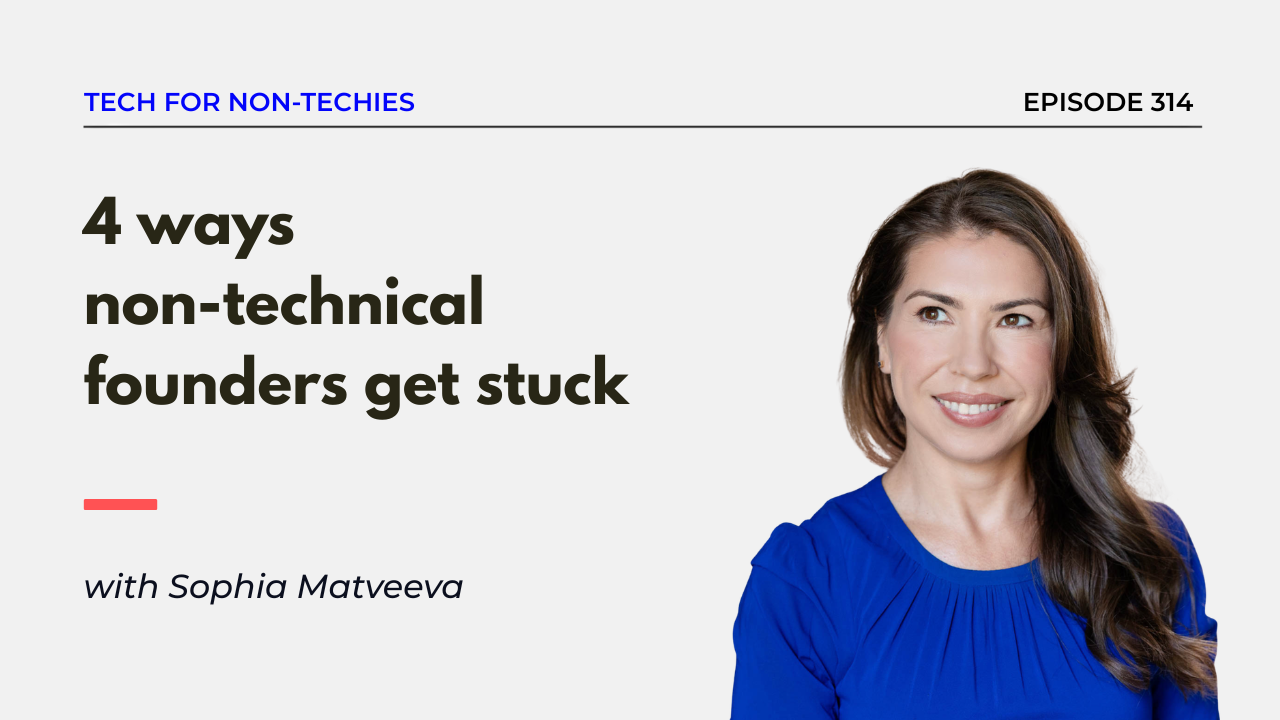
Many non-technical founders don't lose money in one big mistake — they lose it in four small stuck points that all feel completely reasonable at the time.
In this episode, Sophia walks through the four questions that reveal exactly where you're getting stuck, why it's a knowledge gap and not a personal failing, and what to actually do about each one.
Plus: Tech for Non-Technical Founders — Sophia's flagship course — is on a flash sale until Thursday night at midnight. Full details inside the episode.
In this episode:
- Why briefing a developer is a skill nobody ever taught you — and how to spot the gap in your own brief
- Why "AI vs. hire a team vs. find a co-founder" is the wrong question entirely
- How to tell if you're leading your own product development, or just funding it
- The six stages every product goes through — and why most founders can only name two
Plus: Tech for Non-Technical Founders — Sophia's flagship self-study course — is on a flash sale until Thursday night at midnight!
You'll get a pre-recorded version of the framework behind our $4,000 1:1 coaching program — plus a 1:1 strategy session with Sophia, for $497.
Taught at Oxford University, Techstars, and London Business School — this is your chance to get the same thinking, without the four-figure price tag.
Enroll here before midnight on Thursday 30 July ET: https://www.techfornontechies.co/flash-sale-tech-for-non-technical-founders
Timestamps:
- 00:00 – 4 signs you're losing money as a founder
- 02:19 – Flash sale: Tech for Non-Technical Founders course
- 04:34 – Diagnostic #1: The developer briefing problem
- 06:58 – Diagnostic #2: AI vs. team vs. co-founder
- 09:12 – Diagnostic #3: Losing control in technical meetings
- 11:30 – Diagnostic #4: The 6 stages from idea to scale
- 13:48 – Why these gaps aren't your fault
- 16:10 – Recap: the 4 diagnostic questions
- 18:28 – Student success story and course details
Follow and Review:
We’d love for you to follow us if you haven’t yet. Click that purple '+' in the top right corner of your Apple Podcasts app. We’d love it even more if you could drop a review or 5-star rating over on Apple Podcasts. Simply select “Ratings and Reviews” and “Write a Review” then a quick line with your favorite part of the episode. It only takes a second and it helps spread the word about the podcast.
Listen to our podcast on:
Transcript:
[00:00] I'm going to ask you four questions today. If you say yes to two or more, you are currently losing money as a non-technical founder, and you don't know it yet.
Welcome to Tech for Non-Techies. This is a podcast for business leaders and non-technical founders building the future in the age of AI. Whether you've been in business for a hundred-plus years and you're looking to modernize, or whether you're building something new, this is the show for you. You'll learn how to come up with new ideas and make them come to life, no matter the size of your organization. I've taught tech and innovation at Oxford University, advise companies like Microsoft, and written for the Harvard Business Review. You're going to hear the frameworks and the thinking that I've built, tested, and taught at the highest level. And now it's your turn. Let's get started.
Hello, smart people. How are you today? My gardening adventures, which I have surprised myself with, are continuing. But as I mentioned, I have no idea what I'm doing. I nearly broke the garden fence yesterday in my enthusiasm — I decided to saw off a tree with my bare hands, and it started falling in the wrong direction. I did save the day, the fence is safe, the tree has been felled, and now I'm very proud of myself. I've discovered a new career as a lumberjack.
But before that — let's talk about you and your problems as a non-technical founder, and how you can solve them. So today I've got four diagnostic questions that are going to help you, as a non-technical founder, figure out where you're losing money or where you're getting stuck. This is obviously very relevant if you're working on your tech venture. It's also very relevant if you're a corporate innovator. This episode is going to help you identify the root causes of why product development is going off track — because when it goes off track, it's very stressful and very expensive. It's also going to help you de-risk scope creep, which is another expensive and very common issue. And it's going to help you clarify your tech strategy, so you stop chasing shiny tools and thinking, "Should I do AI? Should I do no-code tools? Should I work with developers?" — so you can focus on your biggest problems and solve them.
But before we get into it, I have a lovely surprise for you.
[02:19] Longtime listeners would know about my flagship course, called Tech for Non-Technical Founders, and this episode is actually based on some of the material you get taught in this course. This flagship course is on flash sale until Thursday night at midnight Eastern. This is the flagship course I have taught at Oxford University, at Tech Styles at London Business School, and at many more, including Ivy Leagues and top global institutions. Over seven hundred people have now gone through it, and my alumni have built apps and platforms — you've heard some of these alumni on this podcast. My alumni have raised funding, they've completely changed their careers, and not all of them have become entrepreneurs — some have become investors, and I know at least one of them is now a partner at a VC firm. Not bad. Others have joined big tech companies and now lead digital transformation at large corporates. So this is a genuinely strong course with really impressive results to back it up.
And just until Thursday at midnight, this course is on sale. But that's not all — carry on listening.
We're now in the second half of 2026. If you're listening to this when it comes out live — which I hope you are, because the flash sale is literally a flash, it's not going to last forever — you're in this time where you've got time to make this year the year you did something really, really big. But we're also in the second half, so it's not the same as January — you don't have unlimited time. So if your goal is to do something impressive, like launch your venture or launch your product, this is the moment to actually start.
In the flash sale, you're going to get the full six-module course, plus a one-on-one strategy session with me, to apply whatever you're learning directly to your own venture and your own goals. Now, my standard non-technical founder program is $4,000, which I know is a serious investment for most people. So I wanted to create something much more accessible, so more of you can actually get this, apply it, and become my case studies — and come on this show and tell everybody about it. So until Thursday night, this course plus your session with me is just $497.
So if you've been listening to this podcast and coming to my free classes and thinking about building something, this is literally the moment to go deeper — not just to learn about it, but to actually do it. The link to get the flash sale offer is in the show notes, and it's live until midnight Eastern on Thursday, the 30th of July. Do not delay. If you've been learning from this podcast, think about how much more you can get if you actually join the program and have that strategy session with me. Do not delay — this flash sale is literally a flash sale, it's over on Thursday.
[04:34] Okay, now, my dear smart person, let's go through the four diagnostic questions, which will show you where you're getting stuck if you're a non-technical founder.
Question one: have you hired developers and watched the budget explode while getting half of what you expected? Here's the scene: you had an idea, you found a developer or an agency, you got a quote, the quote seemed reasonable, so you said yes. Then three months in, six months in, the quote has doubled or tripled. Half the features you asked for are not there. And the developer keeps saying, "But this wasn't in the original scope." You're now basically paying more for less, you don't understand why, and you don't know when it will end.
The verdict: this is not a developer problem, it is a briefing problem. You can't brief what you can't define, and nobody has ever taught you how to write a proper brief. The developer isn't lying to you — they're building exactly what you asked for, which is exactly the problem, because then you can't blame them. What most likely happened is that, because you didn't know how to brief properly, what you asked for was very vague — which is why you got a very reasonable quote for a much smaller thing.
So notice this: think about the last brief you gave a developer, or the one you'd give tomorrow if you're on the brink of doing this. Could you hand it to a stranger with zero context and have them build exactly what's in your head? If you're not sure, that's not a small gap — that's a serious problem that needs to be solved. A proper product brief has specific components most non-technical founders have never even seen, let alone learned to write.
[06:58] Question two in our diagnostic: have you ever wondered whether you should use AI, hire a team, or find a technical co-founder? Here's the scene: you've been going back and forth on this decision for months. You read an article about no-code tools, got excited, tried one, then hit a wall. Then maybe you thought you need a real developer after all, but you worry about giving away half your equity to a co-founder, and you hear all these nightmare stories about co-founder divorce. So you get on ChatGPT and think, "Okay, maybe if I combine ChatGPT and Lovable, I can somehow make it work." You start using Lovable, and it becomes more and more complicated. You're spending hours and hours on this, and nothing seems to be moving forward. So you're back to thinking, "Should I hire a developer or get a co-founder?"
Sound familiar? I bet it does to many of you. The verdict here is that the question itself is the wrong one, because it's not "which" — it's not AI versus team versus co-founder — it's "at what stage, and for what reason?" Because different stages need different things. Validating an idea needs something completely different from scaling a product with 10,000 users. You've been trying to answer a strategy question with a tools question, and that's why you keep going round in circles. And the whole idea of a technical co-founder versus a non-technical co-founder is a whole other thing — sometimes it's a wonderful thing to do, a lot of the time it isn't.
So notice this: could you say, right now, out loud, exactly which stage your product is at, and what approach is right for that stage? Most founders can't, because nobody has ever laid out what the stages even are. And especially with all the AI hype, with AI companies basically telling you that anybody can build anything with AI, it's really tempting to believe that. But honestly, in my experience, that's just not true.
If the scenario I described sounds really familiar, and you're feeling bad that you haven't moved forward — just know that's not a "you" problem. You just haven't learned a specific skill set. You can learn that skill set, and then you'll move forward. The thing to do is learn about the different stages, figure out which stage you're at, and use the appropriate answer for that stage. That's what's going to get you unstuck — as opposed to sitting there researching and talking to people and trying to build something without getting anywhere. I see this problem happen most often.
[09:12] Okay, let's get to diagnostic question number three. Have you felt lost in technical conversations, unsure what you're actually paying for and what the conversation is even about? Here's the scene: you're in a meeting with a developer, an agency, or even a potential investor. They start talking about the back end, API integrations, database architecture and security, and about all the security issues on platforms like Lovable and Base44. And you're nodding, saying, "Yes, this sounds very good, mm, indeed," rubbing your chin intelligently. But inside, you're really hoping nobody turns to you and asks a direct question, because you genuinely have no idea whether what they're proposing is reasonable, whether you're being taken for a ride, or whether the investor is asking questions you really should have the answer to.
The verdict: if this is what's happening, that's when you're not the founder anymore — you're a passenger in your own company. I have been in this situation, and it is really scary when it happens, because when you're losing the reins, who's holding them? A lot of the time, it's either nobody or somebody you don't want holding them. At this point, you don't need to build the whole thing yourself with Lovable or any other tool, and you certainly don't need to learn to code. But you do need to understand enough to know whether a proposal makes sense, whether the timeline is realistic, and whether the price is fair. You need to understand whether there's enough wiggle room, because there will inevitably be some scope change. Right now, if you can't tell the difference between a good decision and a bad decision in that room, you are in the business of making expensive mistakes.
So notice this: if a developer quoted you six weeks for a feature tomorrow, would you know whether that's reasonable, or whether it's being padded, or whether the developer just has a completely different vision of the feature than you do? Most non-technical founders have no reference point for this at all, and don't even know how to question it. So if you just ask, "Why six weeks?" and they give you a technical explanation — what are you going to do with it? Basically nothing.
So if this is what's happening to you, the answer again is: this isn't because you're stupid, and it's not impossible — it's just a skill set you need to learn. You've learned things before, you could learn this too. And obviously, if you get expert help, you'll move faster. This is what we cover in the Tech for Non-Technical Founders course — it's not the only thing we cover, but it's definitely one of the important aspects. As I told you, this episode is actually based on that very course. So if what I'm talking about really resonates with you, I really encourage you to take advantage of the flash sale. It's not going to be affordable for us as a company to offer this at this price long-term, but I want as many of you as possible to take this course, because honestly, it's had such good results that I want to spread the opportunity — and I want to meet as many of you as possible in our strategy sessions.
[11:30] Diagnostic question number four. Have you been stuck asking, "Should I hire developers?" instead of "How does a product go from idea to scale?" How many of you are even asking how a product goes from idea to scale? You should be — if you have an idea for a tech venture, that's the number one question you should be asking.
Here's the scene: you spend enormous energy on this one decision — whether to build it yourself, hire developers, or find a co-founder — and you've been treating it like the entire problem, like, "Okay, once I figure this out, everything's going to be amazing." I'm going to burst your bubble, because that's literally one step out of at least six. Before you even answer this question, if you still don't know how to design something users will understand, how to work with whoever you hire or partner with as a technical co-founder, or how to get your first users and make sure your product is being used from day one — then you have a problem.
A thing I often see is that so much energy goes into getting a developer or getting the product created, and no energy goes into users and scale. This is when you end up with a product that's expensive — either in time or money, often both — sitting on the app store, sitting on the internet, basically an expensive hobby. Yes, you have a product, but unless you have users, unless you can analyze their behavior and know what to do with that analysis, you've essentially just created something completely useless. The definition of useless is: nobody is using it.
If you're only fixated on step one and not thinking about the whole picture, you're going to end up in the situation I see founders end up in all the time. And if you got some funding, created the product, and nobody's using it, it's going to be really difficult to get future funding, because investors are going to say, "Well, if nobody's using this, it doesn't look like a great success." But the product could be a success if you'd actually thought through what to do next.
The verdict: if this sounds like you, you're solving step one of a six-step problem and wondering why you feel stuck. Answering the hiring question, or even the building question, doesn't unstick you — it just moves you into feeling stuck at the next stage. If you don't know how the stages connect and what problem to solve at each one, you're going to keep stalling at every single one, and a journey that's already risky is going to keep getting riskier.
So notice this: could you list, right now, the six stages a product actually goes through — between an idea in your head and a product at scale that lots of people are using? A lot of founders can name maybe two, potentially three. But the other three or four aren't obvious, because they're not the kind of thing you figure out by thinking harder — they're the kind of thing that somebody who's gone on the journey, who has actually defined this process — i.e., me — could teach you.
[13:48] Okay, so let's bring this together. Actually, before I do that — if you've gone through these questions with me and they've made you feel really bad, because you're thinking, "Oh my God, I've had all of these situations," or, "I think I'm about to embark on this journey and I can imagine myself in these situations" — first of all, don't feel bad, and don't panic. This is not about your intelligence, this is not about your worth, this is not about your abilities. Well — it is about your abilities, but it's about your current abilities. If you don't know how to bake a cake today, it doesn't mean you can never learn to bake a cake, right? You find out how to do it, you have a few practice runs, and off you go. So if you're going through these questions and feeling terrible, the solution is: take some action to prevent these problems. You can take action, and you'll be fine.
So let's bring this together — the four questions. By the way, can you hear this huge rain? I hope you can't hear what sounds like the Amazon falling from the skies.
So the four questions are: Are you vague when you brief developers, because nobody taught you how to be specific? Are you stuck cycling between AI, hiring, and co-founders, because you're answering a tools question with no stage strategy — you don't know what questions to ask for which stage? Do you nod along in technical meetings, hoping nobody asks you a direct question? That's when you're losing control of your venture — which means either somebody else has control, or nobody does, and both are bad in different ways. And finally: are you fixated on one decision, when actually building your product is just part of a six-step journey?
If two or more of these questions really struck you, that's not bad luck — you have a knowledge gap. And the great thing about a knowledge gap is it's fixable, you can fill it. So if you've just heard yourself in one, two, or all four of these questions — here's the thing: this is not a personal failing. This is something we can close in the Tech for Non-Technical Founders course, which is, as I've mentioned, on flash sale right now.
[16:10] So here is what one of our alumni — one of our over seven hundred alumni now — said about the course. Her name is Lucia Marin, founder of a language-learning platform. She was one of my earlier students, and she said she attended Tech for Non-Technical Founders and it helped her understand all the aspects involved in developing an app, and it helped her get investment to build her first prototype. She said I explained everything in a very clear and simple way, and that she couldn't recommend the course highly enough.
Isn't this amazing? You know, when I have my down days, I read testimonials and they make me feel better — this is one I keep going back to.
Anyway, right now the course Lucia is talking about is on flash sale until Thursday night at midnight. We're in the second half of 2026 now, so you've still got time to make this year the one you do something big — but not unlimited time. So this is the moment to actually start. In the flash sale, you get the six-module course, plus a one-on-one strategy session with me, to apply what you're learning directly to your own goals.
Our standard non-technical founder program is $4,000, which I know is a serious investment for most of us. So I wanted to make sure there's something more accessible, so more of you can get this knowledge and take your ventures from vision to reality. Until Thursday night, the course plus your session with me is just $497.
So if you've been listening to this podcast, really applying what you're learning, or thinking, "Okay, 2026 — this is the year I do something about this" — this literally is the moment to go deeper. I'm giving you this amazing opportunity, so please, please take it. Because if you're loving what you're learning from the podcast, just imagine how much further you'll go if you actually take the program and have this strategy session.
The link is in the show notes. It's live until midnight Eastern, Thursday, the 30th of July. Don't delay — this opportunity is honestly a no-brainer, so sign up.
And on that note, my dear smart person, I'm looking forward to seeing you in the course and having our strategy sessions. Have a wonderful day, and I shall be back in your delightful smart ears next week. Ciao.
Sign up to our mailing list!
Be the first to hear about offers, classes and events