313. Nvidia's most valuable asset is not on its balance sheet
Jul 22, 2026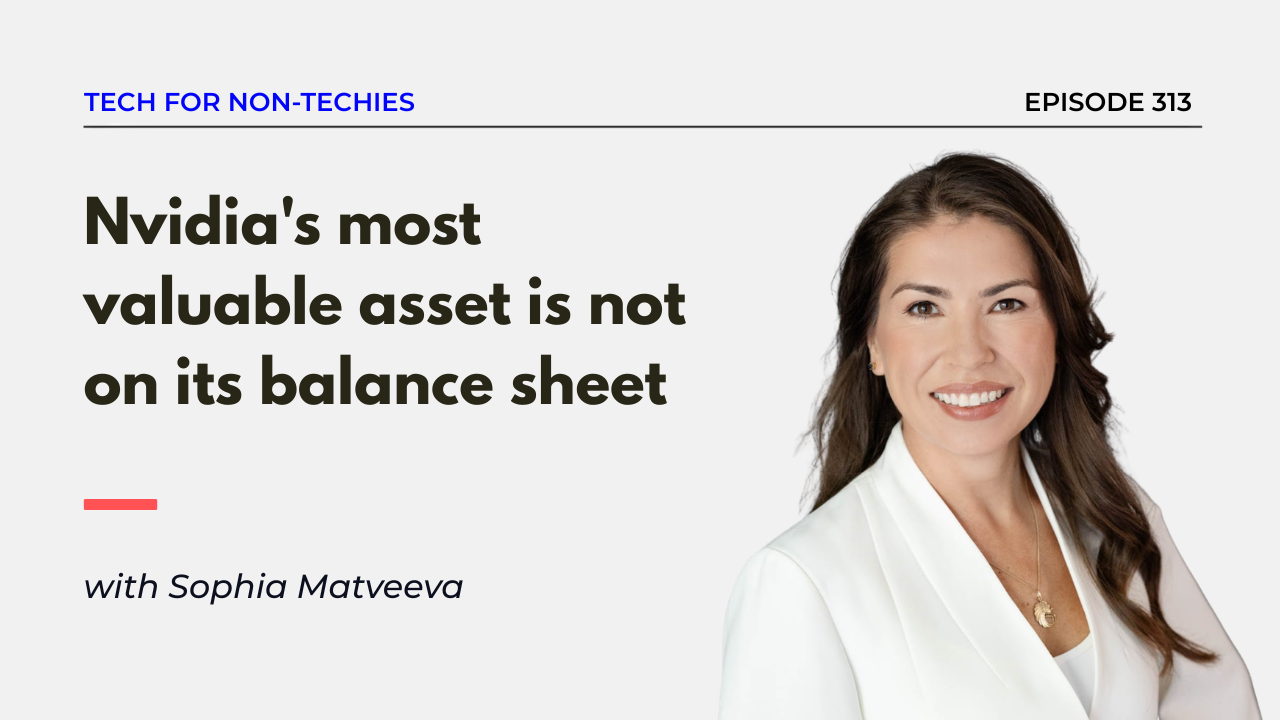
What is Nvidia actually worth?
You could look at their factories, their hardware, their staff. But their most valuable assets — the patents, the processes, the institutional knowledge — don't appear anywhere on their balance sheet.
And Nvidia is not an exception.
Research from Stanford and Chicago Booth, covering 21,000 M&A transactions worth $15 trillion, shows that intangible assets now account for over half the total value of acquired companies.
Customer data alone totals over $1.1 trillion!
Here's what this means for you:
the most valuable things your organisation owns are probably invisible too — and if you're not actively investing in them, they are quietly decaying.
Listen to this episode to learn:
- Why the standard ways of measuring company value are systematically misleading us
- What the research actually shows — and why it should change how you think about your own organisation
- Why intangible assets decay if you don't actively invest in them
- What corporate leaders should be asking about their brand, customer data and institutional knowledge right now
- Why founders who ignore intangible assets while building their product are making an expensive mistake
This episode is for you if:
- You are a corporate leader trying to make the case for investing in brand, data or customer insight
- You are a founder who wants to build something that is genuinely hard to replicate
- You want to understand where real value is created in the age of AI
Book a free consulting session with Sophia: https://calendly.com/sophia-matveeva/sample-consulting-session-2026
Read the full Chicago Booth Review article here: https://www.chicagobooth.edu/review/nvidias-most-valuable-asset-is-not-on-its-balance-sheet
Timestamps
- 00:00 – The hidden asset behind NVIDIA's valuation
- 02:15 – Chicago Booth's research on intangible assets
- 04:35 – Why 70% of companies are undervalued
- 06:50 – NVIDIA's real moat: patents no one sees
- 09:15 – Fixing your company's intangible assets
- 11:35 – Free consulting session offer
- 13:55 – Key takeaways for founders and investors
Follow and Review:
We’d love for you to follow us if you haven’t yet. Click that purple '+' in the top right corner of your Apple Podcasts app. We’d love it even more if you could drop a review or 5-star rating over on Apple Podcasts. Simply select “Ratings and Reviews” and “Write a Review” then a quick line with your favorite part of the episode. It only takes a second and it helps spread the word about the podcast.
Listen to our podcast on:
Transcript
Host: Sophia Matveeva
[00:00] What is NVIDIA actually worth? You could look at their factories, their hardware, their stuff — but some of their most valuable assets, like the patents on their chip architecture and the production processes that make them extraordinary, actually don't appear anywhere on their balance sheet. And NVIDIA is not an exception — this is now true for most successful companies. Today's episode is about what this means for you, whether you're building something new or running something that already exists.
Welcome to Tech for Non-Techies. This is a podcast for business leaders and non-technical founders building the future in the age of AI. Whether you've been in business for a hundred-plus years and you're looking to modernize, or whether you're building something new, this is the show for you. You'll learn how to come up with new ideas and make them come to life, no matter the size of your organization. I've taught tech and innovation at Oxford University, advise companies like Microsoft, and written for the Harvard Business Review. You're going to hear the frameworks and the thinking that I've built, tested, and taught at the highest level. And now it's your turn. Let's get started.
Hello, smart people. How are you today? I'm really enjoying the summer, but in a totally new way for me — I'm kind of having my own reinvention. Usually at this time of year, as long-term listeners know, I'm in the south of France. This year I'm not traveling, because I decided I just really don't want to get on a plane with a baby — which I'm sure other people on the plane are very grateful for. So I'm in our family house, which has a massive garden, and I have discovered that I am really into gardening. Who knew? I'm a woman who's usually drinking rosé in Saint-Tropez in July, and now I'm getting as much, or maybe even more, pleasure from tidying up the garden. I don't understand what's going on. I'm very surprised. I don't know how long this is going to last, but I am into it.
And now let us talk about NVIDIA. So I read this article in the Chicago Booth Review — and for those of you who don't know, I'm an alumna of the University of Chicago Booth School of Business. I want to bring this article to your attention and then tell you what it means for you, whether you are a corporate innovator or a founder.
[02:16] This article is called "NVIDIA's Most Valuable Asset Is Not on Its Balance Sheet." I've pasted the link in the show notes. It's based on research from Stanford's John D. Kepler and Chicago Booth's Charles McClure and Christopher Stewart. So I'm going to tell you the most important part of their research and what it means for you.
The academics found that companies today are generating more and more value from intangible assets. Those intangibles are things like customer data, technology, research and development, brand identity, and so on. Now, these intangibles account for over half of the total value of acquired assets in mergers and acquisitions, up from about a third in the early 2000s. If this all sounds like weird corporate speak, don't worry — just stick with me, and you're going to understand it. I'm going to make it simpler and simpler for you. And this is what I find about the Chicago Booth Review in general: I often think, "You don't have an MBA or a PhD or a degree in economics — can you understand what the articles mean?" But anyway, leaving that aside.
So what they found is that customer data alone now accounts for 23% of acquired assets, totaling 1.1 trillion dollars. In other words, when big money is on the table, what buyers are actually paying for is stuff you can't see. It's not buildings, it's not machinery — it's the brand, the data, the patents, the knowledge, the customer relationships, the institutional knowledge.
Let's look at how they found this out. The researchers looked at close to 21,000 mergers and acquisitions deals between 2002 and 2024, totaling approximately 15 trillion dollars in deals. The companies they looked at included household names like Kraft Foods, LinkedIn, and Time Warner. Here's what they found: they measured company productivity the traditional way — buildings, machinery, basically stuff you can observe — and they got one picture. But then, when they included intangible assets, more than 70% of companies moved into a completely different productivity tier. Essentially, more than 70% of companies were seen to be much more productive, and thus much, much more valuable.
[04:38] And here's something that really shocked me: intangible assets now account for 12% of company revenue, compared to 14% for tangible assets. So basically, the stuff you can't see accounts for almost the same as the stuff you can see, which is really, really interesting. If you want to delve deeper into the research and look at some fun graphs — fun if you're a mega-nerd like me — go read the article, which is linked in the show notes.
So let's make this more concrete and understandable, not just numbers. This is where Chicago Booth researcher Christopher McClure used NVIDIA to make this more obvious. He says that some of NVIDIA's most valuable assets are the patents on chip architecture and the production processes that make these chips extraordinarily efficient. We probably already know this. But what's interesting is that this super-valuable thing doesn't appear on their balance sheet. So McClure's point is that when we don't account for these super-important intangibles, we end up crediting NVIDIA's success to some sort of mysterious secret sauce, some sort of divine intervention. When actually, once you include the intangible inputs, the picture becomes much clearer.
And here's what's super important for investing in startups and investing in innovation: he says this applies to R&D too. If a company is spending heavily on research that isn't going to generate sales until next year or the year after — which happens especially in deep-tech companies, but was also happening at Amazon — excluding R&D from productivity calculations makes the company look less productive than it actually is. This actually reminds me a lot of what Jeff Bezos was saying in his early shareholder letters, when he was like, "Okay, we're not going to be profitable for ages because we're going to keep reinvesting." And he obviously got away with that and has done quite well.
In other words, our standard ways of measuring companies are systematically misleading us in both directions. Some companies look more productive than they actually are; others look less productive than they actually are. So you can have a company with lots of tangible assets that isn't investing in R&D — and therefore shouldn't be valued as much as a company that's investing heavily in R&D and will be productive in the future but has fewer tangible assets, like fewer buildings.
So just remember: just because you can't see it doesn't mean it's not valuable. It's very normal and very human to value stuff that's observable, because we're human beings, we're not valuation machines. We see buildings, we see machinery, we look at cash in hand — that's stuff you can point to. Some economists would argue that, well, you could easily sell it. But what I want you to take from this research is that some of the most valuable things a company owns are going to be invisible. This is especially important for listeners of this podcast, because you want to learn about software companies, you want to learn about innovation in the age of AI. Software companies usually hold most of their value in stuff you can't see and touch. Yes, this is changing for the massive AI companies, because they have data centers — but aside from that huge exception, when you're looking at a traditional software company, intangible assets are going to be super, super important.
And this is not a soft argument about "we have a great culture, we've got great vibes." No — this is literally where the money's going. Because when companies get acquired, buyers do due diligence, and they're not usually idiots. They see everything. They look at the tangibles and the intangibles, and they are paying a premium for the stuff they can't see — for the brand, for the customer relationships, for the institutional knowledge.
[06:53] So what does this mean for you? I'm going to start with corporate innovators, and then I'm going to talk about founders.
So, you're a corporate innovator. Look around you at your intangible assets and think about how they're actually doing. Have you given them any love lately? Is your customer data a mess? What I often see is that customer data in companies is sitting in three different systems that don't talk to each other, and it's really difficult to build anything, to get any insights out of them, because you first have to clean it up. Which brings me to my next point: do you actually have customer insights? How are you getting them? What do you know about your customers — how they think, how they feel, what they need right now, and how they're using your stuff?
Now let's talk about your brand. That's a huge intangible. When did your brand last get any real attention and investment? Are you just seeing it as this annoying thing the CMO keeps asking for more money for? Don't think of these things as fluffy stuff the marketing team wants, or a pet project from the chief innovation officer, because these are real assets. And like all real assets, they require time, money, and effort to build and maintain so you can monetize them.
Intangible assets, just like a building, will decay if you don't invest in them. A brand that isn't tended to will lose relevance. Customer data that isn't updated, that isn't cleaned up, is useless. And relationships that aren't maintained go cold — as we all know, not just from customer relationships, but from real life too, right? If you don't check in with your friends and let your friendships expire, it's going to be unpleasantly difficult to revive them.
[09:16] And the thing is, in many companies, CFOs are going to find it easier to approve budget for something visible, like a new office, a new system, or a new hire. This research makes the case for investing in what cannot be seen. So if you're trying to shake the CFO down for budget, send them this article. Say it came from Chicago Booth and Stanford — these are institutions that CFOs usually respect. I actually sent this article to a CFO the moment I read it, because this particular CFO I know is preparing to sell a really large retail company, and I want her to be able to argue for a higher valuation given all of the intangibles that company has.
Now, over to you. Ask yourself: if somebody were to acquire your division tomorrow, what intangible asset would they be paying for? If you can't answer that clearly, that is the problem to solve first. And if you're thinking, "This sounds interesting, I don't know where to get started, this sounds complicated" — well, here's your chance. Why don't you book a sample consulting session with me? I'm still doing them, hopefully all summer — I'm not sure if I can keep it up, but essentially I'm running a new coaching program where one of the things we're doing is offering free consulting sessions.
[11:36] So if the stuff you're hearing in this podcast is bringing up questions for you, and you're thinking, "How do I apply this to the thing I'm working on?" — this is your chance to get my eyes on your issue for free. Grab it. The link to book is in the show notes, and it's a free consulting session with me.
Okay, now let's talk about what this research means for founders. What I have found is that founders often obsess over the product and ignore the intangible assets, which they should actually be building in parallel with the product. I've been talking about this in the last few episodes, as you'll recall. Your audience, your brand, your proprietary insight into a customer problem — these are real assets that people pay money for. And now I have the evidence to prove it, with graphs.
So treat these assets like assets that people pay money for. What does this actually mean? Build them deliberately, from day one — not as a marketing afterthought after your product is done. Honestly, I do love building great products, I love helping our clients create products that users love, I really enjoy doing that. But I've also seen that if this is all you focus on — if you only focus on the product and ignore building a warm audience and a brand, and you don't codify your proprietary insight — then you will have a great product, but you won't have a valuable company. And surely a valuable company is the point. That's why you're working so hard, right?
Because when it comes to raising money or selling, serious buyers and investors are evaluating the product — the tangibles — and also the aforementioned intangibles. So the founders who understand this, and understand it early, are the ones who arrive at a fundraise or a sale with something that can't be replicated — not just a product, but an actual business.
So if you're a founder thinking, "Yeah, this sounds good, I don't know how to get started, I don't really know what I'm supposed to do, although I am agreeing with Sophia's argument" — then book your sample consulting session. I don't know if I'll be able to keep them up for much longer. By the way, for those who have already booked, I've loved talking to you, and I'm really looking forward to speaking with those of you already in my calendar. Anna, I'm very much looking forward to our session. So if you haven't booked yours yet, do so now.
[13:55] And now let's summarize what we learned today. Some of your most valuable assets in your company are not going to appear on a spreadsheet. This means your company and your efforts may be misunderstood and undervalued, and that would suck. You now have research from Stanford and the University of Chicago proving that when you include intangible assets in valuation, your company becomes much more valuable. What this means for you is that you need to focus on your intangible assets to make sure your company or your division is more valuable. This episode has given you a few ideas on how to do that, and if you want to delve deeper, book a sample consulting session with me.
And now, my dear smart person — if you enjoyed this episode and found it useful, which I assume you did, because you're still listening — make sure to leave this show a rating and a review wherever you get your podcasts, because your reviews leave me in a very good mood. An even better mood than gardening. Okay, on that note, have a wonderful day, and I shall be back in your delightful smart ears next week.
Sign up to our mailing list!
Be the first to hear about offers, classes and events