308. How to innovate without blowing up your business — with Netflix's ex-CFO
Jun 17, 2026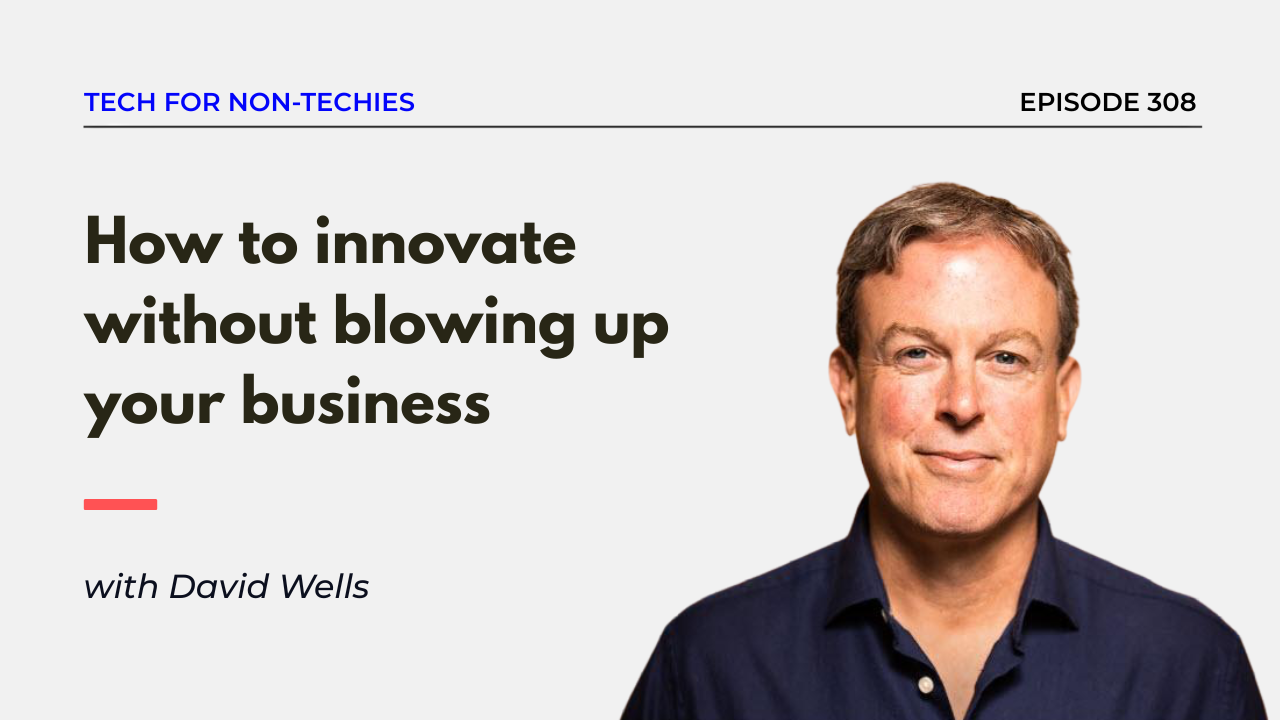
Your core business is doing well. Maybe it's doing really well. But you also know that if you don't innovate in the next 5-10 years, you'll be irrelevant.
So you want to invest in the next thing. But how much? How do you do it without either recklessly spending or being so conservative that you never actually build anything?
This is the innovator's dilemma. And it's not just a startup problem — it's a corporate problem.
David Wells was the CFO at Netflix for nearly 15 years. He joined when they were a fledgling DVD-by-mail company with 400,000 customers. He didn't solve the innovation problem with reckless spending. He solved it with financial guardrails.
Key takeaways:
- Guardrails, not gates: Netflix didn't say "spend whatever you want." They set boundaries like maintaining operating margin growth and never going into consolidated net loss. This let them innovate aggressively within discipline.
- You need three types of people: Financial modelers (business thinking), data scientists (insight), and technical teams (execution). Missing one type is why most innovation projects fail.
- The CFO's real job: Not to hold the company back, but to ensure you can survive hard times. It's constant scenario planning between growth and sustainability.
- Risk tolerance changes: Risk-taking gets harder the deeper you get into life (debt, family, obligations). There's a sweet spot for taking big bets.
- Data matters more than coding: Non-technical people should understand data fundamentals and insight, not learn to code.
Book a call with us if you want to grow your revenue or your margins with new innovative approaches: https://calendly.com/sophia-matveeva/new-meeting
Timestamps:
- 00:00 - Introduction: Balancing innovation and financial discipline at Netflix
- 02:45 - Why David studied public policy alongside his MBA
- 04:45 - Joining Netflix as a DVD-by-mail company in 2004
- 07:03 - Choosing Netflix over consulting and the dot-com aftermath
- 09:30 - Advice for people considering startup risk over a stable job
- 11:49 - Why "tech" understanding matters even in finance roles
- 14:12 - Data science vs software engineering: Which matters more?
- 18:50 - Demystifying algorithms: They're not as scary as the name implies
- 19:50 - The triumvirate: FP&A, data science, and engineering teams
- 21:17 - How Netflix valued content deals using data
- 23:42 - Building an anti-fraud team across 120 countries
- 25:00 - The innovator's dilemma: How much should you spend on the next big thing?
- 26:07 - Netflix's growth boundaries: Operating margin and no consolidated net loss
- 28:33 - Applying the innovator's dilemma to traditional companies
- 30:54 - Advice for bankers trying to break into fintech
- 33:17 - Why founders want to see you use the product, not a PowerPoint deck
Free AI Mini-Workshop for Non-Technical Founders:
Learn how to go from idea to a tested product using AI — in under 30 minutes.
Get free access here: https://www.techfornontechies.co/aiclass
Follow and Review:
We’d love for you to follow us if you haven’t yet. Click that purple '+' in the top right corner of your Apple Podcasts app. We’d love it even more if you could drop a review or 5-star rating over on Apple Podcasts. Simply select “Ratings and Reviews” and “Write a Review” then a quick line with your favorite part of the episode. It only takes a second and it helps spread the word about the podcast.
Listen to our podcast on:
Transcript:
[00:00:00] David Wells: Again, in the early Valley days, the role of the CFO was not to get in the way, right? How do I not hold the company back? But yet ensure you're the first person that will be looked to if the company hits hard times.
[00:00:21] Sophia Matveeva: Hello and welcome to the Tech for Non-Techies podcast. I'm your host, Sophia Matveeva. If you're a non-technical founder building a tech product or adding AI to your business, you're in the right place. Each week you'll get practical strategies, step-by-step playbooks, and real-world case studies to help you launch and scale a tech business without learning to code. And this is not another startup show full of jargon, venture capital theater, or tech-bro bravado.
[00:00:53] Here we focus on building useful products that make money without hype and without code. I've written for the Harvard Business Review and lectured at Oxford, London Business School, and Chicago Booth. So you are in safe hands. I've also helped hundreds of founders go from concept to scalable product. And now it's your turn. So let's dive in.
[00:01:21] Hello smart people. How are you today? In this episode, you are in for a clever treat. You're going to learn how to balance innovation, that is the drive to experiment and create something new, with financial discipline. And you're going to learn about it from the person who did this at Netflix. David Wells was the CFO at Netflix. So here's the problem that David solved. Imagine your core business is doing well. Maybe it's actually doing really well, but you also know that if you don't innovate, in five or ten years, you are going to be irrelevant. So you want to invest in finding the next thing. But how much? And how do you do it without either blowing up your current business or being so conservative that you never actually build anything new? And this is the innovator's dilemma, and that's what we are discussing today.
[00:02:14] And it's not just a startup problem, it's also a corporate problem, as you will hear. And I work with large companies constantly that ask me this exact question. So they basically say we need to innovate, but we also need to hit all our numbers. So how do we do that? And you'll learn all about that in today's episode. So this one is super relevant for you if you're building a startup because you're thinking, my God, my runway is running out, and I've got to find a solution to this. I've got to create something new that works. And also, this is really relevant if you're leading in a corporate because you will have somebody like David, somebody who's the CFO, basically saying, okay, yes, you do need to create something new, we do need to move into a new market or create a new product, but we also have to make sure that our investors are happy.
[00:03:03] So, this one is going to be really good and I know you're going to find this episode super useful. And so when you do, can you please do me a favor and leave this show a rating and a review wherever you get your podcast? Because honestly, it really does help my work get discovered by other smart people like you and reading your reviews makes me very, very happy. So thank you very much in advance. And now let's learn from David.
[00:03:32] Welcome, David, to Tech for Non-Techies. I'm going to ask you some questions, but we also have some technology members online who are now going to ask you some questions. So basically let's get started. I really want to understand your interest in public policy. Because I saw that at the University of Chicago, you studied public policy as well as your MBA. So what was it about public policy that drew you?
[00:04:00] David Wells: Well, I think before Chicago, before I went back for a grad degree, I worked for a nonprofit. So I've always had an orientation sort of towards the pro social side of the house. It probably took twenty years to get back to it, if you will, because when I went to Chicago I did the dual degree. So I did a policy degree and an MBA, and had always had that orientation. I did 20 years of pure capitalism, if you will, in terms of management consulting and then near 15 with Netflix. And then now I'm splitting my time between a corporate board member for three public companies and the other 50% of my time I do sort of nonprofit work for a number of different organizations, small to larger. And that's where I'm applying more of the policy interest and skills and things like that. But that's where that came from.
[00:04:45] Sophia Matveeva: So I really want to dig into kind of you joining Netflix because the journey from Chicago Booth to management consulting, that's a fairly normal and standard journey. But I wanted, so you joined Netflix in, I'm just looking at my notes. In 2004, done my research. And at this point, was that, did that seem like a crazy move?
[00:05:10] David Wells: Not a crazy move. I mean, for, let's see, you know, it's become, it's evolved for MBAs over the last, you know, twenty years, right? When I graduated in '98, you know, I'll make the numbers up, but they'll be pretty close, like fifty to sixty percent of the class either went to investment banking or management consulting. It was one or the other. Consulting, we used to joke was like what you did when you didn't know what you want to be when you grew up, because it kind of forestalled, you know, making the choice. And there's a little truth to that. I did it for six years, which is probably three too many, if there's MBA grads listening. And it's cause I had good projects and there was some interest and I liked the travel too that came with it. But you eventually reach a point in consulting, most do, where you know that this isn't the career for me, right? I don't want to be a permanent dilettante, if you will, in terms of jumping from project to project. I want to go build something.
[00:06:08] And so I took what I knew to be true, even if I didn't know what I wanted to be when I grew up, which was I liked consumer products, right? I like brands and consumer products and things like that. And in 2004, you know, the sort of second era of the internet was emerging from the dot bomb of the 2000, 2001 era, where it shook out sort of the business models that didn't make any sense. And so I looked at companies like Google, which were emerging with dominant search, and I looked at this fledgling DVD by mail company called Netflix, but I really liked the direct-to-consumer approach to it. I liked the promise that they were gonna get to where they are today, but certainly then it was a much more risky endeavor. And then the third thing is kind of like I'm an operations type geek. I like OR type problems and optimization, things like that. And I knew that this environment would be rich with that, and it was in terms of professionalizing dashboards and trying to optimize the heck out of everything across the company.
[00:07:03] Sophia Matveeva: So this is interesting because right now, you know, a lot of our listeners I think they are thinking that, well, I am in a corporate or I have a kind of interesting or at least a well paid job working sort of outside of tech. And then there are all of these up and coming startups because kind of everybody knows that if you work at Facebook, you know, even whatever reputational stuff is happening there, you are not going to go broke working at Facebook. But the kind of more glamorous choice is looking at a Series A or a Series B company. And then when a person is thinking of, I don't know, leaving JP Morgan to work at a Series A or Series B company, they're obviously thinking, well, how do I back the right horse? Like how do I make the right choice? So how, to that person, what would you say?
[00:08:00] David Wells: There are no guarantees, right? So there's obviously lots of hard work, lots of good choices, but some, and lots of luck comes into how a company like Netflix, which was, you know, four hundred thousand US DVD by mail customers when I joined it, becomes the company they are today. It's tough. The things you can do are diligence on the management team. You know, is this a team that I think is gonna make good decisions, make good choices, you know, are they the team that even with evolution and even with additions and pruning, are they the team that can take this company to four or five, ten times value? And so you can do diligence on that. You can do diligence on the market, you know, in terms of their business model, but so many young companies, you know, they don't know if they have product market fit. So there is that leap of faith, leap of choice, leap of risk.
[00:09:09] And so, you know, sometimes look, I don't look down on anyone for making a choice for money, right? You used to have these speakers that would say don't choose the paycheck, choose, you know, the mission of the company or the items of the company that you think are gonna make a career. I think that is a little too lofty, honestly, for reality. I think I graduated in '98, which was, you know, over 20 years ago, with I think $70,000 in debt, right? And so, you know, you multiply that now and I don't know what people are graduating with, but for a reason, it's not ready. You've got to pay that back, right? And you have to have some assurances to pay that back. So, you know, I think each person needs to make the decision of their risk tolerance, their personal financial situation. I will tell you that risk taking doesn't get easier the deeper you get in your life, right? And so there is this sweet spot, I think, that maybe after you get debt paid back, before you have families to support, you know, and children and elderly parents and all these other pressures that get put on you in life, that might be the sweet spot to take some risks, right? And to figure out, like, hey, I'm gonna take a risk with some early stage companies.
[00:09:30] Sophia Matveeva: Interesting. And so now I really want to dig into essentially what you had to learn about technology in order for you to do this. Because obviously, and here when I talk about technology, I really want to talk about actually the software and the tech sector because as a Chicago Booth MBA, I'm sure you learned to do things like derive the equity beta, which I learned, I don't know what it is, but I know how to do it. And so, you know, it is quite technical, but I had no idea what an API was. And so I'm assuming that might have been, I see you laughing, so listeners, David, I'm assuming, David, that might have been similar to you. You knew a bunch of finance stuff, but not the front end.
[00:11:49] David Wells: Yeah, the corollary again, you know, it's called tech or working in tech, but honestly the entire economy is gonna be this and you know, over time. So calling it tech is a little apocryphal at this stage. It just might be companies that are in various stages of how technical each position needs to be within it. You know, do you need to understand the deep sort of technological aspects of whatever company you're working in, if you're in a line function like finance or like FP&A, financial planning and analysis. And so for me, you know, the corollary was in 2004, I do remember interviewing at Google and they cased me on 95th percentile bandwidth pricing, which at the time I didn't know anything about the internet in terms of bandwidth pricing. And I was pretty, you know, I was very candid with them going into the interview. I was like, look, I work on consumer. In the consulting field, I worked on consumer brands and on financial operations, like back office financial operations and things like that. I didn't know anything about bandwidth pricing, but they did it anyway. And they were arrogant in that regard because they really were a bunch of engineers that thought they knew everything and they didn't need these MBAs.
[00:13:00] Now they've come a long way since then. Obviously, Google has a ton, but at the time they did have this attitude, and it was fairly pervasive in the Valley and Silicon Valley that, you know, only software engineers matter. Everything else, maybe some hardware, but mostly software. And everyone else doesn't really matter. We can do what we need to do without any of the other functional skills of business, despite there being a hundred years of, you know, the New York Stock Exchange, S&P 500 having a rounded out set of skills in these companies, that was kind of their attitude. But, you know, that changed over time. I mean, we proved out the need for things like financial planning and analysis, things like that over time. There's still a little bit of that attitude that you get from founders and co-founders if they come from a technical field. I would say, for me, I'd always understood computers and programming and had taken some programming. So I understood it from a fundamental level, even if I couldn't actually do C, I understood how it worked. And so, you know, the advice for your sort of people coming from a non-technical field is you don't need to be deep. You don't need to be a coder. You do need to have some fundamental understanding of it.
[00:14:12] Sophia Matveeva: I honestly think that there's more advantage, and hopefully this is reflected in the curriculum of the MBA programs, there's more advantage in understanding the fundamental aspects of data science than there is software engineering. And I would love to understand why. So what are your thoughts on that?
David Wells: Well, because data science is the analysis blood of a company, right? Like you end up having massive amounts of data coming out of distributed databases and you have to ask fundamental insight questions against that. And so the more that you understand, again, you don't have to run Hadoop clusters yourself, but you do have an advantage in a tech, especially in a tactical company, of understanding the fundamentals of how all that works. And so I think that there are advantages. I think, you know, Chicago still is a very quantitative curricula, which lends itself to tech because, you know, you understand what an R squared is. You understand the fundamentals of statistics, and that ultimately ends up being the fundamentals of consumer A/B testing science. It ends up being sort of data driven decision making, all of that, you know, lends itself. So I think Chicago is good in that respect.
[00:15:40] Sophia Matveeva: It's interesting because actually I did take a data science course but I didn't understand that I was learning things that I didn't understand that this is what A/B testing would be. So you kind of learn these skills. And then I remember we were running, in my first company, we were running Facebook campaigns. And I was thinking, I understand kind of what's happening, but I didn't understand these words. And actually, one of my classmates did take a data science course with me and it formed the basis of his AI company. So we actually had an earlier episode with him called How I Built an AI FinTech Company as a non-technical founder. Because essentially he took this data science course, he understood what algorithms do and how to use algorithms to essentially make lending decisions as a banker. And then he thought, well if I can create this lending algorithm and sell it to my former bank, he left Citigroup and he started selling this algorithm to his former banking colleagues. And obviously, you know, now he's working with some of the largest banks in Asia. I think he's raised about thirty million dollars so far. To your point, that came out of a Chicago Booth data science class.
[00:17:00] David Wells: Yeah, and I think there's a tendency for jargon to be, you know, used by experts. It distances from the actual understanding of something, right? So you call something artificial intelligence, but it's actually just the marriage of using machines to run algorithms against a data set with what used to be called, you know, the early days of neural nets, but cluster analysis, right? You learn in statistics cluster analysis, which is basically taking data and then seeing what correlations there are within it. And then that becomes artificial learning or AI, but that's all it is, right? And so it demystifies it a little bit, I think, especially if you take some of the fundamentals courses.
[00:18:00] Sophia Matveeva: Well, you know, I actually remember when, again, in my first company, we were working on creating an algorithm. And I thought, I remember my CTO said, okay, we need to work on this content algorithm. And I'm thinking, I have no idea what I'm going to do. I really don't want to go to this meeting. But, you know, I'm kind of running the company, so I have to go and suck it up. And it kind of went swimmingly. I did really well, to my great surprise. And I remember thinking, my God, this is a hoax. Like this stuff is actually not that hard.
David Wells: Not as hard as the name sometimes implies.
Sophia Matveeva: Exactly. Sometimes algorithms are not quite as sophisticated as just the name algorithm implies.
[00:18:50] David Wells: But yeah. Well, exactly. And once I started, once I kind of understood that you don't have to have a computer science PhD to understand what's going on, then I think once you kind of get this confidence, then you can actually ask insight questions afresh.
Sophia Matveeva: Yeah. Because it's kind of what really matters is the insight. Like it doesn't really matter how you get there in terms of, yes, it's incredibly hard to structure massive data sets. It's incredibly hard to structure the program that runs against that, but ultimately what matters is the insight that comes out of it. So could you give us some examples of when on the business and finance side, when you would have to collaborate with a colleague on the tech side, kind of, I'm assuming since you're the CFO, you sometimes talk to the CTO. So what kind of, sorry.
[00:19:50] David Wells: Yeah, I think the most direct is the application of algorithms to business sort of operations. And so my financial and planning and analysis team, there was kind of a triumvirate at Netflix. You would have financial planning and analysis that were more financial modelers, right? They were running in spreadsheets and sort of applying things to either plan the business or to make decisions. You would have a data science team that were deep math PhDs, right? These were folks that studied, you know, and ran deep algorithms and models. They might actually come up with the algorithm, but sometimes they had trouble applying that to a business application, right? And then the third part of that triumvirate were the deep technical team that ran sort of the database side. And so you put all three of those together. You need everybody in that group, right, to make something happen. But the financial planning and analysis team might actually be the team that applied those insights to the business.
[00:21:17] So in Netflix's case, you know, we wanted to try to understand from the data, you know, could we have insights that informed our content green light and decision making processes? And so there is a team, right, that worked together with all three of those components to make that happen. But the FP&A team were the team that actually worked with the team making the deals on the content side, you know, to actually value it. Like, okay, should we pay, you know, fifty million for this, seventy five million? Is it more likely or not? Where should the budget cap be? If we pay more than a hundred million, it's not likely to be as efficient as some of this other content. So that would be an example of an application.
[00:22:00] Sophia Matveeva: Another example would be just, sorry, I just wanted to backtrack to just sum up. So you would have the content team, whom I blame for many hours of my life lost, when I shouldn't have been, you know, socializing and going to theaters and meeting new people, instead I'm there for seven hours surrounded by cookie crumbs. So those people. And so you have the content team, then you have the data science team who are basically seeing how is the content being watched. And then you basically have the money team who is then deciding, okay, well given all of this, how much money are we going to spend on this one? Is that the correct summary or am I missing something?
[00:22:40] David Wells: Yeah. I mean, the only tweak to that would be the money team in this case acted more like consultants than the actual, you know, the deal team made the decision. They were on the hook for if you do it for this amount, you know, and make that content, it's either gonna work or not. So they were the ultimate decision maker. The FP&A team were kind of like consultants, you know, where they were like, hey, we're gonna help you make this decision. This is what I would pay for it. This is the analysis I ran on it, you know.
Sophia Matveeva: That's interesting. So it's a sort of like a mini CEO and a mini CFO. Like the deal team is making the decision, but then the FP&A team is saying, well, this is what I would suggest.
David Wells: Okay.
Sophia Matveeva: How exciting, how interesting. Any other examples that you wanted to share? Kind of a final one?
[00:23:42] David Wells: Yeah, this one's probably a little less sexy, but there were lots of applications where we worked with the again, the deep math teams, the data science teams to apply sort of a business application in the anti-fraud area, right? So Netflix operates in over 120 countries. Some of those countries are not very good neighborhoods, if you will, from a credit and financial payments fraud perspective. And so in many cases, we were paving the way for e-commerce in some of these markets, especially at the low price point recurring subscription segment. And so banks were very reluctant to sort of open up direct debit, if you will. This was again in the earlier days of e-commerce payments. And so we had many, many applications where we essentially built out an anti-fraud group from our FP&A unit, right? And so that group is still going today, and I think they're best in class in the world in terms of trying to increase the funnel of people paying on a non friction basis but not let in the bad guys.
[00:25:00] Sophia Matveeva: Everybody wants to go through the innovation of Netflix. We've all read the case studies, but obviously nobody, or not many people can do it. And one of the tensions that I see, especially on the CFO front, is how do you essentially allocate money towards risky projects and innovation without, you know, and have some kind of sensible financial approach to it, because there is this creative tension of we need to invest money into projects, they're not working out, but also how long is a piece of string? Like when do we stop this?
[00:25:30] David Wells: Well, yeah, you just described the role of a growth company CFO, right? So in the early Valley days, the role of the CFO was not to get in the way, right? How do I not hold the company back? But yet ensure you're the first person that will be looked to if the company hits hard times. So you're constantly balancing scenario planning around, you know, growing more than you thought versus growing less than you thought. I mean, you're constantly sort of balancing those two things. Honestly, I had a very good partner with Reed even from the beginning, where he was very aggressive and very aggressively pursuing a large addressable market, but understood that he couldn't completely press everything on the growth gas pedal, right? So we set up some boundaries with the company around growth of operating margin over time. And again, that helps because a company doesn't suddenly go from loss making to profit making elegantly. You have to provide some metrics and steps along the way for that to be an elegant journey. And even then it can be hard.
[00:26:30] And so I had a very good partner where we just sat down and we had sort of constant operating margin, and the company still does that. The other boundary we had when we were pursuing international expansion, and it was aggressive, is no consolidated net loss, right? So we had our early markets like the US that were profit making, but the newer markets were loss making. And so the agreement together was we wouldn't go so aggressively that we would take the entire consolidated income negative. Meaning, you know, that was our boundary. We could grow faster if we grew profit faster in the profit making markets. And so that was a useful guiding, multi-year guiding mechanism for balancing risk.
[00:27:30] Sophia Matveeva: So I wonder how that would translate to a traditional business that wants to innovate. Because for example, I'm just thinking, I mean, this is literally one of my clients and they ask me, and that's an interesting one, so I'm gonna ask you, because obviously the company I'm thinking about, they're a large company, they're kind of in that Netflix model of when things were pretty good with the DVD, so they actually, but they know that they need to do the next thing, which is the tension of, well, things are pretty good here, but if we don't do something in the next twenty years, things are not gonna stay this good.
[00:28:33] David Wells: This is the innovator's dilemma, right? There's a book about this. It's pretty well studied. You know, you have to force yourself to be disciplined about spending X percent on the next income generating thing, right? And so they just have to force themselves to carve off, you know, you don't have to spend all of it because that's a bet the farm bet, but you certainly want to be spending a good portion on reinvesting for the next thing.
Sophia Matveeva: Interesting. So essentially it's a question of risk tolerance.
David Wells: Well, it can be risk. There's, well, embedded in that is several questions, right? Or at least preparatory steps. Is the company public or not? Because that enters into the dynamic, right? If your investors expect a certain income or cash flow stream, do you have to create the room to reinvest, you know, and that can be multi-years and you don't want a management team turnover in the middle of that. So you have to prep those steps. The second element is organizational. How do you organize against the new thing, right? Are you taking the best folks out of the company and putting them in the new thing? Do you carve it off separately? There's lots of sort of organizational design elements to how you increase the probability of success for the newer venture. And then the third thing is what you were saying is risk tolerance and that sort of calculus.
[00:30:54] Sophia Matveeva: Just as we're finishing up, what I'd really want to understand is if somebody, you know, I'll kind of give you a case study of what I see fairly often, especially now that I'm in London. So in London there are many bankers. Some of them have Chicago Booth MBAs and a lot of them do not want to be bankers anymore. And they want to work for a company like Wise. They want to go into FinTech. And they are kind of wondering how do you go about this? And one of the problems that I see that they end up facing, because they tell me, is that they're trying to apply for these jobs and they basically think that they are very important and they get paid very well and they're very used to people being very, very nice to them. And then they apply for a job at Revolut or at Wise and they don't even get an interview. And so with those people, they're basically like, well, should I take a coding course? Like what should I do? And I know you mentioned data science before, but I'm not sure if telling them to just do a data science course is going to help them.
[00:31:54] David Wells: Yeah, probably not in that context. No, I would probably wouldn't say take a data science course. I understand their plight. It is hard to make a career change, especially if the company you're in might be considered a negative cultural signal by these newer market entrants, right? Of saying, if you've been 10 years at Barclays, you're not going to be a cultural fit because that's not the type of people we hire. We like innovation, yada yada. Honestly, I think the most relevant advice might be go out and use all these products, develop a point of view about what works well and what doesn't. So that at least if you get that one interview or if you write a letter to a product leader at one of these companies, you can say, hey, you guys stink at this. And here's why you should be doing it this way as a product, like approach from a consumer. And if you have that first person consumer point of view, you're much more likely to catch someone at those companies and say, this person might actually have something additive to add here. It wouldn't be to go take a data science course. It might be something like that to experiment. And who knows, they could find a job lead just from that experience of playing around with the different products that are out there.
[00:33:17] Sophia Matveeva: That's interesting because this is literally when I have founders on the show, this is what people often say is, you know, I expect somebody to have had a look at my product and to tell me what they think about it. And if they don't, then really I'm not that interested. Whereas I do find that people who are coming from traditional backgrounds and, you know, including many of my MBA classmates, they think, well, but look, I have created you a case study and I have PowerPoint slides. And that's when I think this is the cultural thing, is that, you know, from business schools and kind of the consulting world and that world, you get taught that if you give people a PowerPoint, then that's what people really want. But then you have the tech founder who really does not want to see your PowerPoint, at least not on the first thing.
[00:34:08] David Wells: No, the cultural, what, you know, the cultural expectation there is I don't care about analysis. I care about the real world, how it works, how it could be better, how it could have a different product or an improved product. And so if you approach it from there, I think you're more likely to understand how a founder thinks or how a technical product person might be.
[00:34:40] Sophia Matveeva: Well, this is so useful because, you know, this is not just about rescuing frustrated investment bankers because that is definitely not one of my life aims. This also applies to anybody else who wants to transition into a career that is more exciting with interesting and innovative products. Wasn't that interesting? I mean of course it was, I told you it would be. And so now my question for you is, have you left the show a rating and a review? Well, you should, because this episode was super good. Okay, on that note, I'm gonna love you and leave you, wish you a wonderful day, and I shall be back in your delightful smart ears next week. Ciao.
Sign up to our mailing list!
Be the first to hear about offers, classes and events