305. How to build a company you're proud of — with Eric Ries
May 27, 2026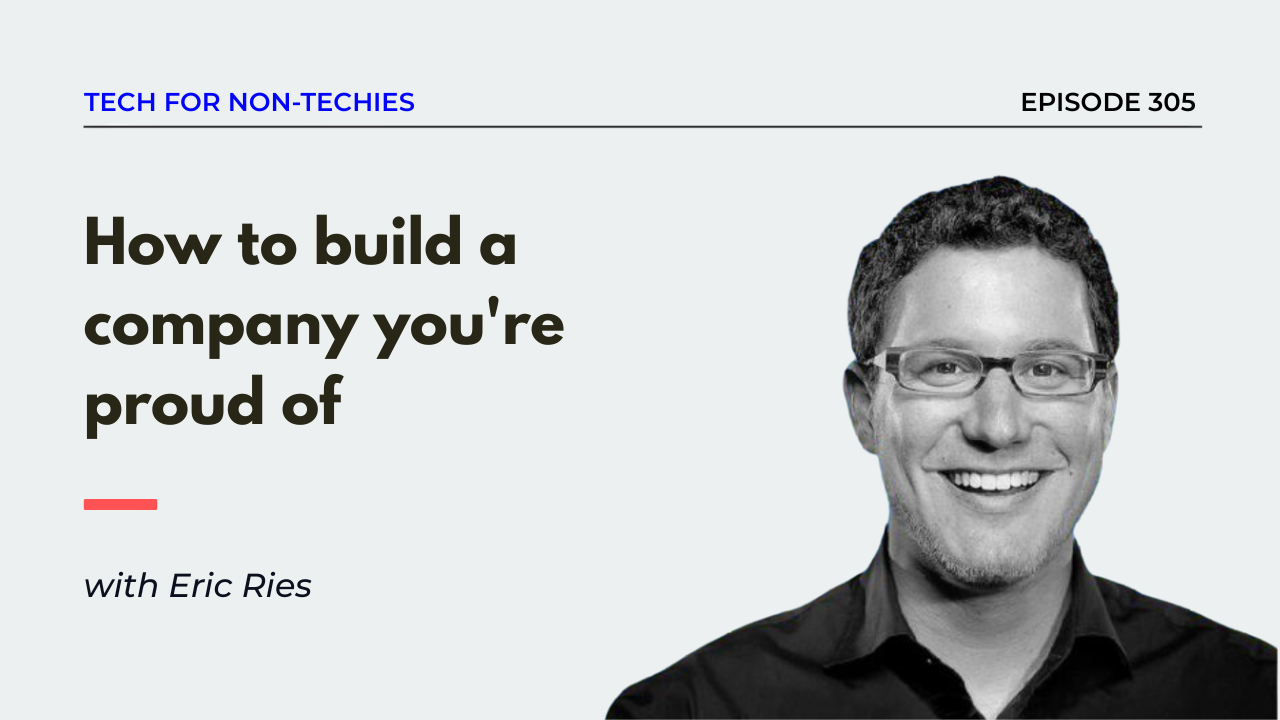
Most founders start with the best intentions.
And then somewhere along the way — without noticing — the company they've built becomes something they're ashamed of.
Not because they're bad people. But because nobody taught them how to prevent it.
Eric Ries wrote The Lean Startup — the book that changed how Silicon Valley thinks about building companies.
His new book, Incorruptible, tackles the question that comes next: how do you build a company that makes money without destroying the thing that made it worth building in the first place?
In this episode, Sophia Matveeva speaks with Eric about the practical techniques any founder can use today — no revolution in how business works required.
Listen to learn:
- Why investors are not your bosses — and what happens when you treat them like they are
- How the most successful mission-driven companies are structured so they cannot make money any other way except by achieving their mission
- Why doing the right thing by your customers and employees is often the highest ROI decision you can make — just not on a short-term spreadsheet
Eric also shares the story of a Texas grocery store that told customers to take their shopping home for free during an ice storm — and what that decision reveals about what it actually means to build with integrity.
Resource mentioned in this episode: The Lean Startup by Eric Ries — covered on episode 111 Lessons from the Lean Start-Up by Eric Reis
---
Ready to build your tech venture the right way?
Book a call: https://calendly.com/sophia-matveeva/new-meeting
Timestamps:
- 00:00 - Introduction: The ice storm story - When HEB gave away groceries
- 02:53 - How every founder starts with good intentions but ends up somewhere else
- 05:05 - Mission-driven vs mission-hopeful: What actually counts
- 08:18 - Costco's governance fortress and violating "best practices"
- 10:55 - Long-term vs short-term: Maximizing human flourishing
- 14:04 - Why business founders have a bad reputation
- 17:41 - Investors are not your bosses - The fundamental mistake
- 21:52 - The AI insurance startup hiding their nonprofit foundation
- 25:08 - The HEB ice storm story: When doing right pays off
- 28:45 - Closing and resources
Free AI Mini-Workshop for Non-Technical Founders:
Learn how to go from idea to a tested product using AI — in under 30 minutes.
Get free access here: https://www.techfornontechies.co/aiclass
Follow and Review:
We’d love for you to follow us if you haven’t yet. Click that purple '+' in the top right corner of your Apple Podcasts app. We’d love it even more if you could drop a review or 5-star rating over on Apple Podcasts. Simply select “Ratings and Reviews” and “Write a Review” then a quick line with your favorite part of the episode. It only takes a second and it helps spread the word about the podcast.
Listen to our podcast on:
Transcript:
[00:00:00] Eric Ries: There was an ice storm in Texas, caused massive power outages. And so one day there's a store and they lose power and the point of sale system goes down. So they can't take payment. The lights go out. So there's this like collective groan in the store as everyone realizes there's no way for them to pay for the stuff in their shopping carts and they're gonna have to go home empty-handed. And it's like very important because like it's why, why are they in the store today stocking up? Because it's a freaking ice storm. Of course, this is probably their last chance to stock up before things get really bad. And the store manager just tells everybody, take the stuff with you. Just don't pay for it. Just take everyone, take your shopping carts, take them home. And people burst into tears. People are like so moved. Because when was the last time like a for profit corporation like treats you with anything remotely approaching dignity?
[00:01:00] Sophia Matveeva: Hello and welcome to the Tech for Non-Techies podcast. I'm your host, Sophia Matveeva. If you're a non-technical founder building a tech product or adding AI to your business, you're in the right place. Each week you'll get practical strategies, step-by-step playbooks, and real-world case studies to help you launch and scale a tech business without learning to code. And this is not another startup show full of jargon, venture capital theater, or tech-bro bravado. Here, we focus on building useful products that make money without hype and without code.
[00:01:34] I've written for the Harvard Business Review and lectured at Oxford, London Business School, and Chicago Booth. So you are in safe hands. I've also helped hundreds of founders go from concept to scalable product. And now it's your turn. So let's dive in.
[00:01:54] Hello, smart people. How are you today? Today's guest wrote the book that changed how Silicon Valley thinks about building companies. And I'm super excited that you are going to learn from him today. Eric Ries wrote The Lean Startup, and it is practically a founder's bible and if you haven't read it I actually did a summary of it on this show. It's episode 111, Lessons from the Lean Startup by Eric Ries, and I highly recommend that you listen to it. In this episode, Eric joined me to talk about his new book called Incorruptible. And when I first got the pitch, I thought, okay, is this going to be a lecture about corporate ethics? Because I don't want that. That would be really boring. But actually it wasn't that.
[00:02:39] It's something that every founder needs to think about. So the question really that Eric is answering is how do you build a company that makes money and also stays true to what you actually care about? Because the thing is, we all start out with the best intentions. I mean, most of us do. Apart from the few psychopaths, most of us start out with the best intentions. And then somewhere along the way, without noticing, the company just becomes something that they're ashamed of. And this is not because the founders are bad people.
[00:02:53] How every founder starts with good intentions but ends up somewhere else
It just sort of happens. You end up in a place you never meant to go to. And I don't want that for any of us. And this episode will help with that. And also in this lesson, Eric talks about investors, specifically why they are not your bosses and what happens when founders treat them like they are your bosses. And that alone is worth a listen. So if you're building a tech venture and you want to make sure that you're doing it right, not just technically, but commercially and ethically, this episode is for you. And if you want our help building your product the right way from the start, then book a call with us. The link to that is in the show notes. Now, let's learn from Eric.
[00:03:32] Eric Ries: I'm not trying to get people riled up about something with no solutions. So to me, the critical point is to take the world as it exists today and figure out what we can do. So my promise to the reader is that every technique that I outline in the book, just like Lean Startup, is a technique you can use today. You know, there's nothing that's like, well, after we change the world, after the rules are changed, after investors become enlightened, then blah, blah, blah, nothing like that. Everything takes the world as it exists today.
[00:04:04] I think it was important for me not only to understand what are the practices that mission-driven companies use to create all this value, but like why? Why do they have these seemingly impossible benefits? Like they basically have these superpowers to resist corruption, but then also to attract customers and employees and investment capital, because investors, when they're doing the investing, when they're doing deal selection, they love mission-driven companies. You hear it in the kind of outdated phrase missionaries versus mercenaries, although I feel like that has some racist overtones, probably time to retire that phrase. But anyway, the same VC that can be like, I'm all for missionaries over mercenaries. Once they join your board, the tragedy is they've been trained to then adopt this different set of best practices as a board member that kind of treats mission as like the dessert of, you know, you get to do a little mission after you've eaten your vegetables of financial performance.
[00:05:02] So anyway, there's a bunch of problems that need to be solved. But at its core, the solution is always to bring everybody back to the fact that we build a mission driven company. We will be able to achieve this really successful outcome and the outcome powers not just social, moral, ethical returns, but financial returns also.
[00:05:05] Mission-driven vs mission-hopeful: What actually counts
Sophia Matveeva: You know, whilst I totally see your point, when I hear the term mission driven, I just think this is wokewashing. You know, this is some company just basically who's called in a bunch of consultants or, you know, just used AI to basically say, we're really nice. Buy stuff. And so if we then but then when I was reading the book, I was actually seeing examples of companies that are creating value and, you know, making money and creating products that people love, whilst also, you know, treating their employees well. And so, could we have a couple of examples of companies that have done these things so people could really see what is it that you mean by mission driven? Because I would imagine that if I'm thinking, mission driven, yeah, that sounds nice, but I think that term's just become kind of rubbish.
[00:06:01] Eric Ries: Totally. God. It was very hard to, it was hard to write this book because all the terms have been co-opted that you might want to use mission, purpose, stakeholder. I mean, give me a break. And so yeah, I say in the book that unless you do a specific series of specific steps that I'll outline in a second, you're not even, even if you say you're mission driven, you're lying. You're actually more like mission hopeful. Like, maybe something good will happen here. We sure hope so. Whereas the companies that actually pay attention to aligning every element of their business model, their strategy, culture, vision, every element of the company is aligned towards one and only one goal, which is to achieve a defined, concrete mission, not just like make the world a better place in the abstract.
[00:06:50] But even more importantly, these companies have structured themselves in such a way that they cannot make money any other way except by achieving their mission. It is not possible for them. And that requires both a bunch of cultural practices and a bunch of structural practices that today are considered total business heresy. So let's give some examples. I think that's a good idea. And what's funny is everyone listening actually already knows the examples. Okay, so here's what's really funny. You ask people why are businesses so corrupt today, they'll always give an excuse like this. Well, it's just an inevitable part of scale. It's human nature. When companies get to a certain size, they just, you know, they give in to temptation, that kind of thing. It's a very common just-so story we hear all the time.
[00:07:35] In fact, I was listening to, I think it was an economist giving a lecture, and he said, you know, really it's only family-run businesses that can resist these forces of over obsession on efficiency, ROI, quarterly returns, all that kind of stuff. And he's listing out the family companies. At the end of his speech, he's like, and you know, yes, this, this, this, but also Costco for some reason. And he's like, I know Costco's not a family run business. But they also seem to be able to do this for some reason anyway. Moving on. Like he dropped it as a bomb because everyone knows, yeah, Costco's a company you can rely on to do the right thing because we see evidence of it all the time, not just recently in their public statements, but they've been going on this for 40 years.
[00:08:18] Costco's governance fortress and violating "best practices"
But people forget Costco is a $400 billion public company. It's not family run, it's not family owned. The original founder is retired. They've been through three or four CEO successions, and yet the culture endures. And people sometimes say, well, I guess they just got lucky or I guess once you get to a certain size the activists can't attack you or whatever, no. Costco gets attacked by activists all the time. I tell several of these stories in the book, but they have what's called a governance fortress, a worst practice governance fortress that violates most modern corporate governance best practices in order to resist corruption. And you see the same thing is true of Patagonia and Vanguard and REI and Hershey Chocolate and IKEA and Novo Nordisk and John Lewis Partnership for those listening in the UK.
[00:09:14] There's all these companies, Mondragon in Spain, that most people know and have interacted with one of the companies that I just named. But if you ask them why is that company different from other companies, they generally don't know. And they're actually usually quite surprised to learn that those companies are total violators of most of today's best practices. Now we call them best practices, but they're actually terrible. One of my favorite stats in the book is that since 2008, so we're now going on 18 years, companies that have been rated as having bad governance have outperformed companies rated as having good governance. So what are we doing here? Which approach is actually serving shareholder value? I think it's actually not the advocates of this discount shareholder primacy set of practices.
[00:09:31] Sophia Matveeva: So when I was reading your book, I noticed one thing stood out for me, which was that essentially it's long, good long term decisions, decisions that are good for the long term, tend to equate more with a mission-driven company than decisions that are good for the short term. And the example that you gave, it was I think it was an eighteenth century mill, but it was essentially, you know, paying people well, paying people above market is a good decision for the long term because you get the best people applying to you, you have great employee loyalty. So actually your recruitment costs go down. So in the long term, your costs are probably lower because you don't have the same churn situations. And you have better customer service and you probably have more innovation because people are working really, really hard to stay at this well-paid job. But in the short term, obviously it's hard because your margins become lower. So would you say that in general, you know, if somebody's listening to this and they don't get the book because they have made a mistake, and they're thinking, well, I wanna, or they're just thinking, okay, this is good, but I wanna do something now. Like give me one framework. Would you say that it's long term versus short term? Is that a good way to think about actually creating a company that you're proud of?
[00:10:55] Long-term vs short-term: Maximizing human flourishing
Eric Ries: Yeah, yeah. All we need to do really, I mean it's easy to say but hard to do. We have to build a company that is designed to maximize human flourishing. And when you press on that and say, wait a minute, which humans? Well, you tell me. Like the thing I think that's really beautiful about a democratic market economy and society is that we don't need to have one universal set of values that everybody has to have adherence to. The point of having organizations is to experiment with diversity of forms. That's actually like part of our human birthright going back thousands of years. Human beings love to experiment with different polities, that is, different ideas about how power should be shared between people.
[00:11:40] And so, yeah, I would say you tell me what you really care about. Who do you care about and over what time horizon? And the problem is most people, even if they say like something very simple, some people are like, listen, human flourishing, I don't care about climate change, I'm not woke, whatever. Like I, you know, I hear that a lot from people. I'm not into stakeholders, I'm not into this. I just want to create a great product. And I'm like, well, you don't realize how revolutionary that statement is. And I'll tell you a story. I had a founder, repeat founder, like three or four startups he had done. And he had left each of them in frustration because of what they became. He was starting a new company. Like, this time I'm really going to do everything right. This company is going to be all about product quality. He's like, don't tell me about stakeholders, none of that stuff. I was like, okay, I won't talk to you about stakeholders, but how do you feel about your employees? He's like, I would do anything for my employees.
[00:12:43] Okay. So you want to treat your employees well. He's like, I want to create a company where this will be the best place in the world to work if you're an engineer. I want to build high quality products. I said, okay. And he's like, and then because of that, we're going to make a ton of money. So I really like, all this, all these frameworks and all this stuff that you're making things complicated. I'm just going to make a lot of money, you know, by whatever means necessary, and that will give us the leverage and the power to make things the way that we want them. I said, okay, that's good. But imagine this scenario for me for a second. What if in the future someday someone comes to you and says, boss, I just realized we could make extra money if we lower the quality of a certain product. Like let's take that stainless steel part and replace it with a plastic part, and then we'll get recurring revenue as people have to replace it more and more frequently. He's like, I would never do that. I said, I thought you said you're gonna make money by whatever means necessary. He's like, well, not like that. I was like, so there are limits on the ways you might be willing to make money. Uh-huh. Okay. Here's the problem. Even such a simple, humble mission statement.
[00:13:16] That I want to make the world a better place through creating superior products with high quality, my focus is on craftsmanship and employees. That simple idea is already at odds with our dominant business culture in a really profound way. In fact, most founders have never ever read their own corporate charter and have no idea that although they say this is a company that's all about high quality products, their charter says this is a company all about enriching shareholders by whatever means necessary. And so this yawning chasm as a company grows between its stated official mission or purpose and its actual legal reality, the divergence creates incredible tension. And of course that's why this poor founder had been, had to leave three companies already in frustration. And I was like, look, if you don't make a change, you're gonna leave this company in frustration too.
[00:14:04] Why business founders have a bad reputation
Sophia Matveeva: And you know, since there are so many business founders who are either working with CTOs or want to create a tech company, but they're the business founder, I think it is important for us to be aware that we kind of have that reputation for being the person who is like, yeah, you know what, replace that steel part with the plastic part. And a while ago I did a review of the Blackberry movie. I don't know if you saw it, it was on Netflix. It came out a few months ago and it really shows, you know, these brilliant engineers who are being horribly dominated by this business guy. And it was such a caricature. I don't know if it was actually that true to life. But anyway, it is true that on the business side you do have this reputation. So what would you say to the business person, to the non-technical founder who is thinking, yeah, like I'm not a horrible person. I want to treat people well. I want to treat my customers well. Like I don't want the world to be worse off because I existed. But at the same time, we gotta make money. We've got investors. The investors are writing us horrible emails. So we gotta deal with that. What would you say to that person?
[00:15:23] Eric Ries: Yeah, well that person is half right. You do have to make money because just like a human body cannot live without oxygen, a company cannot live without money. No organization can live without resources. But to say that the purpose of an organization is to breathe as much air as possible. It's like, you know, as though to breathe were life, as the famous poem goes. Like what are we talking about? What? No, that's totally backwards.
[00:15:54] So in this case, if you're a business co-founder, you have a really vital and exciting opportunity in front of you. You need to be the interface between the technical and product and kind of inner vision of the company and these outside realities. And the second you bring those outside realities into, like think of yourself like a submarine or a spacecraft, right? And you're like, my God, there's incredible pressure outside. Guys, what are we going to do? Okay. As soon as you're like, well, let's bring that pressure inside, let's breach the hull and let the water rush in. The second you've done that, you have violated your most sacred responsibility to the company. Your job is to help build an organization with high integrity such that that pressure is not felt inside.
[00:16:38] So the question is, can you find a way to help your team understand what are the financial realities, but then also to go looking for what I call the positive externalities. Go look for, like you may be surprised. Investors may be telling you, you got to squeeze employees to make money. You got to screw people over to make money. And if we don't see that, we're not happy. But you got to interrogate, is that really true? Maybe you'll discover, as is often the case, that if you treat employees well, they'll perform better for you. Maybe you'll discover that if you treat customers fairly, they'll perform better for you. That is, you might actually make more money because you're doing the right thing as you define it. And I think a lot of people are so blinded by this ideological fealty that we expect everybody to pay to this idea of extraction that they don't even realize that it's going on when it's right under their nose.
[00:17:29] Think about how many people ruin a product that was otherwise great. That's why business co-founders, frankly, have such a bad reputation, because we all know tons of stories like that. Yet when I meet companies that I'm like, wow, you guys are really doing it right.
[00:17:41] Investors are not your bosses - The fundamental mistake
The business co-founder will often apologize to me. Like, I know, I'm sorry, we don't follow the normal best practices, but we're kind of weird and quirky, and I hope you don't mind. They've been so beaten down by everyone outside, like constantly hassling them, they're not even willing to defend their own approach. And the more you bring that defeatism into the building, the more self fulfilling of a prophecy it becomes. So don't do that.
[00:18:09] Sophia Matveeva: It's actually one of the things that I mentioned on the show. So in my previous company I did have investors and because it was, I was a first time founder, I really didn't understand that investors are not bosses that, you know, once they've invested unless you are doing something completely wrong against your articles of association, then actually you could do what you like, basically. And I didn't realize that. And so they would say things and I remember they would suggest strategies that I just knew were just not, they were just not gonna work because you know, like we were the experts in the room, not the investors. This is why we were the management team that got investment. And I didn't realize that actually you were just allowed to say no. Like that it didn't occur to me. Because I remember I still had that employee mindset that okay, the people who pay you, like the people who give you money, they're the bosses. Like that's what happens when you're working in corporate. But it's not actually how it works when you're a startup founder and you have investors. They give you money and you still get to say no. And I think that's from what I'm hearing, this is one of the core things that you're saying is that, okay, if you're hearing stuff that you think is gonna be fundamentally bad for your business, just say no. Is that correct?
[00:19:30] Eric Ries: Well, certainly. I had it even worse than what you're describing. I didn't understand that if you violate your own principles to please an investor, and then it doesn't work, they're not gonna take responsibility. Right? They're gonna say, why didn't it work? And you're gonna be like, you told me to do this thing. And first of all, they're not gonna remember that they told you that thing. Okay, believe me, they're not gonna remember. But even if they do remember, they're gonna be like, well, it's your job. It's your job, right? So what are we doing? I feel like so many founders just sacrifice the things that are most precious and valuable to them in a vain attempt to like vaguely make investors like somewhat more happy or something. Like it is, I just wish we taught founders better. And again, investors are not the villain of this story. It's just they have a fundamentally different role, a different job, a different skill set.
[00:20:22] You know, it's always great to give, you know, to take advice. You can ask for their advice if you want it. One of the most successful investors I ever met put it to me this way. He's like, look, I invested in you. So if I thought you needed my help, I'd go find someone to invest in who I didn't think needed my help. I'm gonna invest, I'm gonna find founders who don't need help, who don't need value add, who don't need advice, who already know what to do. So, like, if you need my help with something, if you need my advice, call me, of course, I'll be there for you. But like, generally speaking, I prefer if you just figure it out on your own. Yet a lot of investors have not yet learned that lesson. And so they like to meddle, they like to give all kinds of feedback. And frankly, because a lot of founders do not defend or even explain or even speak out loud their true ethos, their real philosophy, their real principles, it creates a vacuum into which something must fill.
[00:21:14] So I'll give you an example, I go over this awesome AI founder who was trying to apply AI to the insurance industry. And he had built this product that had to do with
[00:21:52] The AI insurance startup hiding their nonprofit foundation
creating better insurance underwriting, better insurance policies for people that had real world interactions with customers. So we're thinking about like restaurants, bars, hospitality, hotels, places where there's a lot of like possibility for something to go wrong and therefore there's liability, but also where training can make a big difference. Anyway, he built this product and I was, you know, trying to help him and we're talking lean startup stuff. And it took me like several meetings. I got in the habit a few years ago of just asking people like, why did you start this company? What's it really about? What's really important to you? Because if I don't know what your principles are, how can I ever trust you? I don't know how you're gonna behave. And over time, I realized that this team was kind of hiding something from me because they wouldn't give me a straight answer, but there clearly was an answer. And so finally I pressed and pressed and pressed and pressed. And finally they, after several meetings, they were like, okay, we're kind of embarrassed about this, but please don't get mad. But actually, like we have this nonprofit foundation. I think they called it healing hospitality.
[00:22:58] And like our belief is like an important part of making the world a better place. We have to take care of the people that take care of us. And so this business is actually kind of like a wrapper for this philosophy. But we don't want to come across as hippies. We don't want anyone to know. It's like a secret, you know, because we don't want to sound like we're like doing this heart-centered thing. We're supposed to be like serious business people or whatever. And I was like, you guys, you're like missing such a huge opportunity to make this what the company is about. Not just for me, not just for your employees, not just for your customers, but for everybody you touch. Because first of all, it's the truth. You may as well be honest about what you stand for. But also that's going to make it so much easier for you to attract the right investors, for you to have employees like choose to work there. Cause that's a philosophy I can get excited about. But most importantly, it's a guide for decision making every day. Companies are faced with millions, truly millions, of these little decisions every little day. Optimize this, optimize that. This, da, da, da, da, da.
[00:24:00] And I talk a lot in this book, that when you want to be trustworthy, you want to do the right thing, you find these situations where the cost of doing the right thing, you know, to refund a customer even though you don't have to, or to give additional family leave to an employee even though you don't have to, like all these situations where the cost of doing it shows up on your balance sheet. But the returns are totally intangible. So as a result, such actions always score as ROI negative. So people who've been trained in the Chicago School to stack rank everything by ROI miss these opportunities all the time. So when you have a principle that people can apply, like in this case, we're going to take care of these people. That's our purpose. I tell a story of several such companies in the book where they've made these difficult decisions to do right by their customers, even though they didn't have to. And it's really important that not only that the founder does that or the you know, the top executives do that. But everyone in the company knows that that's what you're supposed to do, even if nobody's watching, this is what you're supposed to do. And so having a clear principle that you can return to makes life easier for your employees, makes it much more likely that you'll build the kind of company you want to build.
[00:24:26] Sophia Matveeva: You know, I'm still a business founder trained by the Chicago School, and so I'm still thinking about ROI. But it sounds like that is just long term ROI as opposed to short term ROI.
Eric Ries: Yes, that's true. Yeah, yeah. So for example, take there's a grocery store in Texas called HEB.
[00:25:08] The HEB ice storm story: When doing right pays off
So let me take this example of a grocery store in Texas. It's called HEB. And they just have a real commitment to the people of Texas. In fact, although the letters HEB actually are the initials of the original founder's son, most people in Texas think HEB stands for here everything's better. Because they just always treat their customers the right way. It's core. So I tell the story, this is kind of a famous story for those who study the lore of companies that do the right thing. There was an ice storm in Texas, caused massive power outages. And so one day there's a store and they lose power and the point of sale system goes down. So they can't take payment. The lights go out. So there's this like collective groan in the store as everyone realizes there's no way for them to pay for the stuff in their shopping carts and they're gonna have to go home empty-handed. And it's like very important because like it's why, why are they in the store today stocking up? Because it's a freaking ice storm. Of course, this is probably their last chance to stock up before things get really bad.
[00:26:18] And the store manager just tells everybody, take the stuff with you. Just don't pay for it. Just take everyone, take your shopping carts, take them home. And people burst into tears. People are like so moved. Because when was the last time like a for profit corporation like treats you with anything remotely approaching dignity? So take an action like that. Now, if you're pedantic about it, you can say, well, yes, today the return is not visible, but the costs are visible. But on the other hand, the investment in loyalty in these customers over time, we should be able to measure that that is going to happen. And that's true. If you measure companies like this over time, you'll see that the customer loyalty that they engender, it pays you back, you know, plenty. So it's fine to use the ROI framework for it.
[00:27:08] The problem is that most people find that too difficult to do in the moment because it's like, well, how much free stuff can I give away? You know, like what am I doing here? Like how can I know that it's ROI positive? And more importantly, you kind of can justify anything by using the phrase long term. Because the point, like a lot of companies, remember that we're living in a time when company life cycles are shortening. So companies are dying at a faster rate than ever before. Average company tenure you know in any public index is shorter than it's ever been. Average stock holding periods have collapsed from like multiple years to multiple months. Like everything is collapsing, and that means that executive tenure is collapsing, which means accountability is collapsing. Most executives aren't in the job long enough to actually be accountable to the damages that they cause.
[00:27:58] In fact, the marketer Rory Sutherland talks about this all the time that we reward people based on cost savings, but we don't hold them accountable for the costs to the customer, to the company's brand, to, you know, to customer experience, to customer support. We don't hold them accountable for the consequences of those cost cuts. So we have lots of people in the economy who are constantly rewarded. They cut costs somewhere, they squeeze somewhere and they move on to the next job. So we have to have guidelines and practices that both make the intangible tangible, that allow us to measure things in a more holistic way, and allow us to handle this time horizon divergence. All those techniques are in the new book.
[00:28:45] Closing and resources
Sophia Matveeva: Awesome. Well, thank you so much, Eric. It has been a pleasure learning from you and reading your new book. And so the book is out now as we're speaking. And apart from the book, or the books, I should say, where can people learn more from you?
Eric Ries: Well everyone's welcome to follow me on social media. I have a mailing list. You're welcome to join. We have a lot of cool bonus stuff coming up there. So check it out. I also have a podcast and basically all the things you'd expect in 2026. However, if you go to incorruptible.co, so incorruptible.co, that's the book website. We have tons of bonus content there. In fact, the book is loaded with QR codes that if you scan them, you can get implementation guides, readers' guides. And I think it's not too late. I think if you go to the website relatively soon and buy the book anywhere you like, you can buy it anywhere books are sold. Bring the receipt to the website. You can get a secret chapter of some pretty cool stuff that was cut from the book. You can get a bunch of bonus content, and we're doing a reader QA, you'll have a chance to ask me questions directly. So I try to create every possible incentive for people to feel like they're getting something extra if they buy the book, especially those who choose to buy it kind of early in the process before it's a big public success. You help make it a success, and I want to thank you for doing that.
[00:30:12] Last thing I'll say is although the book is available on all the big retailers in both physical form, ebook, and audiobook. I read the audiobook myself. It has a bunch of bonus content in it that I'm pretty excited for people to get. So why not consider buying the book at your local independent bookstore? Because it turns out that those are really important pillars of the community and under tremendous pressure, you can imagine what Amazon and its ilk have done to the economics and the lifestyle of those who run community bookstores. And so we have also on the website a bookstore finder. You can see a list of all of the different local independent bookstores all around the country that are carrying the book. And if you feel so inclined, you can buy it from one of them. But honestly, anywhere you buy the book, whatever's most convenient for you does me a tremendous favor. So thank you very much to everybody who has chosen to do that.
Sophia Matveeva: Thank you, Eric.
Eric Ries: My pleasure. Thanks for having me on.
[00:30:50] Sophia Matveeva: Wasn't that interesting? What stayed with me most, I would say, is probably the investor point, because so many first time founders, and myself included, as you heard, basically treat investors like bosses, and we compromise on things that we shouldn't, and we follow advice that we know is wrong, and then the thing is when it doesn't work, whose fault is it? It's our fault. It's never the investor's fault. So basically, I'm hoping that after you've listened to this episode, you are not gonna make that mistake. I also quite like the supermarket story. You know, when a company tells their customers to just take the product home during an ice storm without paying, like not thinking, you know, not having a marketing department thinking, what's the ROI on the goodwill that we're going to build here? No, just like doing it instinctively. That is wonderful. I want to build something like that and I think you do too.
[00:31:48] So if you enjoyed today's episode, then please leave a rating and a review because it takes literally twenty seconds. And it genuinely helps the show reach more smart people like you. And if this episode got you thinking about how you're building your venture, then book a call with us so we can help you. The link to book a call with us is in the show notes. And on that note, have a wonderful day and I shall be back in your delightful smart ears next week. Ciao.
Sign up to our mailing list!
Be the first to hear about offers, classes and events