304. How one founder went from zero to 6 million users with no ad spend
May 20, 2026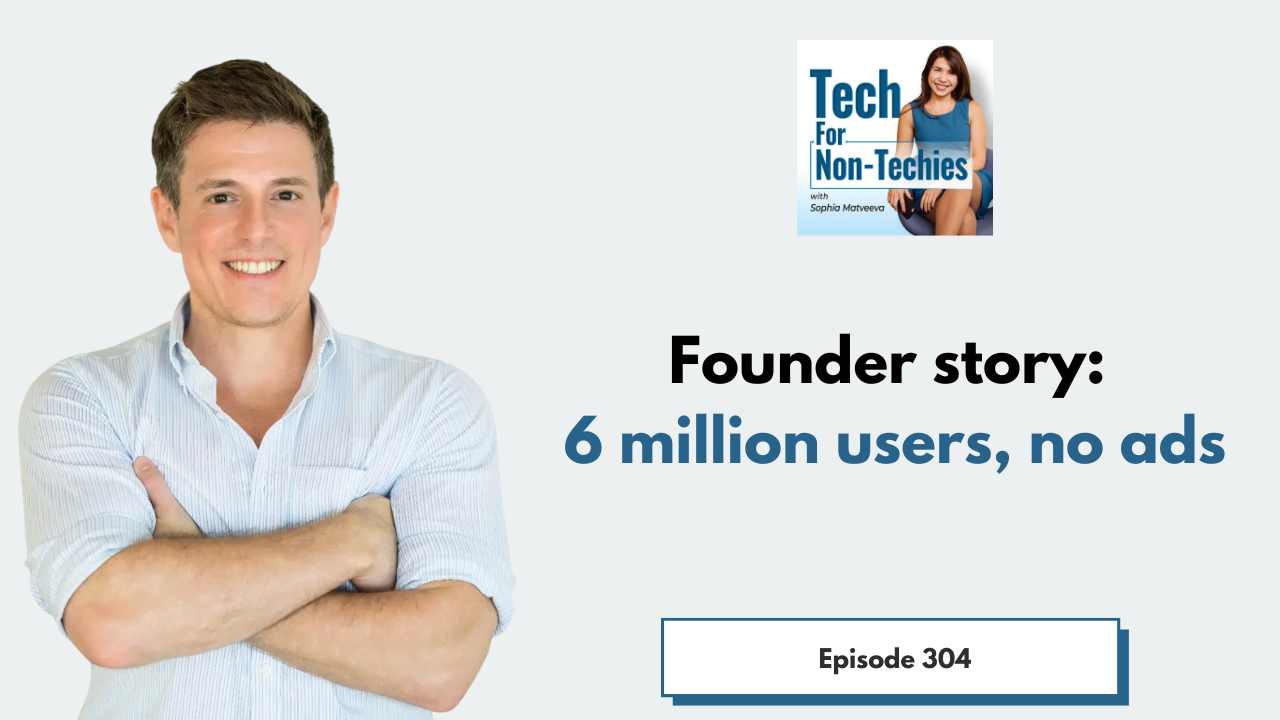
Can you build a B2C app to 6 million users with no advertising?
Colin Hodge did it when he co-founded Bang with Friends — a dating app that went viral purely through word of mouth — because he understood the psychology of his users so precisely that they couldn't help but share it.
In this episode, Sophia Matveeva speaks with Colin Hodge — entrepreneur, growth expert, and author who has scaled businesses to over 100 million users.
He co-founded a viral dating app, served as Chief Growth Officer for 17Live, Asia's leading live-streaming app, and re-acquired his own startup after selling it, growing it into a top 5 US dating app.
But this episode is not really about dating apps.
It is about the one thing that separates products that grow from products that stagnate: understanding your users deeply enough to build something they cannot stop sharing.
You'll learn:
- The overnight pivot that took a failing startup to a million users in three months
- Three practical techniques for getting inside the mind of your user, even if you are nothing like them
- Why the best user interviews feel like anthropology rather than sales
- Why critiquing your own product before user interviews makes you a dramatically better listener
Timestamps:
- 00:00 - Introduction: How Bang with Friends went from zero to 1 million users
- 04:51 - How a bad date launched Colin's biggest business success
- 08:48 - The pivot: From friends of friends to "Who has a crush on me?"
- 11:07 - Reaching 1 million users in 3 months with zero ad spend
- 14:36 - Lessons for boring businesses from a scandalous dating app
- 18:35 - Three methods to understand users who aren't like you
- 20:59 - Method 1: The method acting technique - Live your user's life
- 22:50 - Method 2: Build detailed personas beyond demographics
- 26:55 - Method 3: User research as an anthropologist, not a salesperson
- 27:52 - How to suppress your founder instinct and actually listen
Free AI Mini-Workshop for Non-Technical Founders:
Learn how to go from idea to a tested product using AI — in under 30 minutes.
Get free access here: https://www.techfornontechies.co/aiclass
Follow and Review:
We’d love for you to follow us if you haven’t yet. Click that purple '+' in the top right corner of your Apple Podcasts app. We’d love it even more if you could drop a review or 5-star rating over on Apple Podcasts. Simply select “Ratings and Reviews” and “Write a Review” then a quick line with your favorite part of the episode. It only takes a second and it helps spread the word about the podcast.
Listen to our podcast on:
Transcript:
[00:00:00] Colin Hodge: What we came up with was, well, I have this 2000 friends on Facebook. What if I could figure out which of my friends secretly had a crush on me and wanted to hook up with me? And that was the twist. It was going from friends of friends to very much casual and very much uncovering the secrets within your own friend network. So we came up with a very scandalous name. It was Bang with Friends.
[00:00:30] And everything about the branding matched that sort of angle, from the logos to the icon and the language we used in the app, the copy and all that stuff. So it was very much this pivot into, hey, let's get this thing noticed. Let's play directly to a deep curiosity and desire that a lot of people have. And it was of the moment because as I said, that was when, you know, Facebook apps were taking over.
[00:01:00] Sophia Matveeva: Hello and welcome to the Tech for Non-Techies podcast. I'm your host, Sophia Matveeva. If you're a non-technical founder building a tech product or adding AI to your business, you're in the right place. Each week, you'll get practical strategies, step-by-step playbooks, and real-world case studies to help you launch and scale a tech business without learning to code. And this is not another startup show full of jargon, venture capital theater, or tech-bro bravado. Here, we focus on building useful products that make money without hype and without code.
[00:01:34] I've written for the Harvard Business Review and lectured at Oxford, London Business School and Chicago Booth. So you are in safe hands. I've also helped hundreds of founders from concept to scalable product. And now it's your turn. So let's dive in.
[00:01:54] Hello, smart people. How are you today? In the last few episodes, we've spoken about AI, where to use it when you're building a tech product, where to avoid it and so on. This is very important for anybody building apps or platforms today. And you should definitely listen to the last couple of episodes. But today we are staying away from the AI conversation because despite all of the hype, it's actually not the only thing that matters. In fact, I would argue that what we're covering today matters far more. And that is user psychology. If you don't understand your users, if you don't get your customers, it doesn't matter whether you are an AI virtuoso, your product is just not going to go anywhere. But if you get it, your product could blow up overnight.
[00:02:44] You're about to hear how a dating app went from zero to a million users just by word of mouth. No advertising spend because the founder cracked the psychology of his users and that founder is Colin Hodge. He has scaled businesses to over 100 million users across his career. He co-founded a company called Bang with Friends. Yes, this is serious. This is what you're going to hear about today. And that was later rebranded as Down. And he grew that to over 6 million users with zero ad spend purely through understanding what makes people share something. And you'll hear why they were sharing it in this episode.
[00:03:28] He then served as chief growth officer for Seventeen Live, which is Asia's leading live streaming app. And you're also going to hear about how Colin scaled his first startup, sold it, and then reacquired it, growing it into a top five dating app in the US. In this conversation, you are going to hear three practical techniques for getting inside the mind of your user, even if you're nothing like them. So this is going to be super, super useful for you if you're a founder, if you're leading corporate innovation, basically if you're building anything new, this is going to be super relevant for you. And this is also going to be super relevant for you if you are leading something that you believe needs a refresh and you are thinking, okay, maybe growth has stalled. If growth has stalled, then that is the time to think, do we really understand our users?
[00:04:22] My aim for this episode is to help you think differently about how well you really understand your users. And this is actually the work that we start with with every single founder client that we work with. We help you build a test version of your product, get it in front of real potential customers, and then actually hear what they're telling you, not just what you want to hear. So if this sounds like what you need, then book a call with us. The link to book a call with us is in the show notes. Now let's learn from Colin.
[00:04:51] How a bad date launched Colin's biggest business success
Colin, tell me, how did a bad date launch your biggest business success?
Colin Hodge: When I was about 25 years old, I went on this disaster of a date that changed the entire trajectory of my life. It was so bad, so comical. In hindsight, I realized what happened on that bad date and a few others was I started to grow this really deep sense that this industry, the dating industry was broken and this problem was far from solved. And so it really drove me, drove my curiosity about why we meet the certain people we meet. You know, is it exposure through our friends, our family, workplace? Is it going on dating sites, et cetera? What gets us attracted to them? So the psychology at play in attraction, in finding people who are the right vibes, even if they're friends, but mostly for dating. And then how to turn that into a successful business.
[00:05:56] And when, you know, this bad date happened and I was feeling pretty much, you know, dejected after a series of just dates that didn't go super well, not as bad as this, but didn't go super well. I finally had the fire, the entrepreneurial fire in me to solve a problem that I was completely unaware of any of the other elements in the industry. I didn't have a training in any of that stuff. I wasn't a relationship coach. I didn't have a big network. I wasn't an influencer like we've seen a lot of dating apps start lately. And yet I dove into something unknown and that's what drove me to it.
[00:06:34] So fast forward, I dove into that dating industry and I ended up joining some accelerators, one of which was in Silicon Valley. And during that accelerator, I had another very just honest moment with myself and with the people around me where I admitted that my dating startup was just flat out going to fail. I thought there's no way it's going to work. It's not going to take off. It's not going to get investment at demo day, you know, at the end of the accelerator. And that honest conversation and reflection resulted in the pivot that created this monster of a dating app that did take off, that did finally get some traction with users and then investors. That was the journey. That was the impetus for getting into a successful startup and getting that to a million users within about three months. And that was the beginning of my career and this whole trajectory of being super curious about the psychology behind our consumers, our user base and how to grow them. And then of course, the psychology as an entrepreneur as well.
[00:07:55] Sophia Matveeva: So you've now written a book about user growth and user psychology. And from what I'm seeing from the story, apart from being exceptionally amusing, is that you were creating this startup based on your user experience and thinking, okay, if I've had these experiences as somebody who wants to have good dates, like that's the outcome I want. But instead of that outcome, I'm using these products and getting these other outcomes, which are not what I want. Okay. So I'm creating this as a user, as opposed to as an engineer or as a product manager or basically just somebody who's looking at purely from a commercial end. And so I'm curious, you mentioned that there was a pivot after you realized that things are not going to work as they are. We need to change something. What was that change and why did it work?
[00:08:48] The pivot: From friends of friends to "Who has a crush on me?"
Colin Hodge: Great question. And it's a, it's another scandalous one. So yes. The, the original idea for my dating site was basically I thought the best way to meet people was meeting a friend of a friend. So you have that person in common and they can help give you some vetting information. They can make sure it's safer. You're more likely to behave if you know somebody in common. So all these theories that I think still some of them hold valid. But what I was struggling with was getting users to pay attention because that sounds, you know, it sounds plausible, but it's not exactly something that makes people jump to sign up.
[00:09:34] And so the twist, the pivot that we came up with was, and, you know, you got to remember this was back in 2012, early 2013. So this was the heyday of everybody, it felt like was on Facebook and Facebook had their platform where you could connect to it and utilize that network, your own friend network. And so what we came up with was, well, I have this 2000 friends on Facebook. What if I could figure out which of my friends secretly had a crush on me and wanted to hook up with me? And that was the twist. It was going from friends of friends to very much casual and very much uncovering the secrets within your own friend network. So we came up with a very scandalous name. It was Bang with Friends. And everything about the branding matched that sort of angle, you know, from the logos to the icon and the language we used in the app, the copy and all that stuff. So it was very much this pivot into, hey, let's get this thing noticed, let's play directly to a deep curiosity and desire that a lot of people have. And it was of the moment because as I said, that was when Facebook apps were taking over.
[00:11:01] Sophia Matveeva: And so you reached a million people within three months. And how did that happen?
[00:11:07] Reaching 1 million users in 3 months with zero ad spend
Colin Hodge: Yeah, I think it took us about three months and it was crazy because what we did to seed it was I had two co-founders who, you know, we built it in basically a night and a lot of Red Bull and vodka and just creating this thing. And we just started sending it to our friends in the office, the accelerator office, our friend networks. But we were anonymous. So we were sending it as, oh my gosh, look at this thing we found or look at this thing somebody sent me. They didn't know we created it. That was the initial seeding of it. And it was such a curious, provocative idea that it really got spread by word of mouth initially. And once that started happening, then we started sending it to a few journalists. And one of them happened to take the bait, so to speak, and ran with a very short blog article on their website. Not even, I would say, like a real news outlet, but just one of these kind of like, you know, men's journals sort of blogs. And that one really exploded outside of our immediate networks and, you know, the word of mouth thing.
[00:12:22] So now we had two different fuels on the fire. And what came from there was massive amounts of press attention and massive amounts of users sharing the site to each other. We hadn't even built in yet a referral system. It was them just saying, check out Bang with Friends. Here's the link. But we didn't build in any way to properly incentivize them or track the referrals.
[00:12:55] Sophia Matveeva: So before I ask any more proper business and tech questions, I'm actually curious, was this more popular with men or with women or was it kind of equal?
Colin Hodge: Definitely more popular with men. But I will say, you know, we had a number of matches happen very quickly. There was one of the guys in the startup accelerator. He was probably user number five or something, if I remember right. And he got a match the very first weekend with somebody that he sent it to. So, and they went on a...
Sophia Matveeva: Good things happen.
Colin Hodge: Great things happened. He even shared a photo of them together. She and him were smiling and both said thanks. So it was fun for them. You know, I think she, they went to college together and graduated like two or three years earlier and, and yeah, hadn't reconnected since then, but this kind of brought them back together.
[00:13:58] Sophia Matveeva: Awesome. Wow. Connecting people. So I'm wondering, because I think when people are listening to this, it sounds like, yeah, this is really fun. And like, frankly, if I would have got it, I would have wanted to see it. Like the curiosity factor is a huge driver. But you know, for somebody who is building, let's say some software for accountants, they're thinking, well, okay, this is a really fun, interesting interview, but completely irrelevant to what I'm doing. So are there any lessons for founders who are building things that are basically useful but frankly much more boring than banging with friends?
[00:14:36] Lessons for boring businesses from a scandalous dating app
Colin Hodge: Absolutely. So it took me almost 20 years of my career to figure out the common thread between all of the successes I've had and frankly the failures was this understanding and actually getting into the mindset of your consumers. So yeah, if you are building software for accountants, you really need to understand who they are, not what their hookup needs are or their dating needs, but who they are in that moment when you're trying to get them to try out your product or if they're already using it, what part of the journey they are in so that you can optimize for that.
[00:15:20] I've built a number of businesses and helped a number of different companies to grow at different stages, one of which was a live streaming video app. That one very much not my audience. In fact, before I joined that company, I didn't ever watch live streaming video, but these are content creators or influencers who, you know, they are on video for two to four hours in a row, which is exhausting. And oftentimes they're 20 to 28 year old women who are good looking, you know, lots of makeup, chronically online because they're growing their audience and they're interacting with their fans and all that stuff. That was the furthest thing from who I was. So I didn't even have Instagram at the time. So I had to get into their mindset as well to recruit those content creators and make the experience very valuable for them and easier for them. At the same time, understanding the viewer's mindset of this new interactive media, which is very different than consuming a YouTube video or any other passive media.
[00:16:30] So that was a good challenge for me in a different type of business where I had to adapt to the mindset. I put myself into their shoes and really understand where they're coming from and what they're feeling in the moment. This stuff is so valuable, whether it is your own problem or it's a problem that you're solving for somebody else because the key muscle you're building is this empathy muscle for your customers.
[00:16:57] Sophia Matveeva: I remember when I was working in my first company and we had hired a user experience designer and our product was aimed at women. And the user experience designer was a man. And I remember thinking, is he going to really, like, is this really going to work? Because you need this intuitive understanding and essentially our product, the consumer side, women would take photos of outfits that they were thinking of buying or thinking of wearing and they would get feedback from other women and from professional stylists. So essentially you wanted, it was quite a kind of sensitive thing. And there's something that basically girls do all the time, send each other photos and say, like, I'm going on the stage, should I wear this? And I remember wondering, is a man going to fundamentally be able to understand this thing that we understand, that a lot of women really understand and do intuitively.
[00:17:56] And it ended up working, but I think it's because he wasn't dismissive. It's because he basically just really made an effort. And I think also it's because he spoke to his wife a lot. I think his wife was the brains behind a lot of our designs because he would test ideas on her first because he was so aware that he was definitely not the target user. And so what would be your advice to somebody who is, who wants to do a good job, but they're not exactly the target user. So how do they get into the psychology of the person that they're building for?
[00:18:35] Three methods to understand users who aren't like you
Colin Hodge: Yeah, that's really challenging. And with the live streaming app, I had a team of women on our marketing team and on our recruitment team for the content creators who I definitely give a lot of credit to. And I leaned on to understand these insights. So a big part of that, a big part of my work is trying to identify how do I get into the user shoes, even if it is channeling one of our team members and empowering them to be that representative to really understand what they're going through as a user. I talk about a few different methods in my book, and I think it really is a pick and choose sort of thing. You can do what feels most natural and easiest for you.
[00:19:26] So the first one, if you know a bit about acting, there's a technique called the method acting technique. So a lot of big actors use this and they basically live the life of their character. And so if you can do this, if you can go through the same sort of problems and situations that your customers will have, that is a super effective way. And of course it takes a lot of investment of your time, of your energy, of shifting your mindset and fighting your typical default decisions and default paths that you would go through, but it's really valuable.
[00:20:08] And I did that for the live streaming app where I became a live streamer. I went on camera at least once a week for three hours in a row. And I figured out how do you come up with content for three hours in a row and have people engaged and not have everybody leave and have them interacting with you and have them sending you these virtual gifts. So I was trying to live the life of a streamer for a bit.
[00:20:59] Method 1: The method acting technique - Live your user's life
And what I figured out is every streamer needs to figure out what are they best at? What do they enjoy doing? Because you can't do that much content without enjoying it. And so for me, I love singing and I love karaoke. So I ended up doing karaoke for half the time and that kept the hours rolling by and gave me an insight into, all right, this is what it's like to use the app as a content creator. This is what it's like to keep people entertained. So the first one, I would say the method mindset technique and trying to actually live the problems and the situations of your customer.
[00:21:35] Now, you don't always have to do that. So there are a bunch of other ways we can understand our users. Another one, if you've heard of personas. Personas are basically, you know, just briefly, it's building this character that can stand in for your typical customer and understanding all of the demographics about them. So their age, their income, their job, their family situation, all that stuff.
[00:21:48] Sophia Matveeva: So it's becoming like a real person as opposed to male 20 to 30 who of this income bracket is basically saying, actually I did an episode on this which was inspired by Ferrero Rocher and Kinder eggs. So he, the guy who founded it, he's, he created, the creator of Nutella who basically, I think should be made a saint. He became a billionaire and one of the people who really deserves to be a billionaire, deserved to be a billionaire because he brought us so much happiness. He had this image of Mrs. Valeria and that was the customer. So it was the Italian mother who wants to buy healthy-ish and affordable treats for her kids. And it was like, would Mrs. Valeria buy this? And he was very specific about who she was as opposed to saying, you know, Italian mothers with three kids of this age and this income. Is this what you mean?
[00:22:50] Method 2: Build detailed personas beyond demographics
Colin Hodge: Yes, exactly. So Mrs. Valeria would be Nutella's persona that they were thinking about and they use it. You can use it as a stand-in in all of your conversations and decisions about your product, about your marketing, thinking about how Mrs. Valeria would react to this, right? I take it a step further in that not only do we know her name and a lot of stuff about her, but I ask 10 more deeply psychological questions that will determine how she is interfacing and thinking about your product in this area. So I ask things like, where does she use your product? Is it, you know, in that case, it would be, she's in a rush in the afternoons to get a snack for her kids and she's in the kitchen and she has three kids running around and she just grabs it from the cabinet, throws it on some bread and hands it to her kids. Right. So that's the sort of deeper psychological questions I want to understand because then we can understand what she's feeling in that moment.
[00:23:52] She's feeling rushed, stress and that's going to inform things like the design of the jar and how hard it is to unscrew with one hand versus two. And so we do that for all of our products, even our digital products for a lot of apps. For instance, I talked to, I talked to my team and I talked to other founders and I tell them. Think about where they're going to use this. Is it like a long term, you know, long usage app, they're going to be in it for 20, 30 minutes at a time, just sitting on their couch or in bed, or are they on their commute? Are they in the bathroom, which we have to admit happens a lot, right? And it's like a five minute check-in here and then they go to another app. So understanding this really helps us to hone in on what is the persona that we actually care about and what are they going through in that moment? All the emotions, all of the things that are going to impact their decision environment that is going to drive their behavior.
[00:25:03] Sophia Matveeva: And so you mentioned that there were three things. So there was the become the person. That was number one. Number two was figure out the persona and where that persona uses the product. And so what's number three? We're dying to know.
Colin Hodge: Number three would be extensive user research, user interviews, and all of the stuff that I think a lot of people have heard. I give a bit more ideas of how to conduct these in the book. There are various things, whether you're a B2B business or you're B2C. It's basically you incentivize your customers, you segment them by these are the ones that are already loyal to us. So let's do a focus group and incentivize them to show up and then get some really good conversation and dialogue going so that they are just sharing their free flow thoughts with us and we're understanding what they're going through as a customer that's already there, that is already qualified or they're, you know, we can take another segment, customers that fell off and didn't become loyal users and incentivize them in a different way.
[00:26:22] So those are the deep dive, you know, super, you know, some teams have entire user research teams as a, you know, scrappy founder. I typically do it myself, because I really like being present when I see how people talk about the product or maybe even use the product and their emotions in the moment. And I can internalize that stuff a bit easier when I go through the user interviews and then of course the quantitative stuff like surveys and all that.
[00:26:55] Method 3: User research as an anthropologist, not a salesperson
Sophia Matveeva: We actually take people through the user testing process in our programs. And what I found we often have to say to people is that you have to be an anthropologist, not a salesperson. So you have to watch people in their natural habitat, behaving as they naturally do, and suppress your founder instinct to basically tell them why it's amazing. Because if they think it's crap, you really need to hear that. And so my final question is, what's your advice? How do you get people, how do you get really keen founders to be an anthropologist as opposed to a salesperson? Because I find that that's often so hard, you know, when you're getting feedback, especially if it's your first ever product and you're going through this for the first time, it's really difficult to sit back and just learn from what people are doing.
[00:27:52] How to suppress your founder instinct and actually listen
Colin Hodge: I wish I had this one trick to share that got people in that mindset. What I found the most useful for myself and for my team, so our marketing team, for instance, I tell them. Think about all the masks we put on, all the walls we put up in our brains about the product we live and breathe every day. Think about how much we want to advocate for it, especially as a founder. And we only want to talk about the good sides and we want to grow it as a salesperson, right? Now think about how liberating it would be just to critique it for a while, just to flip that and say, yeah, this part is shit or this part is bad. Just to like really open up and be critic about your own product. That is so liberating. And so when you do that, and I would even do that before you go into these user interviews. You can start to shift your mindset into OK, now I'm, I'm open to critiques. In fact, I want to find more. I want to hear more from those users.
[00:29:02] And it opens up maybe this pathway where now you are welcoming. In fact, I find myself pushing in the user interviews for like, you know, you went by that too fast. Tell me your real thoughts about this. How do you, you know, what do you feel about this color scheme? This logo isn't it a bit drab or, you know, you just try to get people to really feel comfortable giving you that critical feedback or at least the raw thoughts, because when you do, it opens up an entire new perspective and that's what you're going for as a founder. So it detaches you a bit from that very, you know, hopeful, positive, optimistic founder to, now I want to see through their eyes. I want to really get the real stuff. And so you become more vulnerable and more open to that vulnerability by already wearing that critic's hat beforehand.
[00:29:58] Sophia Matveeva: Colin, thank you so much for a really, really interesting conversation. Audience, I think this was really fun. I certainly enjoyed it. So if you want to hear more from Colin, and I certainly do, where can people find you?
Colin Hodge: Thank you, Sophia. You can find me at my website, so ColinHodge.com. That's Colin with one L. And when you go there, I want you to get the free sample of the book. I want you to definitely, if you buy the book, you can get free gifts. And this stuff is going to help you transform your company. So I'd love to hear back from anybody who reads it. Give me your feedback. Give me the ideas that spark for you and we can definitely talk further. So, colinhodge.com and looking forward to hearing from you.
[00:30:48] Sophia Matveeva: Wasn't that interesting? It was also kind of fun. And if this episode made you think differently about how well you understand your users, how well you understand your customers, well, then that was my aim. And understanding your users is exactly where we start with every single founder client that we work with. So we will help you build your test version with AI. We will tell you how to get it out in front of your potential customers and how to listen like an anthropologist, not a salesperson. This is exactly what you need to do in order to figure out what your next move is, whether you need to pivot or whether you need to persevere. Book a call with us and we'll tell you how that process would work for you. The link to book a call is in the show notes. And on that note, have a wonderful day and I shall be back in your delightful smart ears next week. Ciao.
Sign up to our mailing list!
Be the first to hear about offers, classes and events