300. 6 lessons from 6 years of Tech for Non-Techies
Apr 22, 2026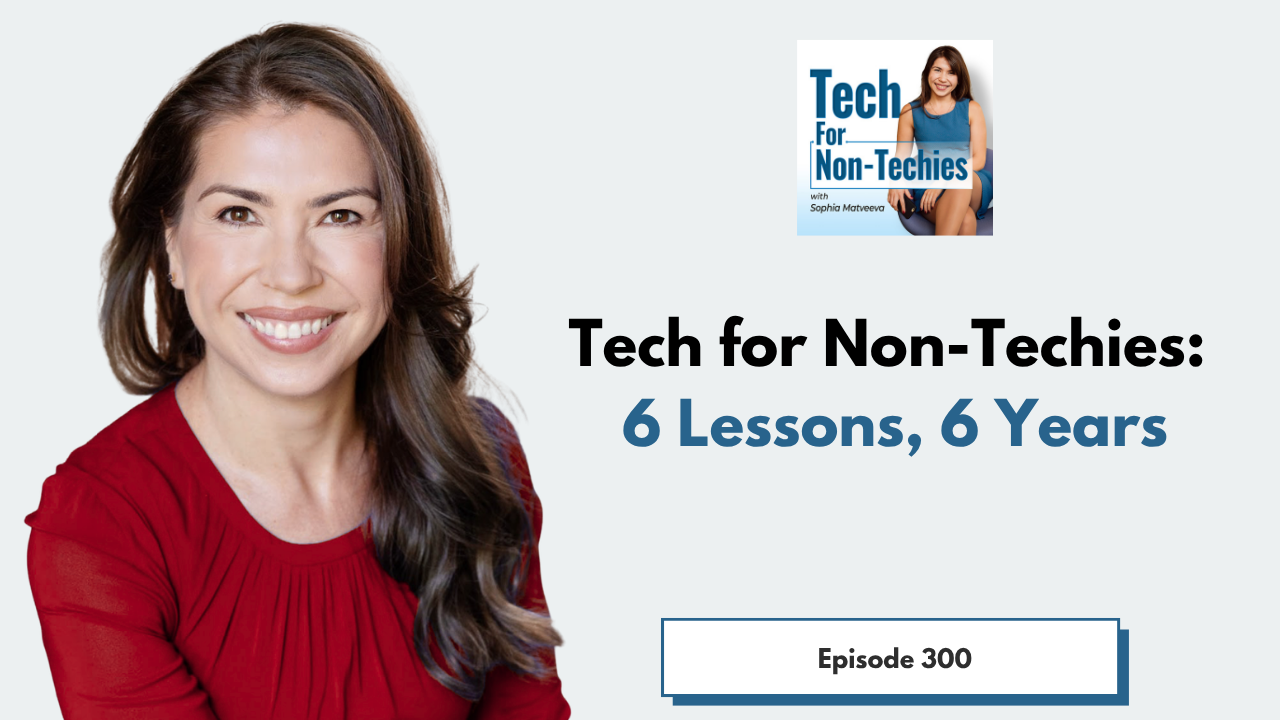
Six years of building a global business teaches you things no business school will.
What actually drives revenue. What wastes your time.
What you wish someone had told you before you started.
In this episode, Sophia Matveeva shares the six lessons that have shaped how she built Tech for Non-Techies — trusted by Oxford University, Microsoft, Techstars and the Royal Bank of Canada — without external funding, without a PR agency, and without a technical background.
You'll learn:
- Why fundraising and bootstrapping are both hard — and how to choose which hard is right for you
- Why your personal brand builds business faster than your company brand
- How to diversify revenue without losing focus
- Why human judgement is the scarcest resource in the age of AI
- That mind management is not a luxury — it is infrastructure
- Why paying experts is one of the best business decisions you will ever make
Sophia also shares the evening she was convinced her business was unsolvable, why she has no regrets about bootstrapping her second company, and what a billionaire founder and a Facebook marketing expert taught her about building for the long term.
Timestamps:
- 00:00 - Introduction: Six lessons from six years in business
- 02:46 - Lesson 1: Raising money vs getting customers - Choose your hard
- 07:28 - Lesson 2: Build your personal brand before your company brand
- 12:08 - Lesson 3: Diversify your revenue, but stay focused
- 14:29 - Lesson 4: AI is a game changer, but human judgment makes it valuable
- 16:48 - Lesson 5: Mind management is not optional
- 19:05 - Lesson 6: Pay experts to compress your learning curve
- 21:26 - Summary and closing
Free Live Masterclass — 27 April 2026
How to get featured in the Financial Times, Forbes and Wall Street Journal — without a PR agency
👉 Save your spot: https://www.techfornontechies.co/stand-out-masterclass
Follow and Review:
We’d love for you to follow us if you haven’t yet. Click that purple '+' in the top right corner of your Apple Podcasts app. We’d love it even more if you could drop a review or 5-star rating over on Apple Podcasts. Simply select “Ratings and Reviews” and “Write a Review” then a quick line with your favorite part of the episode. It only takes a second and it helps spread the word about the podcast.
Listen to Tech for Non-Techies on:
Transcript:
[00:00:00] Sophia Matveeva: I have raised money and I've bootstrapped. I've been on the front page of the Financial Times and I have sat on the floor of my home office regretting my life choices. And I've seen the metaverse hype, crypto madness and the dawn of generative AI. There are my six lessons from six years in this business.
[00:00:21] Hello and welcome to the Tech for Non-Techies podcast. I'm your host, Sophia Matveeva. If you're a non-technical founder building a tech product or adding AI to your business, you're in the right place. Each week, you'll get practical strategies, step-by-step playbooks and real-world case studies to help you launch and scale a tech business without learning to code. And this is not another startup show full of jargon, venture capital theater or tech-bro bravado.
[00:00:53] Here, we focus on building useful products that make money without hype and without code. I've written for the Harvard Business Review and lectured at Oxford, London Business School and Chicago Booth. So you are in safe hands. I've also helped hundreds of founders both from concept to scalable product. And now it's your turn. So let's dive in.
[00:01:21] Hello, smart people. How are you today? You know, I'm feeling quite in awe of myself right now because this is the 300th episode of the Tech for Non-Techies podcast which has come out every week for the past six years. That is dedication. And for those of you who have been with me from the beginning, thank you. Six years is a serious commitment and longer than some marriages. So from the bottom of my heart, thank you for being here with me. And today to mark this milestone, I wanted to share six lessons that I have learned from six years of building this business. There are many more, but if I share them all, it would basically be an ebook, not a podcast episode.
[00:02:06] And before we dive in, I want to tell you about a free class that I'm teaching on the Monday after this episode comes out. That's Monday, the 27th of April, 2026. And the class is called, How to get featured in the FT, Forbes and the Wall Street Journal without a PR agency. And the link to register for that is in the show notes. As you'll hear in a few moments, this is one of the skillsets that I have been able to use to build a global business without external funding. So if you want to achieve something remarkable, something really difficult that most people don't, then come to this class because this is a skill set that will really, really help you. Now, let's get started with my six business lessons from six years in business.
[00:02:46] Lesson 1: Raising money vs getting customers - Choose your hard
Lesson one, raising money is hard and getting customers is hard. Choose your hard. Now I have done both. I've raised money from investors for my first company and decided to bootstrap for my second. So I've actually been in business for much longer than six years, but Tech for Non-Techies, my second business, has been around for six years. Anyway, so raising money from investors and bootstrapping are both really difficult, but different. And I've seen too many founders assume that the path to building a successful business runs through investors. And I blame this on TechCrunch and their ilk. I blame media coverage that's super hand-waving, like, you know, there's this company that's raised this round, but have they actually, you know, created a product that people love? We don't know.
[00:03:44] Anyway, fundraising can definitely be a path to success. So for example, if you raise a round of funding, you can hire the right people, you can hire the people that you need immediately, and you can invest in marketing. And so you can go big really, really quickly. So you can grab market share quickly and aggressively, kind of like Uber did or PayPal did in the early days and obviously worked out really well for them and for their investors. But what I want you to know is that fundraising and managing investors is essentially a second full-time job and it's not really a fun job. You know, finding investors, pitching, managing relationships and investor reporting. My God, investor reporting is so boring. So basically that is a serious job and when you're dealing with serious investors, they want you to take it really seriously.
[00:04:38] You're actually also doing this all of the time because think about it. It takes 12 to 18 months to go from wanting to fundraise to basically closing a round if things go well. So the moment that your seed round is done, if you are the CEO, you're basically already hunting for investors for Series A. And this is a big time and energy commitment and managing investors can also get really tricky and you know, there will be times when an investor says, can my niece come in and do an internship with you? And that niece is really, really annoying and you can't say no and you're babysitting an adult. Maybe speaking from personal experience.
[00:05:22] Anyway, for my second company, which is Tech for Non-Techies, I have decided to go a different route. So I tried investors for my first company, for my second company, I decided to basically get consulting revenue. So basically do consulting, which is quite time intensive, but it also pays well, basically get consulting revenue and then fund long-term growth investments that way. So long-term growth investments would include things like this podcast, which I do for you for free, and Facebook advertising, which is expensive but effective. And so no investors means slower growth because I don't just pump hundreds of thousands of dollars into Facebook to generate demand. And you know, it also means that for ages, I was the only instructor teaching courses and doing product coaching and literally last year, basically kind of five years in, Rags Vadali joined us to teach one program and then stayed on.
[00:06:22] And he's the guy who launched Instagram filters to 600 million people when he was at Meta. So if you use Instagram, he has probably made you look really hot. And Rags was also an engineer at Google. So he is really top product and technical talent. And if I had funding, I could have hired people of his caliber and you know, people of his caliber are not cheap. I could have hired those people earlier to join me, but you know, that's the good stuff. But it would have also meant that I would have had to run a parallel fundraising and investor management operation whilst also trying to actually build the business. And I decided not to do that because I just thought, okay, this time I'm going to try this one. I'm going to see which one I prefer. And for me personally, I prefer this right now. I might change my mind later, but right now the bootstrapping, the consulting revenue, that's working for me right now.
[00:07:18] And it also means that I get to keep all of my equity. So if I decide to fundraise at some point later, it will be at a better valuation for me because essentially there will already be a lot of milestones that I have achieved as a founder for the business. It's going to be a better valuation than if I had raised early, which fundamentally means that I will make more money if I decide to sell. Anyway, the point is either path is not easy and choose the hard that suits you.
[00:07:28] Lesson 2: Build your personal brand before your company brand
Lesson two, build your personal brand before you build your company brand. And I know that for some of you personal brand might make you cringe. But stop cringing and listen to me. The thing is we relate to people and not to abstract concepts like businesses. And this is especially true when you're building something new and when you're building a tech product. So I started my career at one of the top financial PR firms in London. I basically got lucky because I was trained in this skill set. When I was working at this financial PR firm and it was called Finsbury at the time, now they've changed the name because they've merged with somebody. Anyway, we worked with the likes of KKR and Burberry and the Dubai government, really big and well-paying clients. And my email address alone could open doors to politicians, to media and to investors.
[00:08:34] And so when I started my first tech company straight out of business school, I knew that I did not have the brand power of KKR or Burberry. My business was unknown. And I knew that turning it into a brand would take basically lots of time and lots of money that I didn't have at the time. So I thought, okay, well, what can I do? I can build my reputation as a founder because I've learned how to do that. And I didn't need a marketing team to do that. So I hustled my way into writing for Forbes and I had a Forbes column for years. And actually it was that Forbes column that led to the creation of Tech for Non-Techies because it was in Forbes that I started writing about what I was learning as a non-technical founder. And people reached out to me and out of that came courses, consulting and a whole company. I also contributed to the Financial Times and I got featured in the Wall Street Journal, CNBC, BBC and so on.
[00:09:34] And the thing is, it worked. And when I say it worked, I basically mean it made me money and it saved me money. Because when I was getting press coverage for myself as a founder, my first company where I had investors, when I was pitching, investors would see me as credible before I even opened the pitch deck and clients wanted to meet me and I still have this happen. So actually I remember I got a contract for Tech for Non-Techies because a client had read something that I had written for the Harvard Business Review and they thought, okay, this is interesting. Let's talk to this person. Let's see what Tech for Non-Techies can do. And then that led to a really, really serious contract.
[00:10:18] In both cases, in both companies, my team has been proud of who they've worked for. And if you've ever tried to retain good people, you know how important it is. And so here's what I want you to remember. Before your product has traction as the leader, as the innovator, you are the product and investors are backing your judgment, your judgment. Early customers are taking a chance on your credibility and on what you think is true. And also today, in the age of AI, there is another dimension to this because let's say a potential investor, they got interested in you, but they want to research the market. So they'll go to ChatGPT or Claude or Gemini or whatever, and they are going to ask who are the credible voices in your industry, who are the credible voices in your space. And the thing is when ChatGPT answers them, they are going to get their answer from serious publications like the FT, the Wall Street Journal or Forbes.
[00:11:18] So the point is if you want your venture to succeed, focusing only on your product, unfortunately is not enough. This is actually good news for non-technical founders because yes, you can work on product innovation, but you can't code. You can't really get into the weeds of building. And so when your engineers are building your product, you should be focusing on your brand, which is why I'm teaching the free class that I told you about on how to get featured in the FT, Forbes and the Wall Street Journal without a PR agency. And that class is happening on Monday, the 27th of April. And this is the skill set that is honestly one of the key factors that has helped me to build a global business. So come register via the link in the show notes and learn the super, super important skillset, which will basically help you achieve your aims faster.
[00:12:08] Lesson 3: Diversify your revenue, but stay focused
Lesson three is diversify your revenue, but not so much that you lose focus. So Tech for Non-Techies is now six years in, we've got government clients. So there are Gulf ministries where we create national programs for countries like Bahrain and Saudi Arabia, and these are large multi-year contracts. And we also have individual founders working with us one-on-one and we have our online courses. And also we're working with B2C. So literally there'll be an innovator, a person who has an idea for an app and has no tech skills to build it and so we help them understand what it is that they need to do. And I genuinely love both ends of the spectrum. And I think that they complement each other because too many people who work with governments or large companies have never actually built anything themselves. They're just professional consultants, professional PowerPoint makers, and too many founders are stuck in the details of their business so much that they don't actually have a strategic view on where their industry is going.
[00:13:18] And so sitting with a founder and getting into the tactics of what makes a product succeed, and then the next day talking to a government minister about upskilling an entire population for the age of AI makes me a better advisor to both, but the more important reason for this diversification is actually business resilience, as in cash flow, basically. If one of these revenue streams fails, we've got another one. So if a large contract gets canceled, we have another option. And so here's what not to do. Do not rely on one source of revenue or one source of customer acquisition. I know businesses that depend entirely on Meta advertising to get new clients.
[00:14:04] And this is great when Meta is working for you because it can be a really, really great source of new customers. But I also know businesses whose Meta advertising accounts were suspended for no reason, literally just by Meta's AI and that account recovery took months. And if you don't have any other way of bringing in customers or bringing in revenue, that can literally destroy you. So yes, diversify, but remember, don't be diversified so much that you're pulled in lots of different directions because if you're listening to this, I'm assuming you're not running a massive conglomerate with huge, huge teams. And so actually you want to be diversified, but not so much that you don't know what you're doing, you don't remember all of your clients. You need to remember to stay focused. Diversity should give you stability, not chaos.
[00:14:29] Lesson 4: AI is a game changer, but human judgment makes it valuable
Lesson four, head of my six. AI is a genuine game changer, but human judgment is what makes it valuable. In the last six years of running this company, I have lived through various tech hype cycles. So there was the metaverse hype, crypto, 3D printing, and I'd say metaverse is the craziest one, but I've watched each one arrive with enormous fanfare and then quietly recede. And what I can tell you is that AI is different because it is genuinely reshaping every industry and it is changing how non-technical founders can build products, which is obviously super relevant for me and you.
[00:15:14] So what we tell founders to do now has changed as a result. So our courses like what we deliver, the information and the consulting and the coaching we do is literally different now because now you can build a fairly impressive early product without any technology, which was definitely not the case, you know, five or even three years ago. The thing is, I also want you to know that AI is not the answer to all of your problems as a non-technical founder, unfortunately. Because if you want to scale, if you want to build something that you charge for, if you want your product to have security, which you do if you're going to take people's money for it, you still need to work with professional developers just at a later stage. And your job as the leader is to know when to use AI and when to call in the pros and also what to expect of the pros because your engineers are also going to be using AI. You just don't need somebody who's going to be completely generating code with AI and not checking it.
[00:16:14] Anyway, the more AI can do, the more valuable your judgment as a human becomes. This is why our offering now includes live product coaching and learning from the leading global product experts. So Rags is literally a person who has made 600 million people look hot on Instagram. And I am the world's top expert on non-technical founders. And my company essentially owns that category. And AI means that knowledge is everywhere now. So if I was just telling you, okay, these are the things that you need to know and pay me and then I'll just tell you what you need to know as a non-technical founder. Frankly, my company would not succeed. My company wouldn't be around today because knowledge is everywhere, but it's that human judgment that's really scarce. It's expert judgment that's really, really scarce, which actually is something that you'll hear about in a few minutes. The point is, if you're building something, yes, you need to learn how to use AI to build and test, but it's human judgment that is the skill that you need to hone.
[00:16:48] Lesson 5: Mind management is not optional
Lesson five. Mind management is not optional. Now your monkey mind will eat you alive if you let it. And entrepreneurship will make you face your inner crazy like nothing else. And you have to know how to manage the most anxious, the most worried and the most depressed side of you. So for example, and this literally happened like last week. It was evening and there was an issue in the company that I just genuinely believed that I could not solve, that it was unsolvable and I was just like, that's it. I am really terrible at this whole entrepreneurship thing. I got really upset and basically just decided that this is it. I have no idea what I'm doing. And then I realized, okay, I'm tired. I haven't slept well. And it's also been a really miserable gray day. And I knew myself now that I know that when I'm tired and when I haven't seen the sun for a while,
[00:17:48] I basically get really negative and I just focus on all of the worst things in a situation and often I don't see a way out. So I literally just said to myself, you are not fit for human consumption right now. Go to bed. Do not listen to whatever crazy negative thoughts your brain is coming up with and just see what happens tomorrow. And literally the next day I had a solution to the problem that 10 hours before I thought was completely unsolvable. And I literally laughed at myself because I was thinking, oh my God, I was so dramatic. I was so dramatic. I'm so glad that when I was being really dramatic, I knew myself well enough to just step away from the laptop and go to bed. And this is what I mean by mind management. Your mind is going to do all sorts of crazy things, but you need to know when to listen to it and when to say, okay, I'm not doing my best work right now. I need to stop.
[00:18:42] And there's this billionaire founder called Brad Jacobs. And he wrote a book called How to Make a Few Billion Dollars. And in his book on making a few billion dollars, which he has done over and over again, he actually talks about the importance of mind management and his mindfulness practice, which actually is quite similar to mine. So it's meditation, it's also watching your thoughts, it's also not believing your thoughts. And for me, it's also been working with coaches. If you don't believe me, listen to him because he's made several billion dollars. And the reason why this is super important if you're innovating is that entrepreneurship and innovation, they're really, really hard. Not just at the beginning, but at every single stage. And I've got a friend who has IPO'd his company and he still says that it's really difficult, but just in a different way because the problems are different, right? There are still going to be problems post IPO when you're running a publicly listed business. And there are problems when you are just starting out and working on your first ever prototype.
[00:19:42] Because when you are creating something new, you're going to face rejection and you're going to face failure. And that sucks. You cannot let that suckage grind you down. And this is why in our programs we've now included mindset coaching. And I would say that it's made a huge difference to our clients' results because when you have mindset support and you've had something that didn't go well, which always happens when you're building something new, then that mindset support basically allows you to recover more quickly and to keep going. And that means that you make more of your time and more of your money than you would if you basically had no support and just sat there and wallowed after every single rejection for like two weeks. Which brings me to my next point.
[00:19:05] Lesson 6: Pay experts to compress your learning curve
Lesson six, pay experts to compress your learning curve. And I do this all the time and I recommend that you get into the same habit. So you can learn a lot of business skills and a lot of tech skills yourself without any help or instruction. You can go on YouTube, you can listen to podcasts, you can get books, and then you could just use your own trial and error to basically learn how to do something. The thing is, just because you can doesn't mean you should. Getting expert help shortens your timeline and you get results faster. You make more of your time and more of your money. The thing is, time, unlike money, is a resource that does not renew.
[00:20:26] So, I'll give you a personal example. Right now, I am in a mastermind program on Facebook marketing run by an expert called Claire Pelletreau and the program is called Get Paid Marketing and it costs $15,000 a year so it's not cheap and I could have theoretically figured out what Claire teaches by myself eventually but honestly I shudder at the thought. I'm so glad that she exists and that I can just pay her and she will give me her knowledge because it would have taken me years of trial and error and wasted ad spend and just pain to have got the results that she's helping me get within literally a few months. And I chose to pay to get that time back to make my life easier. And this is a really excellent business decision that has sped up the growth of my business because yes, I am making mistakes on Claire's watch. I'm definitely learning, but that is happening so much faster than it would have been if I had been without her.
[00:21:26] So yes, there are things that you can theoretically figure out alone, but if there is an expert who has already figured it out and you can afford to pay them, then just do it. And if you can't afford to pay them, then make the money and then pay them because the money is going to come back and the time is not going to come back, right?
[00:21:26] Summary and closing
So let's summarize. Here are the six lessons that we've covered today. Lesson one, choose your hard, investors or customers. They're both difficult, so just know what you're signing up for. Lesson two, build your personal brand as an innovator early because building a company brand is going to take quite a long time. Lesson three, diversify your revenue, but stay focused enough to be good at what you do. Lesson four, AI genuinely is a game changer, but human judgment mixed with AI, that's what makes you irreplaceable today. Lesson five, manage your mind. It is honestly the most important business tool that you have. And lesson six, invest in experts because money renews and time does not.
[00:22:24] And on that note, I'm asking you, have you signed up to my fantastic free class on how to get featured in the FT, Forbes and the Wall Street Journal without a PR agency that's happening on Monday, the 27th of April? Now, this is where I will teach you the core skill set that has helped me build a global business without external funding. This is a skill set that makes customers, investors and employees come to you and that is real money. The link to register for that is in the show notes. And if you have been listening to this show for a while and you haven't yet left a rating and a review, this would be a wonderful anniversary present for me. So I suggest that you get your phone out, find the five star symbol and move your thumb over to it and press. It will literally take 10 seconds and it's going to make a genuine difference to how people find the show and it will make me feel warm and fuzzy on this anniversary episode. So thank you in advance. And on that note, I'm wishing you a wonderful day and I shall be back in your delightful smart ears next week. Ciao!
Sign up to our mailing list!
Be the first to hear about offers, classes and events