286: Lessons from Meta and Google for non-technical founders in 2026
Jan 07, 2026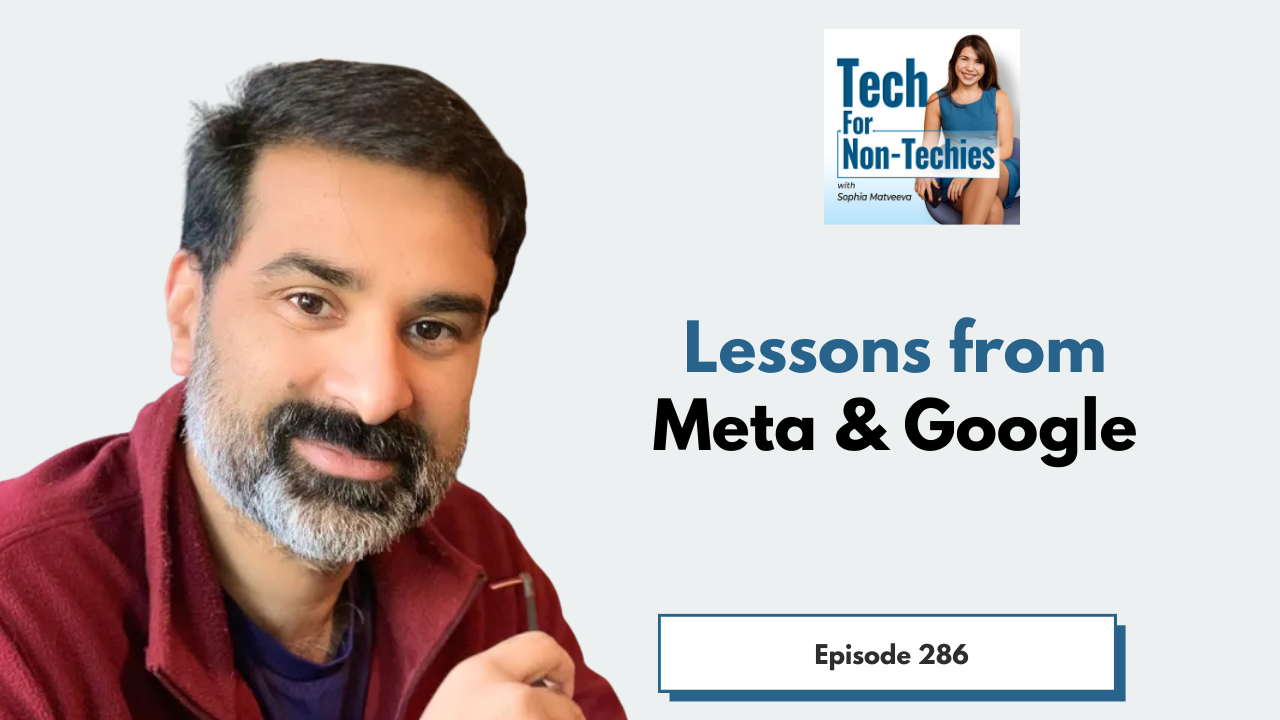
Even billion-dollar teams start simple first.
Rags Vadali's team at Meta gave small businesses in Brazil two phones—one red, one blue—and spent two months tracking every customer message in a spreadsheet.
No fancy tech. No code.
Just analog data collection.
That experiment validated what became a $5 billion product.
In this episode, Rags explains why the hardest part of building a tech product has nothing to do with technology—and why non-technical founders who understand this have a massive advantage in 2026.
What you'll learn:
- Why Meta validated billion-dollar products with spreadsheets before writing code
- The difference between what to build (your job) and how to build it (AI's job)
- Why talking to customers beats "figuring it out" behind your computer
- Why 2026 is the best time in history for non-technical founders to start
If you're ready to stop overthinking and start building, this episode will show you exactly where to begin.
P.S. This January, Rags is joining Tech for Non-Technical Founders as a guest instructor.
If you want 1:1 coaching from someone who's launched products to 600 million people, enrollment opens January 13th. Details at the end of the episode.
Resources from this Episode
FREE class: From Business Owner to Tech Founder, without the $100,000 developer disaster
Join this class to learn:
- The 2-step framework to go from idea to scalable tech product
- Why smart business owners waste $100k+ on their first tech venture—and how to avoid it
- When AI helps vs. when it destroys products (and your ROI)
Sign up here: https://www.techfornontechies.co/january
Follow and Review:
We’d love for you to follow us if you haven’t yet. Click that purple '+' in the top right corner of your Apple Podcasts app. We’d love it even more if you could drop a review or 5-star rating over on Apple Podcasts. Simply select “Ratings and Reviews” and “Write a Review” then a quick line with your favorite part of the episode. It only takes a second and it helps spread the word about the podcast.
Listen to Tech for Non-Techies on:
TRANSCRIPT (Unedited)
[00:00:00] Rags Vadali: I have seen. Too many people who have, who are non-technical founders, who have gone and struggled with, they're spending all of their time figuring out how to get something built, either with the consultant or with the outsourcing team, et cetera, because they think that because they're non-technical, the biggest thing they need to compensate for is the tech part of it.
[00:00:23] Nothing could be further than the truth.
[00:00:30] Sophia Matveeva: Hello and welcome to the Tech Phon Techie Podcast. I'm your host, Sophia Matava. If you're a non-technical founder building a tech product or adding AI to your business, you are in the right base. Each week you'll get practical strategies. Step-by-step playbooks and real world case studies to help you launch and scale a tech business without learning to code.
[00:00:55] And this is not another startup show full of jargon, venture capital, theater or tech bro bravado. Here we focus on building useful products that make money without height. I'm without code. I've written for the Harvard Business Review and lectured at Oxford London Business School and Chicago Booth. So you are in safe hands.
[00:01:15] I've also helped hundreds of founders, both from concept to scalable product, and now it's your turn. So let's dive in. This episode is sponsored by Tech for Non-Technical Founders. The program that helps non-technical entrepreneurs go from idea to market ready product without wasting $100,000 on avoidable mistakes.
[00:01:37] And if you're a non-technical founder who has already spent thousands of dollars and months of time on development, only turned up with nothing really ready to show for it, well, you're not alone. And if you haven't hired developers yet and you're wondering where to start, well that's even better because.
[00:01:54] The biggest mistake I see after coaching hundreds of non-technical founders is not hiring the wrong people. It's actually hiring before you know what you're doing. And that's exactly why I'm hosting a free life class on January the 13th to 2026, called From Business Owner to Tech Founder without the 100 K developer disaster.
[00:02:16] I'll walk you through the exact two-step framework that I've taught at Oxford, London Business School and Techstars, so you can finally understand why smart, capable business owners blow $100,000 on their first tech venture. We'll cover when AI actually helps versus when it destroys your product, and we'll cover how to think like a tech founder instead of a developer client with a credit card.
[00:02:41] I'll also give you the behind the scenes preview of the Tech Nontechnical Founders Program so you can see what's possible with the right guidance and the right process. So make sure to sign up to the free class on January the 13th at Tech Non-Techies Dosio slash January. That's Tech Non-techies slash January.
[00:03:03] And the link is also in the show notes because the next 100 K you spend. It should go toward growth and not towards painful lessons.
[00:03:16] Hello, smart people. How are you today? How is your 2026 so far? You know, I'm genuinely feeling really good about this year, and I hope that you are too. And to kick off this year. I am giving you a really amazing episode, and I don't say that lightly. You are going to hear from somebody who has taught me a lot of what I know now.
[00:03:39] My guest today is Rags Vadali, and this is actually his return to the Teon Techies podcast. He was one of the first people that I ever interviewed, and it's actually. Very likely that you have used the product that he has built, but you don't know his name. Rags has spent 17 years at Google at Meta and at multiple startups working at the very heart of product creation, and right now he leads his own AI startup.
[00:04:07] Rags helped found the YouTube partner program. He launched the click to WhatsApp ads at Meta, and now it's a multi-billion dollar product, and you'll hear all about that later. And he has also led teams that brought AI face effects to over 600 million people on Instagram. So you know, when you look really good on Instagram, that's basically thanks to rags.
[00:04:30] And obviously your amazing genes, but what makes this conversation especially relevant for non-technical founders is not just what he has built but how he thinks. So at Google Rags was taught a deceptively simple idea that has shaped his entire career. A product manager's job is to figure out what to build.
[00:04:50] Not how to build it. And that mindset is exactly why product managers so often become founders and vice versa, as you'll hear today. And also why so many founders who don't have this mindset why they basically don't succeed. So in this episode, you will learn why product management is one of the most powerful founder skill sets.
[00:05:13] You'll learn why even meta validated ideas with spreadsheets and field experiments before writing code. And they can afford developers obviously, and you'll learn why talking to customers beats clever tech every single time. And why? Despite all the AI hype, the real bottleneck has never been technology.
[00:05:35] It's actually clarity. And now I have a treat for you. In January, rags will be joining as a guest instructor in the Tech for Non-Technical Founders program. That means that if you join the program this month, this January, you'll get three one-to-one coaching sessions with somebody who has literally built products you could buy hundreds of millions of people and rags is going to help you prototype, test, and decide what to do next, whether to build, to hire, to fundraise, or to pivot.
[00:06:09] And he has done all of these things. Startup and also at massive scale. So this is an extraordinarily rare opportunity, and if you want 2026 to be the year that you build your tech venture, you couldn't get better advice than this. And on that note, let's learn from Rags.
[00:06:36] Rags. I want to begin this episode by thanking you for making me look really pretty online because you are one of the key people who has created AI effects on Instagram. And so what were you actually doing at Instagram to make, you know, millions of people look hot?
[00:06:54] Rags Vadali: Well, you and 600 million people I suppose.
[00:06:58] So I was a product manager management lead at Meta leading Spark. So Spark is Meta's augmented reality platform for creating mobile based ar. So in that role, me and my team, we. Enabled all of the AR effects that people may have experienced across Facebook's platform, right? These included face effects on Instagram Messenger, things like that.
[00:07:29] So
[00:07:30] Sophia Matveeva: basically all of the face filters that we've now can't live without that. That was basically your fault. That's amazing. And so what is a product manager? Can you tell our audience? Because I think people probably understand what a developer is. People probably understand. Okay. The business side sells stuff.
[00:07:51] What's a product manager?
[00:07:53] Rags Vadali: Uh, great question. So, uh, that takes me back almost 20 years when I started out as a product manager and my first product management education was at Google and I was told a very simple definition of what a product manager does, right? I was taught that the role of a product manager is to figure.
[00:08:11] What to build. And you work with experts, developers, designers, data scientists, et cetera, who focus on how to build it, right? So that was the very simple definition, and I have actually found that. It has actually been true throughout my entire career, right? Uh, there's a bit of complexity, obviously, behind the simplification because in figuring out what to build, there is all of these hard questions you need to answer, right?
[00:08:41] What's the problem you wanna solve? Who do you wanna solve it for? Why is it the right time to solve? Now this. Now how are you gonna make money? So all of these questions are the ones that you work through to finally get to, okay, this is what we are gonna build.
[00:09:00] Sophia Matveeva: Well, this actually sounds like the skillset of a founder, right?
[00:09:05] Because as a founder you have to know exactly what problem you're solving for whom you know. You also need to think about are they willing to pay for it, or is somebody willing. For them, pay them to use the solution. So it's really this founder skillset. Absolutely. So is there an overlap? Yeah.
[00:09:24] Rags Vadali: Yeah, a hundred percent.
[00:09:26] So, uh, I don't know if you're, you're probably aware of it, but product managers have, at times in Silicon Valley, also been referred to as CEOs of the product. Right. And that is not by accident because to your question. I would say, I mean, in fact, I would push to say product management is probably the most critical skill, if you will, for founders amongst like, you know, if you had to choose between writing code, designing, et cetera.
[00:09:52] Because yeah, you are essentially doing everything that you need to do to not just get something built, but then to make it successful as a product and eventually make it successful as a business.
[00:10:05] Sophia Matveeva: You know, there's actually one of the things that I have noticed is that a lot of the people who have become very successful in the tech world actually started off their careers as product managers.
[00:10:17] And the two people I'm thinking of are Satya Nadella, the CEO of Microsoft, who basically rose up through the ranks as a product manager and also Chicago Mni a, like the both of us and Ben Horowitz. The co-founder of Andreesen Horowitz, and you know, both of these guys are like Silicon Valley royalty, right?
[00:10:36] They're billionaires and it's interesting that, you know, especially in Sat NA's case, he is leading this tech, you know, huge tech company, but he rose through the ranks of product management rather than through engineering. And so why do you think. That is that once you get the skillset, yes, you can run a startup, but also.
[00:11:00] Basically lets you run multi-billion dollar companies as well.
[00:11:04] Rags Vadali: Yeah. This is, this observation is, it's everywhere now, right? We can add a third name to it. Sundar Phai. Phai at Google. Oh, him too. I didn't know that. Him too. Right? The reason is that. What you're doing and learning as a, as a product manager is actually a very generalist set of skills that start from when you think about as a product manager, the scope you're playing with is, how do I build a product?
[00:11:32] How do I make it successful? Actually, it's the same set of skills that are applicable when you go one level higher. Okay? It's not just a product, but it's a family of products, right? How do I make this successful? All the way through to, okay, it's now a company which is a collection of a whole set of products or platforms, and how do I make those successful?
[00:11:54] So it is a very transferable skillset from execution all the way to, uh, leadership.
[00:12:01] Sophia Matveeva: And, you know, I remember way back when, when I was actually at business school, so about to graduate from Chicago Booth and I was thinking, do I do this startup or do I go and get a proper job in big tag? I remember one of my classmates said to me, well, you can always go and get a corporate job.
[00:12:18] You know, like that's, that's root is always there, but. Even if you do the startup and even if it fails, then essentially you'll be able to get a better job in corporate in a, in a quicker timeframe than you would if you had to start now. And for me, that was, I think, the final push because I was like, hang on, am I completely insane?
[00:12:41] What am I doing? But when he said, you know, heads I win tails, I. I wonder what it is about kind of both. So you've just explained the product management skillset, but I also think the hyper responsible skillset that you get as a founder, because you know, if you don't sort things out, you don't get paid. Or if you don't sort things out, your people don't get paid, which actually I think in my experience, feels worse.
[00:13:10] Way worse. So I think once you get both of these skill sets, even if the startup doesn't work. Or that startup doesn't work. Then for the next one, people are willing to fund you and the next time people are willing to hire you. And so when you were hiring product managers at Meta. Did you work with former startup founders?
[00:13:36] Was that, was that the case?
[00:13:38] Rags Vadali: Absolutely. Not everybody was a, a former startup founder, but actually there's an even more interesting thing that Meta would do. So Meta would acquire a lot of companies. Right. You know, and they, they acquired, they do a lot of acquisitions. All the big ones do. But at Meta, the founders of these acquired companies.
[00:13:57] They would basically come in as product managers.
[00:14:01] Sophia Matveeva: Oh, that's so interesting.
[00:14:02] Rags Vadali: Right. Absolutely. Right, because exactly to what you said, right? The skill sets and what you do are so complimentary. Right. There's something about how a product manager, how good product managers work, which translates to founders is actually the sense of ownership that they take about the products, right?
[00:14:27] And, and, and that I think is what is the crossover? You see PMs go and become founders. And then when, when you, when people hire, uh, you know, when they bring founders in, they wanna make them PMs because they want basically leaders of these products who are gonna get that sense of ownership. That, okay, I wanna make this successful at all costs.
[00:14:47] Sophia Matveeva: How interesting and you, over the last 17 years, you've worked at the biggest big tech company, so Google EM Meta, and you've also worked at startups as the head of product and you're also now running your own startup. And so having seen product manage management and like seen the skillset literally from a tiny startup to the biggest tech company, what are the differences between how it's done?
[00:15:17] Rags Vadali: Great question. So this is changing by the way, like in the last year or two with like AI and the tools and everything that's available, right? So traditionally. The differences were quite easy to pull apart, right? So you went into a big company, you get a lot more structure, you get a lot more support from all sorts of functions.
[00:15:37] So you're not kind of like a lone wolf kind of a person. But the compromise there was you probably went a lot slower. You had to navigate bureaucracies, right? Like, you know, and all of that kind of stuff. Yeah.
[00:15:47] Sophia Matveeva: Normal, big company stuff.
[00:15:49] Rags Vadali: Exactly. Counter that with a startup, you were resource constrained as a pm you just had one engineer when you could have done with four, you know you are, yeah.
[00:15:57] You're working with far fewer budgets for tools and everything. However, you had a sense of focus and purpose where you just. Pull up your sleeves, jump in and do what you, what you needed to do. Right. So actually go, this, this correlates back to your earlier observation about what you were told going into startups versus, you know, big companies.
[00:16:18] Right? The rate of growth as a PM or anybody else actually in a startup typically tends to be much higher than in a, a bigger company. Right? There are also some differences. The other side, the biggest one I have realized over the years is. Big companies have access to customers and data, right? And that materially affects your role in a very different way.
[00:16:43] So if you're in a startup, you build something. Taking that product to market is infinitely. More difficult than doing the same thing in a big company. Like, you know, I'll take back to where we start, right? Yes. We could reach 600 million people with face effects that, uh, that we were building, right? The product had to be good.
[00:17:05] Absolutely. But once we did, we did have. Access to a whole bunch of people who are using Facebook and Instagram tools, right? Compare that to startup building the same tools. Well, they could probably build better tools, but where they would really struggle is how do we take it to market? So that, that's where I think the, the experiences kind of.
[00:17:26] Are similar and differ.
[00:17:28] Sophia Matveeva: That's such a good distinction because I find that when founders join our programs, you know, because our programs are really, they, yes, they focus on creating a, a thing, you know, whether it's an app or platform or whatever. But I always say like, we literally have a module on baking growth into your Don't happen.
[00:17:50] Students to create something that's perfect and then it's out. Let's say it's an app and it's out on the app store and by that point they've ran outta money and they ran out of steam and they're like, yeah, but it's so great. It'll go viral. And I mean, I wish, I wish it could, but the likelihood of that is tinier.
[00:18:09] Yeah, it's So what would you say to that founder? You know, if they, they're coming to you with an idea and you also kind of wanna, you wanna warn them? To make that they don't end up in this trap.
[00:18:22] Rags Vadali: Yeah. Uh, it's a great question. I think I, it is one of the biggest, you know, traps, right? That for, for, for founders, and, and actually I would say it doesn't matter whether they're a technical founder or a non-technical founder, this is a founder thing, right?
[00:18:35] So I think what I would, what I would really, em, you know, want to emphasize on that emphasize is try to find, I wouldn't say product market fit, that's like a bigger word, but. Try to work at least in parallel on talking to your customers, understanding the problem, right. And getting your own internal sense of of are we building the right thing right before you kind of go and invest a lot of time and money in building something, right?
[00:19:08] I have seen. Too many people who have, or non-technical founders who have gone and struggled with, they're spending all of their time figuring out how to get something built, either with a consultant or with the outsourcing team, et cetera, because they think that. Because they're non-technical, the biggest thing they need to compensate for is the tech part of it.
[00:19:31] Nothing could be further than the truth because actually the more clearer you are in terms of exactly what is the problem that you wanna solve and, and, and what you want to build, the building of it becomes that much more easier, and in fact, sets you up for being more successful.
[00:19:48] Sophia Matveeva: And yeah, the only way you figure out what you're building and for whom is by actually speaking to people.
[00:19:52] Which reminds me of the story you told me about when you flew your team out to Brazil, when you were at Meta. So what happened there and why wasn't I invited?
[00:20:03] Rags Vadali: Well, I couldn't go there too because if I recall, I think maybe it was. Took too long for me to get a Visa, but this is a fascinating story. I think it is probably my it, it is right at the top of my life experiences as a product manager.
[00:20:17] Right? So this was at a time when I was on the ads team at Meta and we wanted to figure out how. Users were interacting with businesses using WhatsApp. So this is in 2017, right? Early days of WhatsApp. But WhatsApp is end-to-end encrypted. So we really had no data to understand this in a typical way that, you know, meta would understand, uh, products right by you by looking at user data.
[00:20:44] So we came up with this. Incredible kind of experiment we wanted to run where we, uh, went to Brazil, we recruited a set of small businesses. We gave them literally two phones, a red phone and a blue phone, right? And then we basically set up and ran a whole bunch of ads with different kind of like creatives, et cetera, some of which would, uh, these ads are targeted users, and we wanted to see if they would contact these businesses and on the business end.
[00:21:15] For about
[00:21:16] Sophia Matveeva: two
[00:21:16] Rags Vadali: months, we made them actually basically write down everything that was happening in a spreadsheet. Every time somebody sent them a message or their thing, which of them resulted in a, in a sale? This was the, the most analog experiment I think Facebook had ever done, and I certainly had done.
[00:21:35] So it took almost like three to four months from planning to kind of like, you know, doing all of this stuff. Then we got all of that data back. And we then kind of set up the end to end, kind of like, you know, correlation, right? Okay. We spent this much money on ads that resulted in this many clicks and this many messages, and by the way, this many sales.
[00:21:56] And when we kind of stepped back and our amazing data scientists crunched this numbers, we realized that the opportunity we were looking at was beyond incredible. Right. We use this data to convince our leadership to Greenlight a project, a product, connecting up Facebook and WhatsApp, and it's called Click to WhatsApp Ads.
[00:22:20] And the last time I checked, based on what they've announced publicly, this is a $5 billion plus revenue product for Facebook today.
[00:22:30] Sophia Matveeva: This is incredible. Wow. Yes.
[00:22:32] Rags Vadali: So, so, so the lesson really here for me that I try to try to take away is when you are starting something. Forget about sort of like, you know, smooth, scalable ways of doing things, right?
[00:22:47] You really need to do things that will get you the signal that you need, right? So we did not really write a line of code except like the prototype that made this happen until we spent the time really understanding the problem, gathering the data to, to sort of like, you know, this extent. Then getting the conviction that, okay, all of us around the table believe that this can be huge right now.
[00:23:15] Just because it's huge doesn't mean that we are gonna get it. And that's when the, the, the skill of the product team and everybody else came in, because then we took that and we act, we killed it by building an absolutely amazing product. It took, took another six to eight months. But yeah, this,
[00:23:32] Sophia Matveeva: well, this such a.
[00:23:39] At the start of their product journey because you know when I tell them that you need to go and speak to customers. They don't always listen to me because nobody wants to do it because it's so much more easy. It's so much more kind of emotionally easy to sit behind your computer screen and fiddle around with things than to actually go to people and you know, especially if they're strangers, and ask them questions and ask them for feedback on what you are creating.
[00:24:06] But essentially, if you don't do this hand to hand combat. Because that's really what it feels like. Just going out there and kind of fighting for your dream, then it's not gonna happen. And I, this story, I really want people to, I really want that to sink in that, okay, if this is what the people, the innovators at.
[00:24:27] Meta are doing. Then what excuse do you have? Like if you know you are just working, you know, with a few co-founders or maybe no cap, no co-founders, you're just working with your cat on that point, we're recording this to be out at the beginning of January, so January, 2026. And we're kind of at this point where AI is a hype, but it's not.
[00:24:52] There's also some, some disillusionment. But given where we are in the AI hype curve and in the technology curve and in the economy, what would you say to nontechnical founders? Is 2026 the year for people to go and try out their tech venture? Or is it the time to really hold back?
[00:25:15] Rags Vadali: Oh, it is absolutely the time to, to try something.
[00:25:18] I'm, I'm proof myself, like, you know, I started my entrepreneurial journey this year, right? There is no better time and, and for many reasons. I think the, the biggest one is tying back to where we started, right? If you go back to what is product management and if it's the difference between, okay, you need to figure out what to do.
[00:25:42] What to build and your team is gonna figure out how to build it. Well, that team is getting replaced by AI today, right? So, uh, AI can help you design AI can help you. Well, uh, analyze your data. But what AI cannot do, and this is what you're, you, you're gonna wait for like artificial general intelligence, et cetera, is figure out what.
[00:26:08] Build. So if you're somebody today who comes from an understanding of a problem where you feel like I know this problem, however you do, right? And you have that kind of spark to say, I think I can solve it. You're down to zero excuses today because there are so many tools that will help you get started way faster than you could before.
[00:26:32] But not only that, once you've started validated something, in fact, you're actually even gonna able to go much farther in even building real product or even getting it built much, much cheaper. So yeah, this is, I mean, this is actually, there has never been a better time in history, I would say, for somebody.
[00:26:52] To do something on their own because the changes that are happening are just so profound. And yet it's a period of change, right? If you look four years from now, all of this stuff may just stabilize. Any alpha is gone, right? So, but this is the time where like, you know, yeah, you can come and do amazing things.
[00:27:12] So I would, yeah, I would just encourage people, if you're thinking about it. It's time to pull the trigger.
[00:27:18] Sophia Matveeva: So strike while the iron is hot. Indeed. What an amazing way to start 2026. Thank you very much. Rags.
[00:27:26] Rags Vadali: Yeah. Thank you Sophia for having me.
[00:27:31] Sophia Matveeva: So there you have it. If there's one thing I want you to take away from this conversation, it is this. The hardest part of building a tech venture is not the technology. It's knowing what to build for whom and why. That's what rags has been doing his entire career from Google to meta to startups, and that's why product thinking is such a powerful skill for founders.
[00:27:54] Now if you are listening to this and thinking, okay, I want to do this properly, then I'm inviting you to our free class from business owner to tech founder without the $100,000 developer disaster. And that's happening on January the 13th, 2026, and you can sign up at Tech for on techies.you. Slash January.
[00:28:17] That's Tech one on Techies dosier slash January, or via the link in the show notes. And then for those of you who actually want real support from rag, so you execute and you make your. Tech Vision a reality in 2026. Then enrollment for the Tech Nontechnical Founders program opens from January the 13th to January the 20th.
[00:28:43] Spots are intentionally limited because we want to make sure that. Every founder in the program gets meaningful time getting one-on-one coaching from rags, and you're going to get three, one-on-one coaching sessions with him. And each session is going to help you prototype, test and decide on your next move.
[00:29:01] So whether to build, whether to hire, whether to fundraise or to pivot. So if you want 2026 to be the year you stop thinking about your tech idea and actually build it, there literally is no better opportunity than this. So make sure to join the free class because that's when we'll also tell you about how to enroll in the program.
[00:29:20] And on that note, thank you very much for listening, my dear smart person, and I shall be back in your delightful ideas next week. Ciao.
Sign up to our mailing list!
Be the first to hear about offers, classes and events